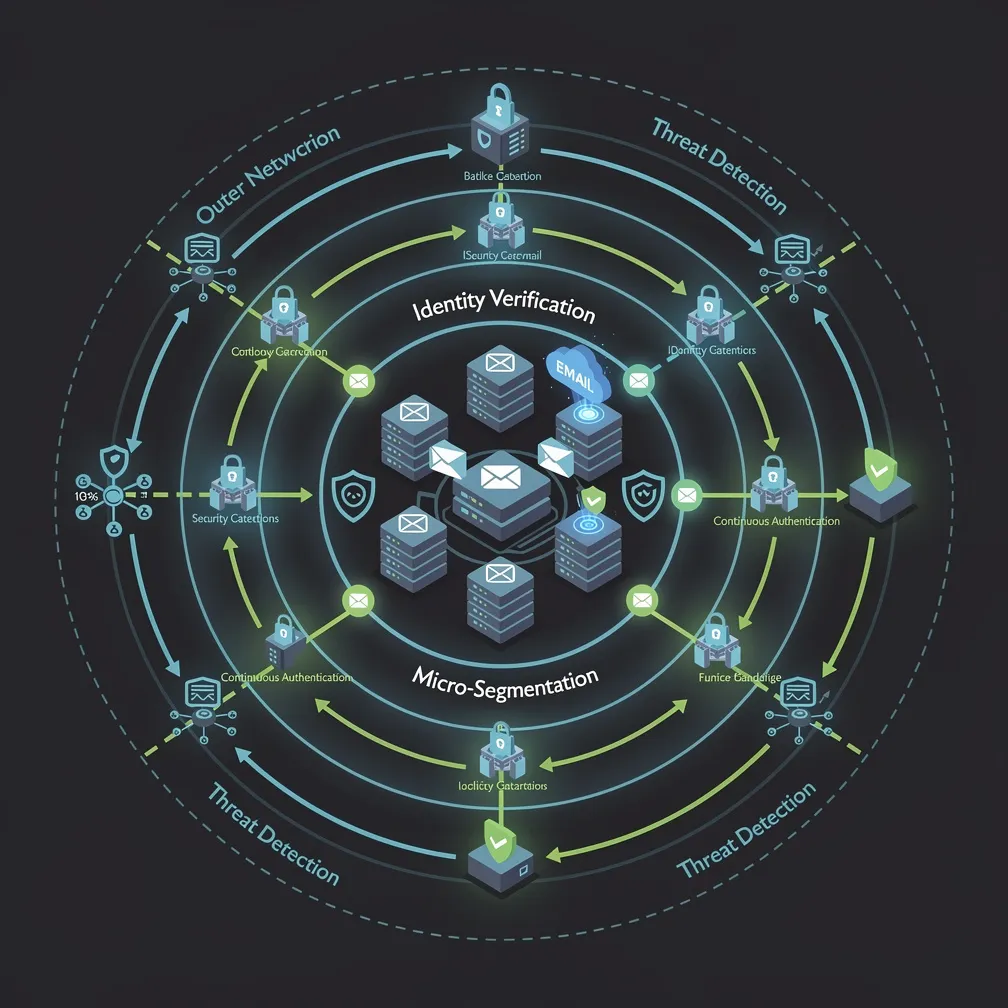
Email remains the primary attack vector for modern cyber threats, yet most organizations continue to rely on perimeter-based defenses that assume internal communications are trustworthy. As threat actors increasingly exploit legitimate email channels through sophisticated phishing, business email compromise, and supply chain attacks, security architects must fundamentally rethink email security architecture. The answer lies in applying zero trust principles to email infrastructure—a paradigm shift that eliminates implicit trust and validates every interaction, regardless of origin.
The foundation of zero trust email security rests on the “never trust, always verify” paradigm. Unlike traditional email security models that establish a trusted perimeter and inspect traffic only at ingress points, zero trust email architecture eliminates the concept of trusted zones entirely. Every email, attachment, and link undergoes rigorous verification regardless of whether it originates from internal users, external partners, or automated systems.
Traditional email security operates on implicit trust assumptions: messages from authenticated domains are safe, internal communications require minimal inspection, and established sender relationships indicate legitimacy. This perimeter-based approach fails catastrophically against modern threats. Compromised credentials grant attackers immediate access to trusted channels. Lateral phishing campaigns exploit internal trust relationships. Supply chain compromises weaponize legitimate vendor communications.
A perimeter-less security model for email infrastructure assumes breach mentality from the outset. Rather than asking “did this message penetrate our defenses,” zero trust email frameworks ask “should this specific communication be trusted right now, given current context and behavior.” This fundamental shift transforms email security from a binary gate-keeping function into a continuous risk evaluation process that adapts to emerging threats in real-time.
Sender identity validation forms the cornerstone of email security zero trust architecture. While SPF, DKIM, and DMARC provide essential domain authentication, they merely confirm that a message originated from an authorized mail server—not that the human or system initiating the communication is legitimate. Zero trust email security demands multi-layered identity verification that extends beyond protocol-level authentication.
Multi-factor sender authentication introduces additional verification dimensions:
The critical distinction in zero trust approaches involves continuous identity assurance versus point-in-time checks. Traditional authentication validates identity once per session; zero trust models continuously reassess sender legitimacy based on behavioral patterns, contextual signals, and risk indicators throughout the communication lifecycle.
Zero trust email security implements real-time authentication scoring that evolves with each interaction. Rather than binary allow/deny decisions, modern systems assign dynamic trust scores reflecting current risk levels. These scores incorporate sender history, communication patterns, content analysis, and external threat intelligence to create nuanced risk assessments.
Session-based trust evaluation monitors entire communication threads rather than isolated messages. A sender’s trust score may degrade if subsequent messages deviate from established patterns—unusual recipients, atypical sending times, or content anomalies trigger re-evaluation. Behavioral analytics establish baseline profiles for each sender, detecting subtle deviations that indicate account compromise or social engineering attempts.
Adaptive authentication policies adjust verification requirements based on risk context. High-risk scenarios—financial transactions, credential resets, or sensitive data requests—automatically trigger enhanced verification regardless of sender trust scores. Trust decay models ensure that historical legitimacy doesn’t grant indefinite access; trust scores naturally degrade over time, requiring ongoing validation through continued normal behavior.
Anomaly-based trust revocation provides immediate response to suspicious activity. When behavioral indicators suggest compromise, the system automatically revokes trust and quarantines suspicious messages pending investigation, preventing lateral movement while security teams assess the threat.
Network segmentation for mail infrastructure isolates components to contain potential breaches. Zero trust architecture mandates strict separation between mail transfer agents (MTAs), submission servers, delivery agents, and management interfaces. Each component operates in isolated network segments with explicitly defined communication paths.
MTA isolation prevents compromised mail servers from accessing broader infrastructure. Relay tier separation ensures that internet-facing relays cannot directly communicate with internal mail stores. East-west traffic control between email components enforces strict protocols—submission servers cannot directly query directory services, delivery agents cannot initiate outbound connections, and management interfaces operate on dedicated administrative networks.
Least-privilege access for email administrators limits blast radius when credentials are compromised. Role-based access controls ensure administrators can only access systems necessary for their specific functions. Data classification-based routing directs sensitive communications through enhanced security controls, while routine messages follow standard paths. Segmented quarantine zones isolate suspicious content in air-gapped environments, preventing malware propagation during analysis.
The assume-breach inspection model scrutinizes all email traffic with equal suspicion. Zero trust email security implements decrypt-inspect-re-encrypt capabilities for TLS-protected traffic, ensuring encrypted channels don’t provide safe harbor for threats. Content inspection occurs at every hop—ingress gateways, internal relays, and delivery agents all perform independent analysis rather than relying on upstream verdicts.
Lateral movement detection via email identifies compromised accounts attempting to expand access. By analyzing communication patterns, recipient relationships, and content characteristics, systems detect when legitimate accounts exhibit attacker behavior. Zero-day threat analysis with sandboxing executes attachments and follows links in isolated environments, identifying malicious behavior before delivery.
Behavioral indicators of compromise supplement signature-based detection. Unusual sending patterns, recipient lists that deviate from norms, or content that mimics legitimate business processes but contains subtle anomalies all trigger enhanced scrutiny. Threat intelligence integration at each trust boundary ensures that emerging threats identified anywhere in the infrastructure immediately inform decisions across all enforcement points.
Modern zero trust email security doesn’t operate in isolation—it integrates seamlessly with broader security architecture. SASE convergence brings email security into unified cloud-delivered security stacks, applying consistent policies across all communication channels. Identity provider federation ensures email authentication leverages enterprise identity systems, creating unified user profiles that inform risk decisions.
SOAR integration enables automated response to email threats. When suspicious messages are detected, orchestration platforms automatically correlate indicators across security tools, enrich context, and execute response playbooks. XDR correlation with email telemetry connects email events with endpoint, network, and cloud activity, revealing multi-stage attacks that span communication channels.
Cloud access security broker alignment extends email security policies to sanctioned SaaS applications, ensuring consistent protection as communications traverse multiple platforms. Conditional access policies for email enforce device trust posture assessment—users accessing email from unmanaged or non-compliant devices face additional verification requirements or restricted functionality.
Successful implementation follows a maturity model progression rather than attempting wholesale transformation. Security architects should begin by assessing current trust assumptions embedded in email infrastructure—documenting which communications are implicitly trusted and why. This assessment reveals quick wins and high-risk trust relationships requiring immediate attention.
Policy engine deployment establishes the decision-making framework for zero trust email. This engine consumes signals from identity systems, threat intelligence feeds, behavioral analytics, and content inspection tools to make real-time trust decisions. Monitoring and visibility requirements expand significantly under zero trust models—comprehensive logging, telemetry collection, and analytics capabilities become essential.
Phased rollout strategy minimizes disruption while building organizational confidence. Initial phases typically focus on enhanced monitoring and alerting without enforcement, allowing security teams to tune policies and establish baselines. Subsequent phases introduce enforcement for high-risk scenarios before expanding to comprehensive coverage.
Metrics for zero trust email effectiveness extend beyond traditional measures. Track trust score accuracy, false positive rates for adaptive authentication, time-to-detect for compromised accounts, and lateral movement prevention. Organizational change management addresses the cultural shift from perimeter trust to continuous verification, ensuring stakeholders understand new workflows and verification requirements.
Zero trust email security represents a fundamental evolution in how organizations protect their most critical communication channel. For security architects and CISOs, implementing these principles requires technical transformation, process redesign, and cultural change—but the payoff is email infrastructure resilient against modern threats and positioned to adapt to emerging attack vectors. The question isn’t whether to adopt zero trust for email, but how quickly your organization can complete the transformation.