Email remains the primary attack vector for data breaches and compliance violations, yet many organizations still struggle with implementing robust email encryption strategies. For IT managers and security professionals, understanding the nuances of secure email encryption isn’t optional—it’s a fundamental requirement for protecting sensitive communications and meeting regulatory mandates. This comprehensive guide explores email encryption best practices that will help your team build a defense-in-depth approach to email security.
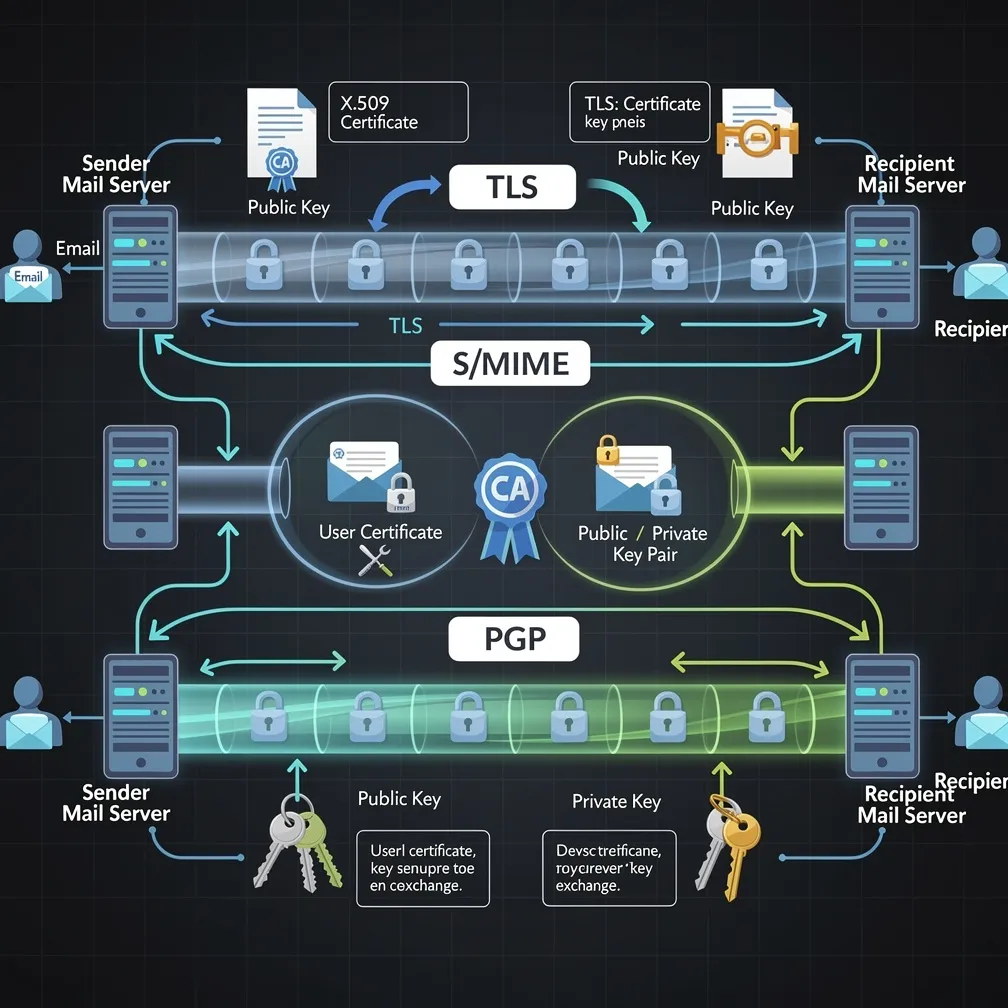
Modern email encryption encompasses three primary approaches, each serving distinct security requirements:
Transport Layer Security (TLS) protects emails during transmission between mail servers. Opportunistic TLS attempts encryption when available but falls back to unencrypted transmission if the receiving server doesn’t support it. Enforced STARTTLS mandates encryption, refusing delivery to non-compliant servers. Organizations should implement TLS 1.2 as the minimum standard, with TLS 1.3 preferred for its enhanced performance and security features. MTA-STS (Mail Transfer Agent Strict Transport Security) enables policy enforcement by allowing domains to declare that they support TLS and specify certificate validation requirements. DANE (DNS-Based Authentication of Named Entities) with TLSA records provides an additional validation layer by publishing certificate information in DNSSEC-signed DNS records, preventing man-in-the-middle attacks during the TLS handshake.
S/MIME (Secure/Multipurpose Internet Mail Extensions) provides certificate-based message-level encryption and digital signatures. Built on X.509 public key infrastructure, S/MIME enables per-message signing and encryption independent of transport mechanisms. Enterprise PKI integration allows organizations to issue certificates through internal certificate authorities, maintaining centralized control over cryptographic identities. S/MIME excels in corporate environments where certificate management infrastructure already exists and users require seamless integration with standard email clients.
PGP/GPG (Pretty Good Privacy/GNU Privacy Guard) operates on a decentralized web of trust model rather than hierarchical certificate authorities. Users generate key pairs and establish trust relationships by signing each other’s public keys. Key servers facilitate public key distribution, while the OpenPGP standard ensures interoperability across implementations. This decentralized trust model appeals to organizations requiring independence from traditional certificate authorities, though it demands more sophisticated key management practices.
Security professionals must recognize that email encryption and authentication serve fundamentally different purposes. Encryption provides confidentiality—preventing unauthorized parties from reading message contents during transmission or storage. Authentication provides integrity and origin verification—proving that messages actually came from claimed senders and haven’t been tampered with in transit.
TLS encrypts the transport channel between mail servers, protecting against eavesdropping. However, TLS alone doesn’t verify sender identity. SPF (Sender Policy Framework), DKIM (DomainKeys Identified Mail), and DMARC (Domain-based Message Authentication, Reporting, and Conformance) provide authentication by validating that messages originate from authorized sources. DKIM cryptographically signs messages, enabling recipients to verify both sender domain and message integrity.
Organizations need both capabilities. Encryption without authentication leaves you vulnerable to phishing and spoofing attacks. Authentication without encryption exposes message contents to interception. A comprehensive email security strategy implements email encryption best practices alongside robust authentication protocols.
Determining encryption requirements involves regulatory obligations, risk assessment, and data classification:
Regulatory triggers mandate encryption for specific data types. HIPAA requires protecting Protected Health Information (PHI) during electronic transmission. PCI DSS mandates encryption for cardholder data transmitted across open networks. GDPR requires appropriate technical measures, including encryption, when transferring personal data. SOX compliance necessitates securing financial communications that could impact reporting accuracy.
Risk-based decisions should guide encryption implementation beyond regulatory minimums. Organizations should establish data classification tiers mapping to encryption requirements—public, internal, confidential, and restricted—with progressively stronger controls. Internal communications containing sensitive intellectual property may warrant encryption even when not legally mandated. External communications should generally default to encrypted channels, with clear policies defining acceptable exceptions.
True end-to-end encryption (E2EE) differs fundamentally from transport-layer encryption. With E2EE, messages remain encrypted from sender’s device through all intermediate systems to the recipient’s device. Only the communicating parties possess decryption keys—not email providers, administrators, or intermediaries.
Zero-knowledge architectures ensure service providers cannot access plaintext content. Client-side key generation means private keys never leave user devices. However, this approach creates limitations for enterprise data loss prevention (DLP) systems and archiving solutions that require content inspection. The ProtonMail and Tutanota model demonstrates consumer E2EE implementations, while gateway-based encryption allows enterprise visibility but compromises true end-to-end security.
Recipient experience presents significant challenges. When recipients lack compatible encryption tools, they must access messages through web portals—adding friction that impacts adoption and usability. Organizations must balance security requirements against operational practicality.
Effective secure email encryption depends on rigorous key lifecycle management:
Key escrow provides enterprise compliance capabilities, allowing authorized recovery of encrypted data for legal holds or employee departures. Certificate authority selection impacts trust scope—public CAs for external communications, private CAs for internal use. Automated certificate provisioning through SCEP (Simple Certificate Enrollment Protocol) or EST (Enrollment over Secure Transport) reduces administrative overhead while improving security consistency.
Regulatory frameworks increasingly mandate email encryption for sensitive data:
HIPAA doesn’t explicitly require encryption but designates it as an addressable specification. Implementing encryption provides safe harbor protections—encrypted PHI breaches don’t trigger notification requirements. PCI DSS Requirement 4 mandates strong cryptography for cardholder data transmitted across open, public networks. GDPR Article 32 identifies encryption as an appropriate technical measure for ensuring security appropriate to risk. NIST 800-177 provides comprehensive email security guidelines for federal agencies. FedRAMP requires FIPS 140-2 validated cryptographic modules for cloud services handling government data.
Industry-specific mandates add additional layers. Financial services face regulations from FINRA, SEC, and banking regulators. Healthcare organizations must address state-level privacy laws alongside federal requirements.
Successful deployment requires strategic planning across technical and organizational dimensions:
Gateway-level deployment centralizes encryption at the email infrastructure layer, providing transparent protection without requiring endpoint changes. Client-level deployment offers stronger security guarantees but demands more extensive user training and support. Policy-based encryption triggers automatically protect messages based on content analysis, recipient domains, or sender classification.
Recipient portal solutions address the challenge of communicating with external parties lacking encryption capabilities. These secure web portals allow recipients to access encrypted messages through authentication without installing specialized software. Integration with DLP systems enables automated encryption based on content inspection results.
Pilot rollout strategies minimize disruption by testing with limited user groups before organization-wide deployment. Comprehensive user training must address both technical procedures and policy requirements, emphasizing when encryption is mandatory versus optional.
Implementing email encryption best practices requires attention to cryptographic details:
Algorithm selection should favor AES-256 for symmetric encryption and RSA-2048 minimum (RSA-4096 preferred) or ECDSA with P-256 curves for asymmetric operations. Perfect forward secrecy (PFS) ensures that compromised long-term keys don’t expose past communications by generating unique session keys for each connection.
Certificate pinning prevents certain man-in-the-middle attacks by validating that server certificates match expected values. Automated key rotation schedules reduce exposure windows if keys become compromised. Monitoring for downgrade attacks detects attempts to force weaker cryptographic algorithms. Fallback policies must balance security and deliverability—defining acceptable compromises when ideal encryption isn’t available.
Encryption header analysis provides visibility into protection levels actually achieved. Regular cryptographic audits verify that implementations remain aligned with current best practices as threats evolve and standards advance.
Email encryption represents a critical control for protecting sensitive communications and meeting compliance obligations. By understanding the technical nuances of TLS, S/MIME, and PGP implementations, distinguishing encryption from authentication, and following structured implementation approaches, IT security teams can build robust email protection programs. At Email Delivery Pro, we recognize that effective secure email encryption requires balancing security requirements, operational practicality, and user experience. Start by assessing your current encryption posture against the practices outlined here, identify gaps in coverage or implementation, and develop a roadmap for continuous improvement. The threat landscape continues evolving—your email encryption strategy must evolve with it.