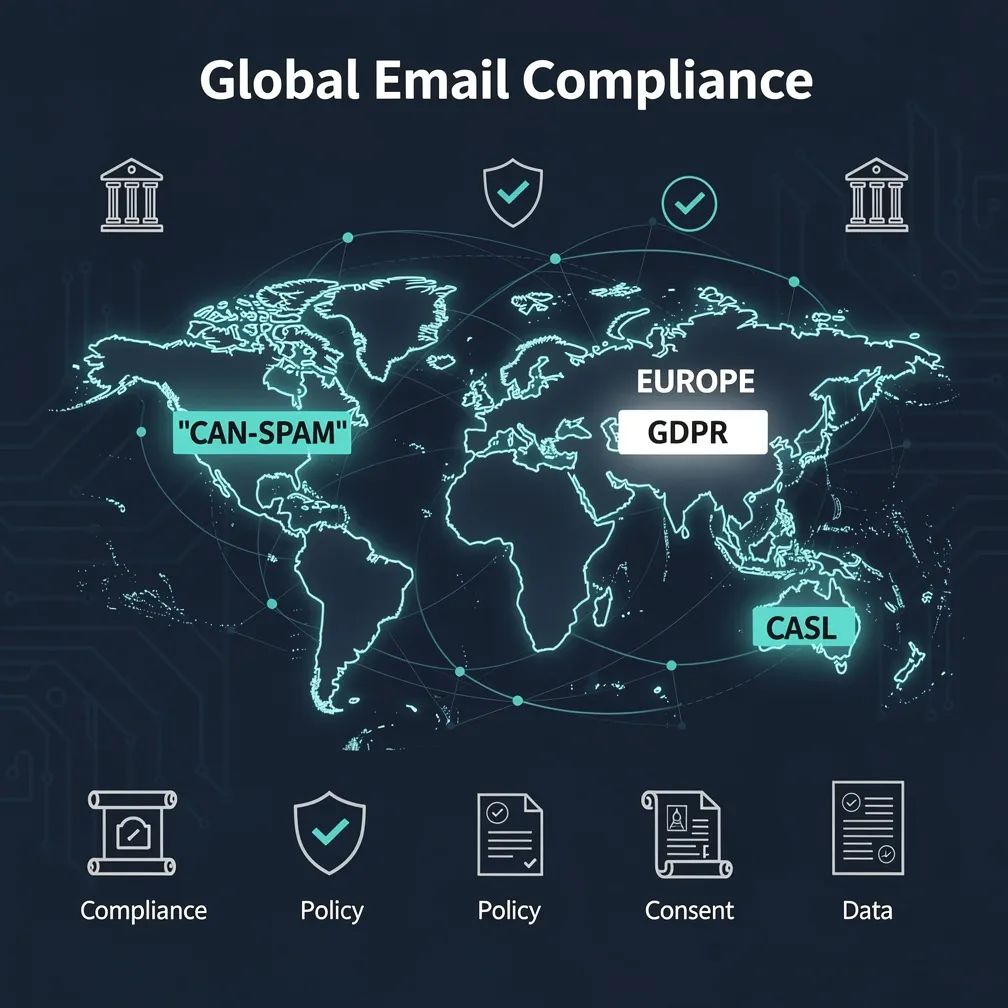
As we navigate through 2026, email compliance has become increasingly complex for organizations operating across multiple jurisdictions. The regulatory landscape continues to evolve, with established frameworks like CAN-SPAM, GDPR, and CASL setting the foundation while new regulations emerge globally. For email marketers, legal teams, and IT administrators, understanding and implementing these requirements isn’t just about avoiding penalties — it’s about building trust with subscribers and maintaining deliverability rates that directly impact your bottom line.
At Email Delivery Pro, we’ve witnessed firsthand how compliance failures can devastate sender reputations and tank email performance. This comprehensive guide walks you through the critical requirements of major email compliance regulations in 2026, provides practical implementation guidance, and helps you develop a robust compliance framework that scales across jurisdictions.
Email compliance 2026 represents a convergence of privacy-first regulations that share common principles while maintaining jurisdiction-specific nuances. The three pillars — CAN-SPAM in the United States, GDPR across the European Union, and CASL in Canada — continue to form the backbone of global email marketing compliance. However, emerging regulations from Brazil, India, and China are reshaping how global organizations approach their email programs.
The stakes have never been higher. Penalties for non-compliance can reach millions of dollars, and beyond financial consequences, violations can result in deliverability issues, domain blacklisting, and irreparable damage to brand reputation. Understanding these regulations isn’t optional — it’s a fundamental requirement for any organization leveraging email as a marketing or communication channel.
The Controlling the Assault of Non-Solicited Pornography and Marketing Act (CAN-SPAM) remains the primary federal law governing commercial email in the United States. Unlike opt-in focused regulations, CAN-SPAM requirements follow an opt-out model, but this doesn’t mean compliance is simple or lenient.
Accurate Header Information: Your “From,” “To,” and routing information must be accurate and identify the person or business who initiated the email. Deceptive header information can result in severe penalties.
Non-Deceptive Subject Lines: Subject lines must accurately reflect the content of your message. Misleading subject lines designed to trick recipients into opening emails violate CAN-SPAM requirements and damage sender reputation.
Commercial Message Identification: The email must be clearly identified as an advertisement unless the recipient has given prior affirmative consent or has an existing business relationship with your organization.
Physical Address Disclosure: Every commercial email must include your valid physical postal address. This can be your current street address, a post office box registered with the U.S. Postal Service, or a private mailbox registered with a commercial mail receiving agency.
Clear Opt-Out Mechanism: Recipients must have a clear and conspicuous way to opt out of future emails. The unsubscribe mechanism must be functional for at least 30 days after sending, and you must honor opt-out requests within 10 business days.
Violations can result in penalties of up to $51,744 per email in violation. Both the Federal Trade Commission (FTC) and state attorneys general can enforce CAN-SPAM, and in some cases, internet service providers can bring civil lawsuits. Criminal penalties, including imprisonment, can apply for egregious violations involving aggravating factors like address harvesting or dictionary attacks.
The General Data Protection Regulation has fundamentally changed how organizations approach email marketing in Europe and beyond. GDPR email requirements are significantly more stringent than CAN-SPAM, requiring explicit consent before sending marketing communications.
Lawful Basis for Processing: You must have a lawful basis to process personal data for email marketing. For most marketing emails, this means obtaining explicit, freely given, specific, informed, and unambiguous consent. Pre-checked boxes and implied consent don’t meet GDPR standards.
Transparent Data Collection: At the point of collection, you must clearly explain what data you’re collecting, why you’re collecting it, how long you’ll retain it, and who will have access to it. Privacy notices must be concise, transparent, and easily accessible.
Right to Access and Erasure: Subscribers have the right to access their personal data and request its complete deletion. Your systems must be capable of fulfilling these requests within one month of receipt.
Data Minimization: Collect only the personal data necessary for your stated purpose. If you only need an email address for your newsletter, requesting additional information without justification may violate data minimization principles.
Consent Documentation: You must maintain records proving when and how consent was obtained, what the subscriber was told at the time of consent, and how they can withdraw consent at any point.
GDPR violations can result in fines up to €20 million or 4% of global annual revenue, whichever is higher. Supervisory authorities have demonstrated willingness to impose substantial penalties for email marketing violations, particularly those involving lack of consent or failure to honor unsubscribe requests promptly.
Canada’s Anti-Spam Legislation is widely considered one of the strictest email compliance frameworks globally. CASL takes an opt-in approach similar to GDPR but with some unique requirements that frequently catch international marketers off guard.
Express or Implied Consent: Before sending commercial electronic messages to Canadian recipients, you must obtain either express consent (explicit opt-in) or qualify for one of the limited implied consent exceptions, such as an existing business relationship within the last two years or an inquiry within the last six months.
Consent Mechanism Requirements: When obtaining express consent, you must clearly describe why you’re requesting consent, provide identifying information about your organization (including mailing address and either a telephone number, email address, or web address), and include a statement that the recipient can unsubscribe at any time.
Identification Requirements: Every message must clearly identify the sender, include the sender’s contact information (mailing address plus one of phone number, email, or URL), and identify any third parties on whose behalf the message is sent.
Unsubscribe Functionality: Every commercial electronic message must include a functioning unsubscribe mechanism. You must honor opt-out requests within 10 business days, and the unsubscribe mechanism must remain functional for at least 60 days after the message is sent.
CASL violations can result in administrative monetary penalties up to $10 million CAD for businesses and $1 million CAD for individuals. The Canadian Radio-television and Telecommunications Commission (CRTC) actively investigates and penalizes organizations for non-compliance.
Email compliance 2026 extends far beyond the traditional three frameworks. Several emerging regulations are reshaping global email marketing strategies.
Brazil’s LGPD follows GDPR’s principles, requiring consent or legitimate interest for marketing communications and providing individuals with comprehensive rights over their personal data. Penalties can reach 2% of revenue in Brazil, up to 50 million Brazilian reals per violation. Organizations marketing to Brazilian recipients must implement GDPR-level consent mechanisms.
India’s DPDP Act, now in active enforcement, introduces consent requirements for processing personal data including email addresses for marketing purposes. The regulation emphasizes clear and plain-language consent mechanisms, the right to erasure, and data localization requirements for certain categories of data. Penalties for significant breaches can reach ₹250 crore (approximately $30 million USD).
PIPL requires separate, informed consent for marketing communications and imposes strict cross-border data transfer requirements including security assessments for transferring personal information outside China. Organizations sending marketing emails to Chinese recipients must carefully evaluate their compliance obligations, including potential requirements for local data storage.
| Requirement | CAN-SPAM (US) | GDPR (EU) | CASL (Canada) |
|---|---|---|---|
| Consent Model | Opt-out | Opt-in (explicit) | Opt-in (express/implied) |
| Pre-Send Consent Required | No | Yes | Yes |
| Sender Identification | Required | Required | Required (detailed) |
| Physical Address | Required in email | Not explicitly required | Mailing address required |
| Unsubscribe Mechanism | Required (functional 30 days) | Required (easy as opt-in) | Required (functional 60 days) |
| Opt-Out Processing Time | 10 business days | Without undue delay | 10 business days |
| Consent Documentation | Not required | Required (burden on sender) | Required (burden on sender) |
| Right to Data Erasure | Not applicable | Yes (within 1 month) | Limited |
| Data Retention Limits | No specific limit | Purpose-limited retention | Implied consent expires |
| Maximum Penalties | $51,744 per email | €20M or 4% global revenue | $10M CAD per violation |
Achieving and maintaining email compliance 2026 requires a systematic approach that addresses technical, legal, and operational considerations simultaneously.
Implement Double Opt-In: While not legally required by all regulations, double opt-in provides the strongest proof of consent and significantly reduces compliance risk across all jurisdictions. This approach requires subscribers to confirm their email address by clicking a verification link in a confirmation email before being added to your list.
Maintain Comprehensive Consent Records: Your email platform should automatically capture and store consent data, including the exact timestamp, IP address, consent language displayed, the specific purposes for which consent was granted, and the version of your privacy policy at the time of consent.
Automate Preference Management: Implement a robust preference center that allows subscribers to manage their consent granularly — choosing which types of communications they want to receive rather than facing a binary all-or-nothing choice.
Ensure Unsubscribe Reliability: Your unsubscribe mechanism must work flawlessly every time. Test it regularly, monitor for failures, implement redundant systems, and support both one-click unsubscribe headers (RFC 8058) and traditional link-based unsubscription.
Don’t apply a one-size-fits-all approach to global email programs. Segment your email list by recipient jurisdiction and apply the appropriate compliance requirements to each segment. Many organizations find it practical to default to the strictest applicable standard — typically GDPR — across their entire program to simplify compliance management and minimize risk.
Define clear data retention periods for subscriber information. Under GDPR, you cannot retain personal data indefinitely without justification. Implement automated processes to purge data that has exceeded its retention period, and document the legal basis for your chosen retention timelines.
Conduct quarterly compliance audits covering consent documentation completeness, unsubscribe functionality testing, email content review for required elements, data retention adherence, and cross-border data transfer mechanisms. Document your audit findings and remediation actions to demonstrate good-faith compliance efforts to regulators.
Use this checklist to evaluate your organization’s email compliance readiness:
Email compliance in 2026 is not a single regulation to follow — it’s a global patchwork that demands strategic thinking, robust technical infrastructure, and ongoing operational discipline. The organizations that treat compliance as a competitive advantage rather than a burden build stronger subscriber relationships, maintain superior deliverability, and avoid the catastrophic penalties that can result from non-compliance.
Start with the strictest standard your audience requires, build systems that document everything, and audit regularly. Your email program’s compliance posture is ultimately a reflection of how much you respect your subscribers’ rights — and that respect pays dividends in engagement, trust, and deliverability.