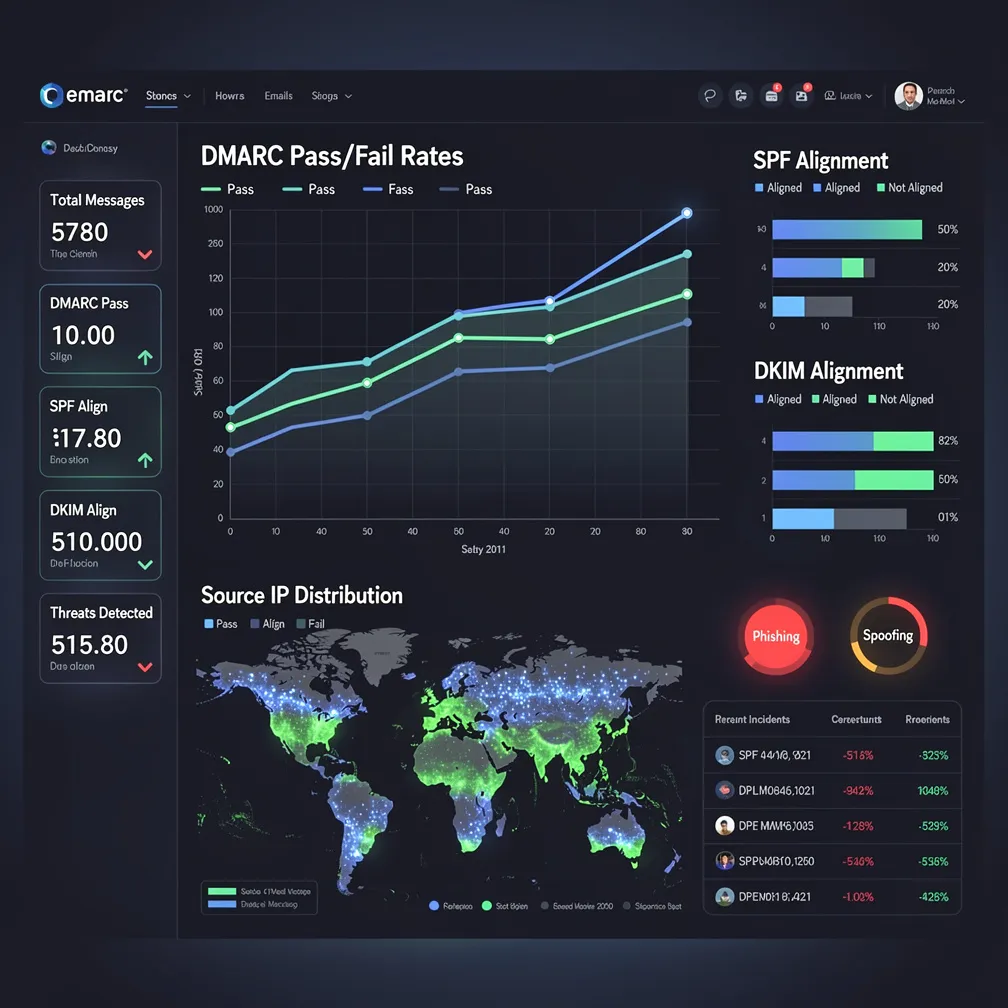
Email authentication isn’t a set-it-and-forget-it proposition. After implementing DMARC, the real work begins: continuous monitoring and analysis of authentication data to protect your domain, identify threats, and optimize email delivery. For email administrators and security analysts, effective DMARC monitoring transforms raw authentication reports into actionable intelligence that safeguards your organization’s email infrastructure and brand reputation.
This guide provides a practical framework for leveraging DMARC analytics to maintain robust email security posture and ensure legitimate messages reach their destinations while blocking malicious actors.
DMARC monitoring provides essential visibility into your authentication ecosystem. Without continuous analysis, you’re operating blind to both legitimate authentication issues and active threats against your domain.
Visibility into your authentication ecosystem reveals which services and systems send email on your behalf. Many organizations discover forgotten third-party senders or shadow IT email services only after implementing monitoring.
Unauthorized sender detection identifies malicious actors attempting to spoof your domain. DMARC reports expose spoofing attempts in real-time, allowing rapid response before significant damage occurs.
Policy enforcement validation confirms that receiving mail servers honor your DMARC policy. Monitoring shows whether your reject or quarantine policy actually protects recipients or if enforcement gaps exist.
Compliance verification demonstrates due diligence for regulatory requirements. Industries with strict email security mandates require documented evidence of authentication monitoring and threat response.
Brand protection measurement quantifies your domain’s security posture. Metrics showing authentication success rates and blocked spoofing attempts provide tangible evidence of security program effectiveness.
Effective DMARC monitoring requires tracking specific metrics that reveal authentication health and security threats:
Selecting appropriate DMARC reporting tools determines how effectively you can analyze authentication data. Different platforms offer varying capabilities:
Aggregate report processors parse XML reports from receiving mail servers, transforming technical data into readable formats. This foundational capability is essential for any monitoring solution.
Forensic report analyzers provide detailed information about individual authentication failures, including message headers and authentication results for deep investigation.
Real-time dashboards visualize current authentication status, enabling quick assessment of your email security posture without manual report analysis.
Historical trend analysis reveals patterns over time, helping distinguish normal variations from genuine security incidents or configuration problems.
Multi-domain management becomes critical for organizations protecting multiple domains and subdomains, centralizing monitoring in a single interface.
API integrations enable automation and connection with existing security infrastructure, streamlining workflows and incident response.
When evaluating solutions, compare free versus enterprise tools based on reporting volume capacity, analysis depth, alerting sophistication, support requirements, and integration capabilities. Free tools suit small domains with straightforward authentication, while enterprise platforms provide advanced analytics for complex environments.
Understanding DMARC analytics requires familiarity with report structures and authentication results:
XML report parsing extracts meaningful information from aggregate reports. These reports contain authentication results grouped by source IP, authentication outcomes, and message volumes.
RUA versus RUF report differences matter significantly. Aggregate (RUA) reports provide statistical summaries ideal for trend analysis, while forensic (RUF) reports contain specific failure examples useful for troubleshooting but raise privacy concerns.
Authentication results codes indicate specific failure reasons: SPF none, DKIM temperror, alignment failures, and policy results all require different remediation approaches.
Disposition actions show what receiving servers did with messages: none, quarantine, or reject. Comparing your published policy with actual dispositions reveals enforcement effectiveness.
Percentage calculations help prioritize issues. Calculate authentication success rates, failure percentages by source, and policy compliance rates to focus remediation efforts.
Baseline establishment creates context for identifying problems. Monitor for several weeks to understand normal patterns before reacting to apparent anomalies.
Anomaly identification flags deviations from established baselines, triggering investigation of potential security incidents or configuration changes.
Seasonal pattern recognition prevents false alarms from predictable volume changes during business cycles, holidays, or marketing campaigns.
DMARC monitoring reveals specific authentication problems requiring remediation:
SPF alignment failures from forwarding occur when legitimate email passes through forwarding services that change the envelope sender, breaking SPF alignment. Consider DKIM-only alignment or ARC protocol support.
DKIM signature breaks from content modification happen when mailing lists or security scanners alter message content, invalidating signatures. Implement relaxed canonicalization or coordinate with service providers.
Third-party sender misconfiguration appears when vendors or service providers fail to properly authenticate email sent on your behalf. Work with vendors to configure SPF, DKIM, and proper domain alignment.
DNS propagation delays cause temporary authentication failures after updating SPF records or DKIM keys. Monitor propagation across global DNS infrastructure before declaring changes complete.
Include mechanism limits in SPF records create authentication failures when exceeding DNS lookup limits. Flatten SPF records or transition to DKIM-based authentication for some senders.
Key rotation problems break DKIM authentication if new keys aren’t properly published before use or old keys removed too quickly. Implement overlapping key rotation procedures.
Subdomain policy gaps leave subdomains vulnerable when lacking explicit DMARC policies. Implement subdomain policies or use the sp tag in your organizational domain policy.
Beyond authentication monitoring, DMARC analytics enables proactive threat detection:
Unauthorized sender identification reveals IP addresses sending email claiming to be from your domain without authorization, indicating spoofing attempts or compromised systems.
Domain spoofing attempts appear as authentication failures from unexpected sources, often concentrated in short timeframes during phishing campaigns.
Phishing campaign detection shows volume spikes of unauthenticated email using your domain, enabling rapid response to protect customers and partners.
Volume spike analysis identifies unusual sending patterns that may indicate compromised accounts, unauthorized bulk mailing, or targeted attacks.
Geographic anomaly detection flags email originating from unexpected countries or regions, suggesting compromised infrastructure or sophisticated spoofing operations.
Lookalike domain correlation identifies similar domains used in conjunction with spoofing attempts, revealing coordinated phishing infrastructure.
Threat intelligence enrichment combines DMARC data with external threat feeds, providing context about known malicious IPs, domains, and attack patterns.
Manual report review doesn’t scale. Automated alerting ensures timely response to authentication issues and security threats:
Threshold-based alerts for failure rate spikes notify administrators when authentication failures exceed normal levels, indicating configuration problems or active attacks.
Volume anomaly alerts detect unusual message volumes that may represent spoofing campaigns or compromised sending infrastructure.
New source IP detection triggers alerts when previously unseen IPs send email claiming to be from your domain, requiring immediate investigation.
Policy violation notifications alert when receiving servers don’t honor your DMARC policy, revealing enforcement gaps.
Report delivery failure alerts ensure your monitoring infrastructure remains operational, preventing blind spots in security coverage.
SLA monitoring tracks authentication success rates against defined service levels, supporting operational excellence.
Escalation workflows route alerts to appropriate teams based on severity and type, ensuring critical issues receive immediate attention.
Integration with SIEM and SOC tools incorporates DMARC data into broader security operations, enabling correlation with other security events and centralized incident management.
Effective DMARC monitoring drives ongoing security posture improvement:
Policy progression from none to quarantine to reject should be data-driven. Monitor authentication success rates and legitimate sender coverage before advancing to more restrictive policies, ensuring business email continuity.
Third-party sender onboarding workflows use monitoring data to verify proper authentication configuration before vendors begin sending email on your behalf.
Authentication gap remediation prioritization focuses efforts on issues affecting the highest message volumes or posing the greatest security risks.
Subdomain policy tightening extends protection across your domain portfolio based on subdomain-specific authentication analysis.
Reporting infrastructure optimization ensures comprehensive coverage by monitoring which receivers send reports and addressing gaps.
Quarterly review cadence establishes regular assessment of authentication metrics, threat trends, and security posture evolution.
Stakeholder reporting dashboards communicate security program effectiveness to leadership, demonstrating ROI and supporting resource allocation decisions.
DMARC monitoring and analytics transform email authentication from a compliance checkbox into a dynamic security capability. By systematically tracking key metrics, leveraging appropriate DMARC reporting tools, and establishing automated alerting, email administrators and security analysts gain the visibility needed to protect domains, detect threats, and optimize email delivery.
The journey from initial DMARC implementation to mature monitoring practice requires commitment to continuous improvement. Start with foundational monitoring, establish baselines, implement automated alerting, and progressively advance your DMARC policy as data confirms authentication coverage. Your monitoring data provides the roadmap—follow it to robust email security and brand protection.