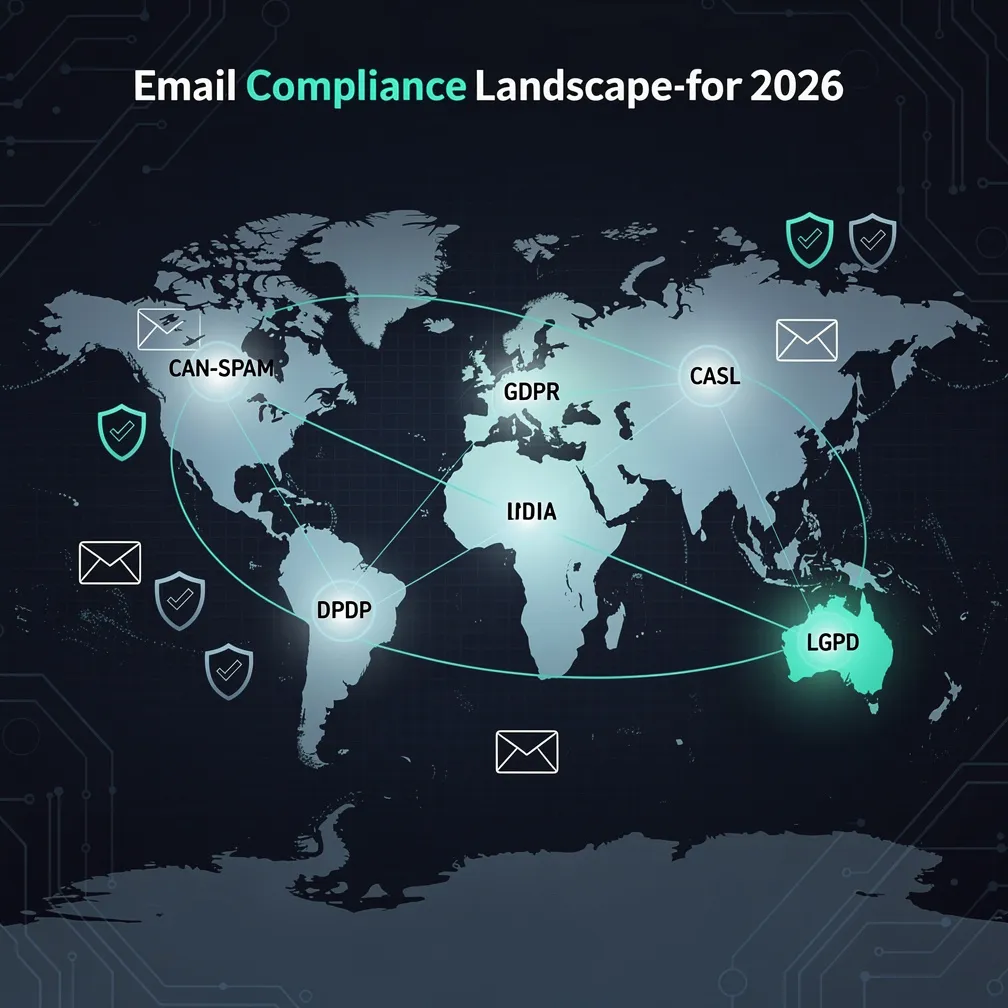
The email compliance landscape has shifted more in the past 18 months than the previous five years combined.
If your compliance posture hasn’t evolved since 2024, you’re already behind. Here’s what’s reshaping the terrain in 2026 — and what forward-thinking organizations are doing about it.
We’ve moved well beyond a CAN-SPAM + GDPR world. The current landscape includes:
The era of “one compliance framework fits all” is over. Organizations sending internationally need jurisdiction-aware consent management — not a single opt-in checkbox.
Here’s what most compliance teams are missing: Google and Yahoo’s 2024 sender requirements didn’t go away — they expanded.
In 2026, the de facto compliance standard is now set by mailbox providers, not just legislation:
Miss any of these and you don’t get fined — you simply don’t reach the inbox. That’s a more immediate consequence than any regulatory penalty.
Generic “I agree to receive communications” consent is dying. Regulators and providers now expect purpose-specific consent — separate permissions for marketing, transactional, and service communications. Your preference center needs to reflect this.
Multiple frameworks now require demonstrating why you’re still holding email addresses and engagement data beyond a defined period. “We might email them someday” is no longer a valid legal basis for retention.
The EU AI Act and emerging US guidelines are creating new disclosure requirements for AI-generated email content. If you’re using AI to write your campaigns, transparency obligations are coming — and some are already here.
Sending an email to a recipient in another jurisdiction increasingly means complying with THEIR framework, not just yours. This is especially acute for organizations with global subscriber lists touching the EU, India, China, and Brazil simultaneously.
SPF, DKIM, DMARC, and now BIMI aren’t just deliverability tools anymore — they’re becoming compliance requirements. Several frameworks now reference authentication standards as part of “appropriate technical measures” for email security.
Email compliance in 2026 is no longer a legal checkbox — it’s an infrastructure capability.
The organizations that treat compliance as a deliverability advantage (not just a risk mitigation exercise) are the ones consistently reaching inboxes while their competitors land in spam or get throttled entirely.
Your authentication stack, your consent architecture, and your data governance practices ARE your compliance posture. They’re inseparable.
The question isn’t “are we compliant?” anymore. It’s “are we compliant in every jurisdiction where our emails land — according to both the law AND the mailbox providers enforcing their own standards?”
If you can’t answer that with confidence, it’s time to audit.
#EmailCompliance #EmailDeliverability #GDPR #CANSPAM #DMARC #DataPrivacy #EmailSecurity #Cybersecurity #EmailMarketing #Compliance2026