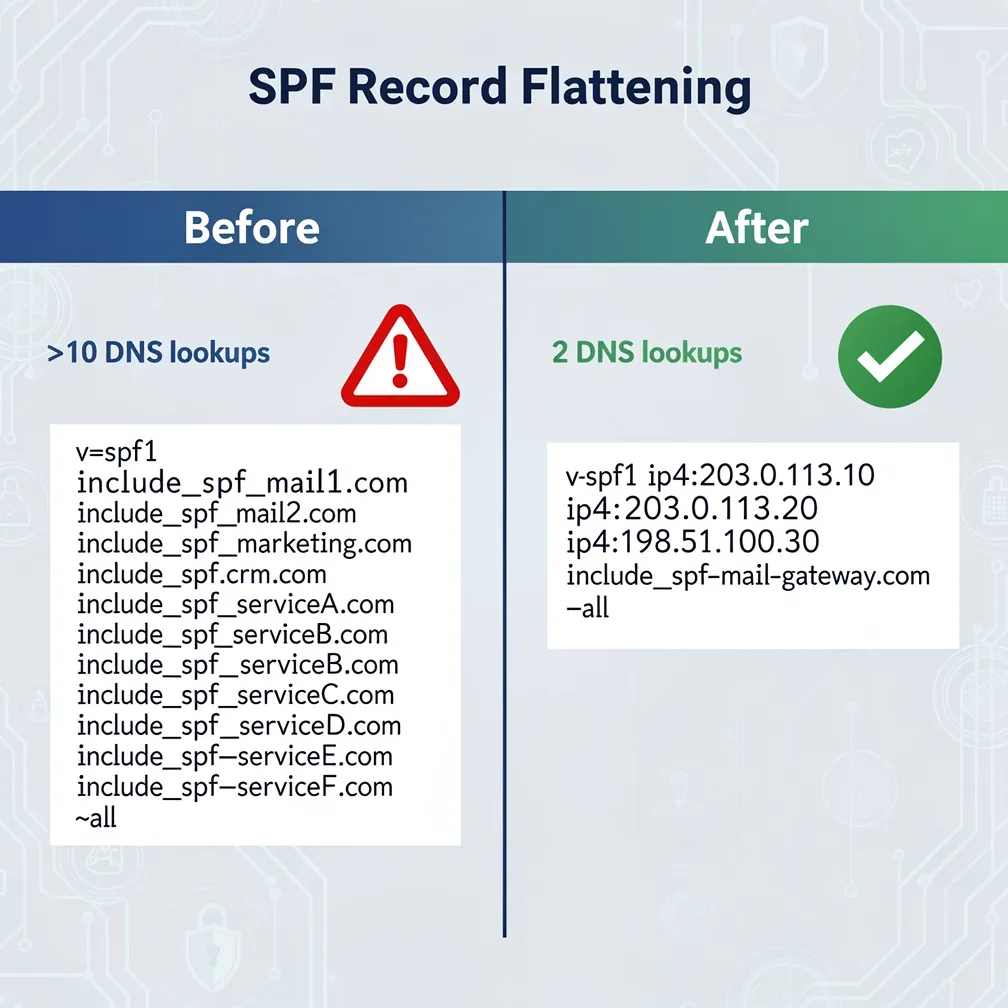
If you’ve ever received a permerror in your SPF authentication results or watched legitimate emails bounce due to SPF failures, you’ve likely encountered the infamous 10 DNS lookup limit. As email administrators juggle multiple SaaS platforms, marketing automation tools, and CRM systems, SPF records have become increasingly complex—often exceeding the strict limitations defined in RFC 7208. This is where SPF flattening becomes not just useful, but essential for maintaining reliable email delivery.
SPF flattening is the process of converting include mechanisms in your SPF record into their underlying IP addresses, effectively compressing the record and reducing the number of DNS lookups required for validation. When a mail server validates SPF, each include, a, mx, and redirect mechanism triggers a DNS lookup. The SPF specification imposes a hard limit of 10 DNS lookups per authentication check to prevent resource exhaustion and DNS amplification attacks.
Here’s how the resolution works: When your SPF record contains include:_spf.salesforce.com, the receiving mail server must perform a DNS lookup to retrieve that domain’s SPF record. If that record contains additional include mechanisms, each triggers another lookup, creating a chain that quickly exhausts the 10-lookup budget. An spf flattening process resolves all these nested includes, extracts the IP addresses and CIDR ranges, and consolidates them into a single, flattened record containing primarily ip4 and ip6 mechanisms that don’t count against the lookup limit.
The result is a record like v=spf1 ip4:192.0.2.0/24 ip4:198.51.100.0/24 ip6:2001:db8::/32 -all instead of multiple include statements. This flattened version requires zero additional DNS lookups beyond the initial query for your domain’s SPF record.
Modern email infrastructures rarely use a single sending source. Consider a typical enterprise setup: you’re sending transactional emails through your CRM, marketing campaigns through an email service provider, support tickets through a helpdesk platform, and internal communications through Microsoft 365 or Google Workspace. Each vendor requires an include mechanism in your SPF record, and many of these includes contain nested includes of their own.
A marketing platform might require three lookups, your CRM another two, your helpdesk system one more, and your primary email provider could consume three or four lookups alone. You’ve now exceeded the limit before accounting for your own mail servers. When you cross the 10-lookup threshold, receiving mail servers return a permerror result, treating your SPF record as invalid. This triggers authentication failures, causing legitimate emails to be rejected, quarantined, or marked as spam.
The consequences extend beyond immediate delivery problems. Failed SPF authentication impacts your DMARC alignment, potentially causing DMARC failures even when DKIM passes. For organizations with strict DMARC policies (p=quarantine or p=reject), this means legitimate business communications simply don’t reach their destination, resulting in lost revenue, damaged customer relationships, and help desk tickets from confused recipients.
Email administrators have two fundamental approaches to implementing spf flattening: manual resolution or automated services. Manual flattening involves querying each include mechanism, documenting the returned IP addresses, and consolidating them into your SPF record. This one-time process requires DNS lookup tools and careful documentation of which IP ranges correspond to which services.
The advantages of manual flattening include zero ongoing costs and complete control over your SPF record. However, the maintenance burden quickly becomes overwhelming. When a vendor changes their sending infrastructure—adding new IP addresses or retiring old ones—your manually flattened record becomes stale. Your SPF record may block legitimate emails from new vendor IPs or remain overly permissive by including deprecated addresses that could be reassigned to malicious actors.
Automated spf flattening service solutions continuously monitor included domains, detect IP changes, and update your SPF record accordingly. These services eliminate staleness risk and reduce administrative overhead, but introduce dependencies on third-party platforms and recurring costs. The choice between manual and automated approaches ultimately depends on your infrastructure complexity, change frequency, and available resources for ongoing SPF maintenance.
The market offers several categories of SPF flattening solutions, each with distinct technical approaches. Hosted SPF services manage your entire SPF record on their infrastructure, providing a single include mechanism that points to their dynamically updated record. This approach minimizes your published SPF record length while centralizing management.
Macro-based solutions leverage SPF macro expansion capabilities to perform conditional lookups based on the sender’s IP address, effectively distributing the lookup budget across multiple possible code paths. API-driven flattening services integrate with your DNS provider through APIs, automatically updating your SPF record when vendor IP changes are detected. Managed DNS approaches combine DNS hosting with built-in flattening capabilities, treating SPF optimization as a native DNS feature rather than a separate service layer.
Each category offers different trade-offs regarding control, complexity, vendor lock-in, and integration requirements. Organizations should evaluate these options based on their existing DNS infrastructure and operational preferences. For detailed comparisons of different approaches, visit our service comparison page.
Dynamic spf flattening represents an advanced approach that uses SPF macros and real-time evaluation to maintain lookup efficiency while preserving freshness. These solutions leverage the %{i} macro variable, which represents the sender’s IP address, to perform conditional lookups. By structuring SPF records with macro-based logic, dynamic systems can check only relevant IP ranges for each sending attempt rather than validating against all possible sources.
Some dynamic approaches use void lookups—include mechanisms that intentionally return empty results for certain IP ranges—to control which code paths execute during validation. This technique allows the SPF record to maintain references to vendor includes while ensuring that only applicable lookups occur for any given email, staying within the 10-lookup limit through selective evaluation rather than complete flattening.
The primary advantage of macro-based dynamic flattening over traditional static flattening is that vendor SPF records remain referenced rather than resolved. When vendors update their infrastructure, the changes propagate automatically without requiring updates to your flattened record. However, these solutions introduce complexity and require careful testing to ensure proper validation across different mail server implementations, as macro support varies.
While SPF flattening solves the lookup limit problem, it introduces new risks that administrators must manage. The most critical concern is IP address staleness. When vendors change their sending infrastructure without notification, your flattened record continues authorizing old IP addresses while potentially blocking new legitimate ones. This creates a window where authentication failures occur until your flattening process detects and incorporates the changes.
Stale IP addresses also create security vulnerabilities. Deprecated addresses may be reassigned to other organizations or malicious actors, yet your SPF record continues authorizing them to send on your behalf. This over-permissive configuration enables spoofing and damages your domain reputation. Regular monitoring and rapid update cycles are essential to minimize this exposure window.
Flattening eliminates automatic vendor updates, transferring the responsibility for infrastructure changes from vendors to your flattening solution. You must implement robust monitoring for vendor IP changes and ensure your flattening service provides timely notifications. Additionally, overly aggressive flattening that consolidates many services into broad CIDR ranges may authorize more IP space than necessary, expanding your attack surface.
RFC compliance presents another consideration. While flattening itself doesn’t violate SPF specifications, some dynamic techniques using macros or void lookups operate in gray areas that may not be universally supported by all validating mail servers. Thorough testing across major email providers is essential before production deployment.
Selecting the right spf flattening service requires evaluating multiple criteria beyond basic functionality. Update frequency determines how quickly vendor IP changes are detected and incorporated—look for services offering hourly or daily monitoring rather than weekly checks. Change notifications should alert you immediately when vendors modify their infrastructure, allowing you to assess potential delivery impacts.
Comprehensive monitoring dashboards provide visibility into your SPF record status, lookup counts, and vendor change history. DMARC integration helps you understand how SPF changes affect overall email authentication posture. Multi-domain support becomes critical for organizations managing numerous sending domains, while API access enables integration with existing automation workflows.
Rollback capabilities protect against problematic updates by allowing quick reversion to previous record versions. Vendor IP change detection should be proactive rather than reactive, identifying infrastructure modifications before they cause delivery failures. Finally, evaluate pricing models—whether based on domain count, query volume, or flat subscription fees—against your budget and scaling requirements.
Before committing to an SPF flattening solution, consider whether alternative approaches might better suit your infrastructure. Subdomain delegation distributes services across multiple subdomains, each with its own SPF record and lookup budget. For example, marketing emails could originate from marketing.yourdomain.com while transactional emails use transactional.yourdomain.com.
Envelope sender alignment per service ensures each platform sends from dedicated subdomains, isolating their SPF requirements. Dedicated sending domains take this further by using completely separate domains for different email streams, though this approach impacts brand consistency and may confuse recipients.
Reducing the number of services by consolidating vendors naturally decreases SPF complexity—evaluate whether you truly need multiple email platforms or if consolidation is feasible. SPF macros without full flattening can optimize specific high-volume paths while maintaining include mechanisms for lower-volume services. Finally, consolidating vendors who offer multiple capabilities (email, CRM, marketing automation) into single platforms reduces the total number of SPF includes required.
SPF flattening has evolved from an optional optimization to a necessity for organizations managing complex email infrastructures. Whether you choose manual flattening, automated services, or dynamic solutions, the key is implementing a sustainable approach that balances lookup optimization with ongoing maintenance requirements. As email authentication standards become increasingly critical for deliverability, properly managing your SPF records through flattening or alternative strategies ensures your legitimate emails reach their intended recipients. Email Delivery Pro specializes in helping organizations navigate these technical challenges—contact us to discuss how we can optimize your email authentication infrastructure for maximum deliverability.