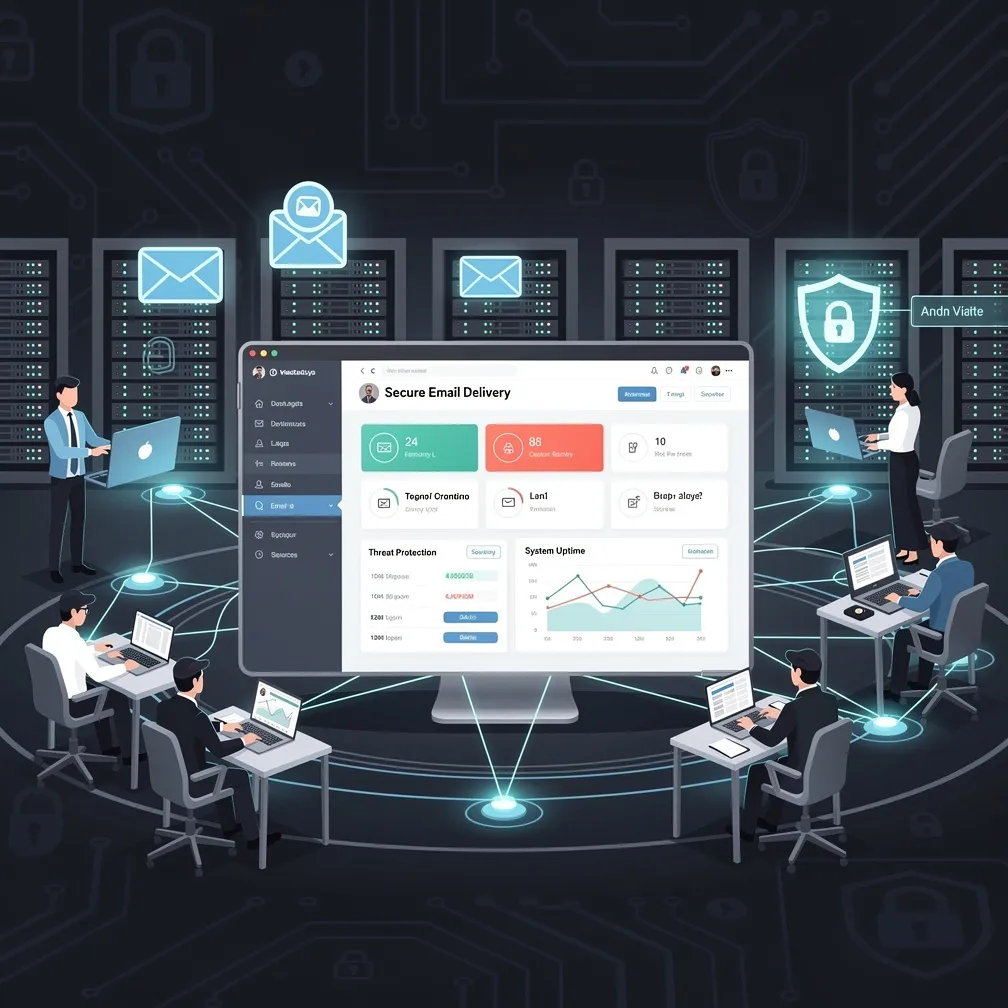
Email remains the backbone of business communication, with over 347 billion emails sent daily worldwide. For IT administrators and security teams, managing email services isn’t just about ensuring messages arrive—it’s about maintaining security, compliance, and operational reliability in an increasingly complex threat landscape.
Modern email services encompass far more than simple message delivery. They integrate authentication protocols, threat detection systems, compliance monitoring, and infrastructure management into a unified platform that must operate 24/7 with near-perfect reliability.
SPF (Sender Policy Framework) records define which mail servers are authorized to send email on behalf of your domain. Without proper SPF configuration, your legitimate messages may be marked as spam or rejected entirely. A typical SPF record looks like:
v=spf1 ip4:192.0.2.0/24 include:_spf.google.com ~all
DKIM (DomainKeys Identified Mail) adds a digital signature to every outgoing email, proving the message hasn’t been tampered with in transit. This cryptographic authentication is essential for maintaining sender reputation and preventing email spoofing attacks.
DMARC (Domain-based Message Authentication, Reporting & Conformance) builds on SPF and DKIM by telling receiving servers what to do when authentication fails. It also provides visibility into who is sending email using your domain—both legitimate senders and potential attackers.
Advanced email services include multi-layered security that scans for:
Organizations in regulated industries must implement email filtering that automatically quarantines messages containing PII, PHI, or payment card data sent to unauthorized recipients.
The MTA is responsible for routing email between servers. Enterprise-grade email services typically use redundant MTAs across multiple geographic regions to ensure delivery even during infrastructure failures. Key considerations include:
Many organizations use email relay services to route outbound email through specialized infrastructure with established sender reputation. This is particularly important for:
Smart host configuration ensures all outbound email flows through authenticated, reputation-verified servers rather than directly from internal systems that may lack proper DNS configuration.
Email services must support compliance with industry-specific regulations:
Enterprise email services include archiving capabilities that maintain tamper-proof copies of all messages for regulatory and legal purposes. Features include:
Email downtime has an average cost of $74 per minute for mid-sized businesses. Robust email services include:
When your primary email server is unavailable, spooling services queue inbound messages and deliver them once services are restored. This prevents message loss during maintenance windows or unplanned outages.
IT teams should monitor:
Email service providers and mailbox providers assign reputation scores to your sending infrastructure. Factors affecting reputation include:
A damaged sender reputation can result in legitimate email being filtered to spam folders or rejected entirely. Regular monitoring and rapid response to reputation issues is critical.
Email services should feed authentication failures, malware detections, and policy violations into your SIEM platform for correlation with other security events. This enables detection of coordinated attacks that begin with phishing emails.
When a security incident involves email (phishing campaign, account compromise), your email service should support:
Cloud email services (Microsoft 365, Google Workspace) offer:
On-premises email servers provide:
Many organizations adopt a hybrid approach, maintaining on-premises infrastructure for sensitive communications while using cloud services for general business email.
Regardless of your email platform, dedicated security gateways (Proofpoint, Mimecast, Barracuda) add:
Technical controls must be paired with security awareness training covering:
Quarterly reviews should verify:
Email services are a critical infrastructure component that requires ongoing attention from IT and security teams. Proper authentication, filtering, monitoring, and compliance controls protect your organization from threats while ensuring reliable communication with customers, partners, and employees.
As the threat landscape evolves, email security must advance in parallel. Organizations that invest in robust email service infrastructure, automated threat detection, and continuous monitoring maintain both operational efficiency and security posture in an increasingly dangerous digital environment.