Your email marketing campaigns are only as effective as your ability to reach the inbox. You can craft the perfect message, segment your audience flawlessly, and time your sends strategically—but if your emails land in spam folders or never arrive at all, your efforts are wasted. Understanding and implementing email deliverability best practices is the foundation of successful email marketing, yet it remains one of the most misunderstood aspects of email infrastructure management.
Email deliverability refers to the ability of your emails to reach recipients’ inboxes rather than being filtered to spam folders, blocked entirely, or bouncing back. This differs significantly from delivery rate, which only measures whether an email was accepted by the receiving mail server. An email can be technically delivered without being deliverable to the inbox—a critical distinction that many marketers overlook.
The ultimate goal of email deliverability is inbox placement: ensuring your messages appear in the primary inbox where recipients actually see and engage with them. Internet Service Providers (ISPs) and mailbox providers use sophisticated algorithms to determine whether your email deserves inbox placement or should be relegated to spam, making email deliverability a complex challenge that requires strategic attention.
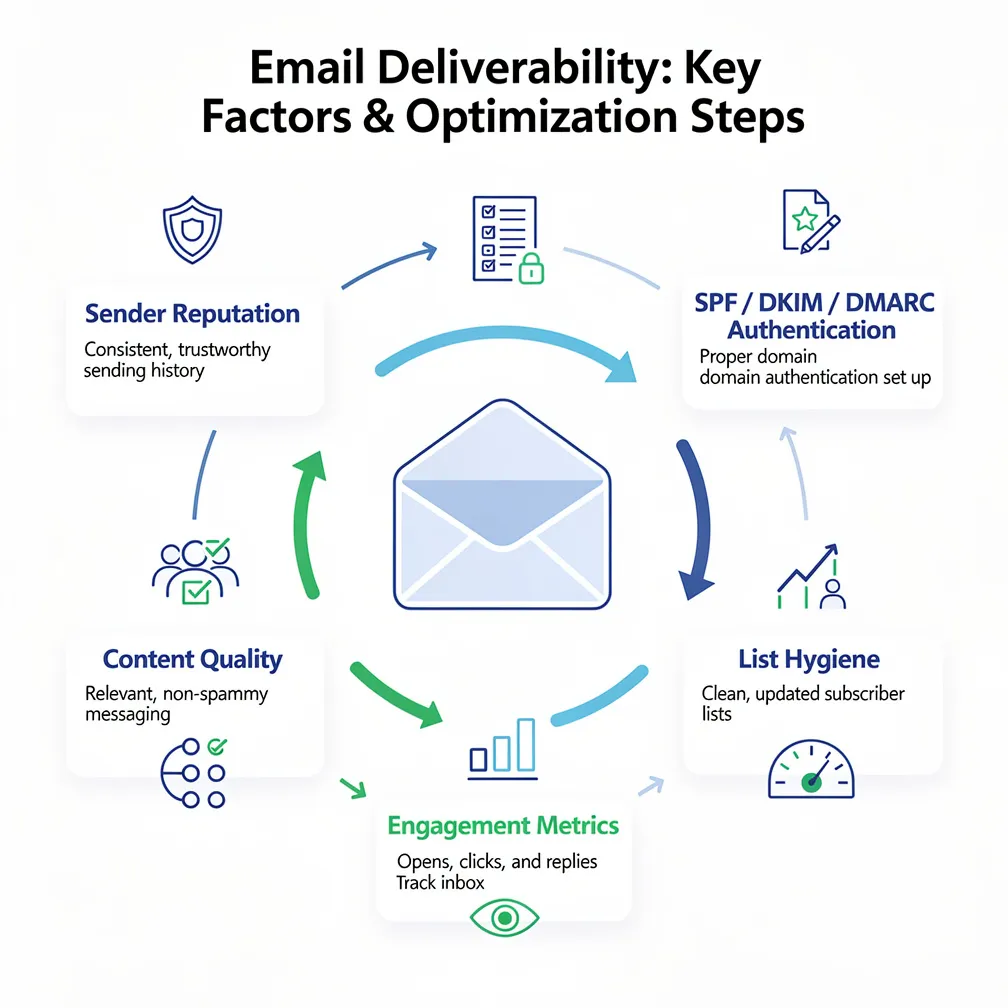
Email deliverability isn’t determined by a single factor but rather by a combination of elements that ISPs evaluate to assess your trustworthiness as a sender. The primary factors include:
Understanding how these factors interconnect allows you to develop a comprehensive strategy to improve email deliverability across your entire email program.
Your sender reputation functions like a credit score for email—it’s the single most influential factor in determining whether ISPs trust your messages enough to deliver them to the inbox. This reputation is tied to both your sending IP address and your domain.
IP reputation reflects the sending behavior associated with a specific IP address. ISPs track metrics like complaint rates, spam trap hits, bounce rates, and engagement patterns. When multiple senders share an IP address, one sender’s poor practices can negatively impact others, which is why dedicated IPs are often recommended for high-volume senders.
Domain reputation has become increasingly important as ISPs recognize that bad actors frequently change IP addresses but maintain consistent domains. Your domain’s reputation follows you across IP addresses, making it essential to protect through consistent best practices.
For organizations implementing new IP addresses, proper warming is essential. ISPs view sudden high-volume sending from new IPs with suspicion. A gradual warm-up schedule—starting with your most engaged subscribers and slowly increasing volume over several weeks—establishes positive sending patterns and builds reputation organically.
Maintaining consistent sending patterns also matters. Erratic sending behavior—such as sending sporadically or experiencing massive volume spikes—can trigger ISP scrutiny and harm your reputation.
Email authentication protocols are technical standards that verify your identity as a legitimate sender. Implementing these protocols is non-negotiable for serious email marketers seeking to improve email deliverability.
SPF (Sender Policy Framework) allows you to specify which IP addresses are authorized to send email on behalf of your domain. When a receiving server gets an email claiming to be from your domain, it checks your SPF record to verify the sending IP is authorized. Proper SPF configuration prevents spammers from spoofing your domain and protects your reputation.
DKIM (DomainKeys Identified Mail) adds a digital signature to your email headers that receiving servers can verify using a public key published in your DNS records. This cryptographic authentication proves the email hasn’t been tampered with in transit and genuinely comes from your domain.
DMARC (Domain-based Message Authentication, Reporting and Conformance) builds upon SPF and DKIM by telling receiving servers what to do when authentication fails and providing reporting mechanisms so you can monitor authentication results. DMARC requires alignment between the domain in the “From” address and the domains authenticated by SPF or DKIM.
Together, these protocols create a robust authentication framework that dramatically improves your email deliverability by proving to ISPs that you’re a legitimate, trustworthy sender.
Even with perfect authentication and stellar reputation, poor content can trigger spam filters and damage your deliverability. Content optimization focuses on both what you say and how you structure your messages.
Subject line optimization requires balancing engagement with avoiding spam triggers. Excessive punctuation, all caps, and misleading claims can flag spam filters. Focus on clear, relevant subject lines that accurately represent your email content.
Certain words and phrases have historically been associated with spam, though modern filters are sophisticated enough to evaluate context. Nevertheless, exercise caution with excessive promotional language, urgency manipulation, and financial promises.
Maintaining a proper text-to-image ratio is essential because image-heavy emails with minimal text resemble common spam patterns. Aim for a balanced approach that includes substantive text content even when using images for visual appeal.
HTML formatting should be clean and standards-compliant. Broken HTML, excessive inline CSS, and hidden text can trigger spam filters. Test your emails across multiple clients to ensure proper rendering.
Personalization extends beyond inserting a first name—it involves tailoring content to recipient preferences and behavior, which improves engagement metrics that ISPs monitor when evaluating your sender reputation.
Your subscriber list quality directly impacts your email deliverability. Sending to unengaged, invalid, or non-existent addresses damages your reputation and signals to ISPs that you’re not managing your list responsibly.
Regular list cleaning involves systematically removing hard bounces immediately and monitoring soft bounces for patterns. Continuing to send to addresses that consistently bounce is a reputation killer.
Removing inactive subscribers may seem counterintuitive when you’re focused on list growth, but ISPs notice when recipients consistently ignore your emails. Low engagement rates signal that your content isn’t wanted, negatively impacting deliverability to engaged subscribers.
Double opt-in processes confirm that subscribers genuinely want to receive your emails and provided valid addresses. While this may reduce list size initially, it dramatically improves list quality and engagement rates.
Re-engagement campaigns give inactive subscribers an opportunity to confirm their interest before removal. These campaigns can win back some subscribers while identifying those who should be removed.
Implementing sunset policies—automatically removing subscribers who haven’t engaged within a defined timeframe—protects your sender reputation by ensuring you’re only emailing people who value your messages.
You cannot improve what you don’t measure. Comprehensive monitoring provides the insights needed to identify deliverability issues before they become critical problems.
Key metrics to track include:
Seed testing involves sending to a list of test addresses across major ISPs to monitor where your emails are placed. This provides direct visibility into inbox placement rates across different providers.
Registering for feedback loops with major ISPs allows you to receive notifications when recipients mark your emails as spam, enabling you to remove these subscribers promptly and investigate what prompted the complaints.
Implementing email deliverability best practices requires actionable strategies that address the factors ISPs evaluate:
Segment your audiences to send more relevant content to specific subscriber groups. Better targeting improves engagement metrics, which ISPs reward with better inbox placement.
Send at optimal times when your specific audience is most likely to engage. Higher immediate engagement signals to ISPs that your emails are wanted.
Honor unsubscribe requests promptly—ideally within hours, not the legally allowed ten days. Continuing to email people who’ve unsubscribed generates complaints that devastate your reputation.
Use dedicated IPs for high-volume sending to maintain complete control over your reputation without being affected by other senders’ practices.
Implement preference centers that allow subscribers to control email frequency and content types. Giving recipients control reduces unsubscribes and complaints while improving engagement.
Email deliverability best practices are not a one-time configuration but an ongoing commitment to maintaining sender reputation, authentication standards, content quality, and list health. The email landscape continuously evolves as ISPs refine their filtering algorithms and bad actors develop new tactics, requiring vigilant monitoring and adaptation.
Organizations that prioritize email deliverability as a core component of their email strategy—rather than an afterthought—consistently achieve better inbox placement rates, higher engagement, and stronger ROI from their email programs.
At Email Delivery Pro, we understand the complexities of maintaining optimal email deliverability across diverse sending scenarios. Explore our comprehensive comparison tools to identify the email infrastructure solutions that best support your deliverability goals and ensure your messages consistently reach the inbox.