As a senior executive, you face a cybersecurity threat specifically engineered to exploit your authority, bypass your technical defenses, and manipulate your most trusted business relationships. Business email compromise represents a sophisticated category of attacks that consistently result in the highest financial losses of any cybercrime type. Unlike automated malware campaigns, BEC attacks target decision-makers with carefully researched social engineering, often succeeding where technical exploits fail. Understanding and preventing business email compromise must be a board-level priority.
Business email compromise refers to sophisticated phishing attacks where cybercriminals impersonate executives, vendors, or business partners to fraudulently authorize financial transactions or extract sensitive data. While standard phishing campaigns cast wide nets hoping to install malware or harvest credentials, BEC attacks are precision operations targeting specific individuals within an organization’s financial or executive hierarchy.
The distinguishing characteristic of bec attacks is their reliance on social engineering rather than technical exploitation. Attackers leverage publicly available information about organizational structure, business relationships, communication patterns, and executive travel schedules to craft convincing impersonations. These attacks frequently involve no malicious attachments or links—just carefully worded emails that appear to come from trusted sources requesting legitimate-seeming business actions.
The targets are typically CFOs, controllers, accounts payable personnel, HR staff with payroll access, or executive assistants with authority to initiate wire transfers. The impersonated parties are usually CEOs, CFOs, vendors with established billing relationships, or legal counsel. This combination of trusted relationships and financial authority creates a vulnerability that technical controls alone cannot address.
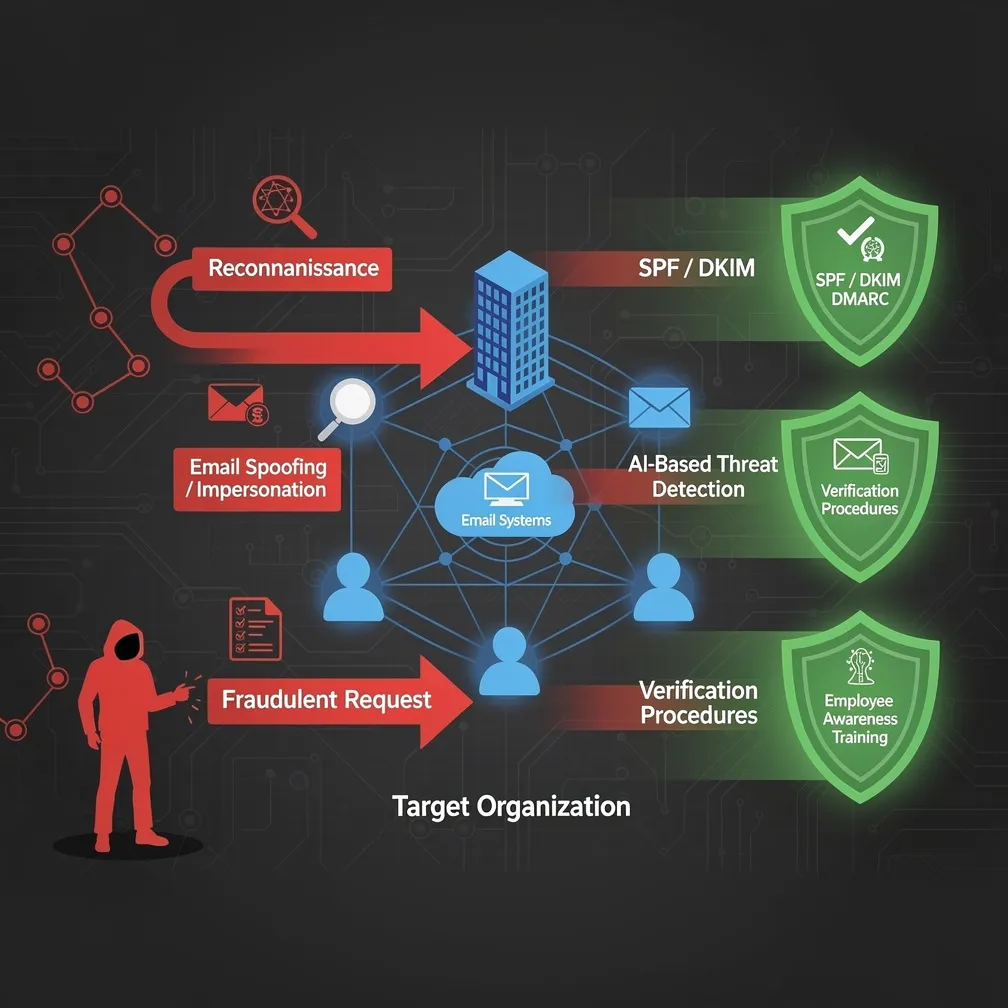
Understanding the BEC attack lifecycle reveals why these schemes prove so effective. The process typically unfolds in five stages:
Reconnaissance: Attackers research target organizations through LinkedIn, company websites, press releases, and social media to identify key personnel, reporting structures, vendor relationships, and business patterns. They may monitor email communication for weeks or months after compromising an account to understand communication styles and approval processes.
Infrastructure preparation: Criminals establish their attack platform using either domain spoofing (forging the sender address to appear from a legitimate domain) or lookalike domains (registering domains with subtle variations like replacing ‘i’ with ‘l’ or adding hyphens). Some attackers compromise legitimate email accounts through credential theft, allowing them to send from genuine addresses.
Email account compromise: In sophisticated BEC campaigns, attackers gain access to actual employee email accounts through phishing, credential stuffing, or exploiting weak passwords. This provides authentic sending addresses, access to email threads for context, and the ability to create inbox rules that hide responses from victims.
Executive or vendor impersonation: The attacker sends carefully crafted emails that mimic the communication style of the impersonated party. These often create urgency (“I’m in a meeting, need this done immediately”), confidentiality (“This acquisition is sensitive, don’t discuss with anyone”), or exploit established trust (“Use the banking details I sent earlier this week”).
Fraudulent request execution: The ultimate goal varies—wire transfer to attacker-controlled accounts, redirection of legitimate vendor payments, purchase of gift cards, or extraction of employee tax data. By the time the fraud is discovered, funds have typically been laundered through multiple accounts across jurisdictions, making recovery extremely difficult.
According to the FBI’s Internet Crime Complaint Center, business email compromise is consistently ranked as the costliest cybercrime category, with reported losses measured in billions of dollars annually. While ransomware and data breaches dominate headlines, BEC attacks quietly drain far more capital from organizations worldwide.
Organizations report losses ranging from tens of thousands to tens of millions per incident, with the average incident representing a significant financial impact. The growth trajectory remains concerning, as attackers refine their techniques and expand their targeting to include not just large enterprises but mid-market companies and even small businesses with less sophisticated controls.
What makes these statistics particularly alarming is that they represent only reported incidents. Many organizations never report BEC losses due to embarrassment, concerns about reputation damage, or hope of quiet recovery. The true financial impact likely exceeds official figures by a substantial margin.
Understanding typical BEC scenarios helps organizations identify and prevent these attacks:
CEO fraud/executive impersonation: The attacker impersonates the CEO or CFO, typically targeting accounts payable or an executive assistant, requesting an urgent wire transfer for a confidential acquisition, legal settlement, or vendor payment. The request emphasizes urgency and confidentiality to discourage verification.
Vendor invoice manipulation: Criminals compromise or impersonate a legitimate vendor, sending invoices with altered banking information. Because the vendor relationship is established and invoices are expected, these changes often go unquestioned, especially when the email appears to come from the vendor’s actual address.
Attorney impersonation: Attackers pose as external legal counsel handling a time-sensitive matter requiring immediate payment. The legal context adds legitimacy and urgency while discouraging questions from non-legal staff.
Payroll diversion: An employee’s email account is compromised, and the attacker changes direct deposit information to redirect paychecks to attacker-controlled accounts. This often goes undetected until the legitimate employee notices the missing payment.
Data harvesting for W-2/tax fraud: Attackers impersonate executives requesting employee W-2 forms or payroll data from HR, ostensibly for legitimate business purposes. This data enables identity theft and fraudulent tax returns filed in employees’ names.
Email authentication protocols represent the foundational technical defense to prevent business email compromise through domain spoofing. Three protocols work together to verify sender legitimacy:
SPF (Sender Policy Framework) allows domain owners to specify which mail servers are authorized to send email on behalf of their domain. DKIM (DomainKeys Identified Mail) adds cryptographic signatures to verify that messages haven’t been altered in transit. DMARC (Domain-based Message Authentication, Reporting and Conformance) builds on SPF and DKIM by instructing receiving servers how to handle authentication failures and providing reporting on email authentication results.
Implementing DMARC at enforcement level (p=reject) prevents attackers from successfully spoofing your domain to target employees, customers, or partners. This eliminates a significant attack vector for bec attacks. For detailed implementation guidance, consult our DMARC policy configuration technical guide.
However, email authentication has limitations. These protocols only prevent exact domain spoofing—they cannot stop attackers using lookalike domains, compromised legitimate accounts, or display name spoofing where the visible name appears correct but the actual email address differs. Email authentication is necessary but not sufficient for comprehensive BEC prevention.
A layered defense strategy incorporates multiple controls working together:
Technical controls fail when human judgment is compromised. Effective BEC prevention requires security awareness specifically designed for the executive and finance context:
Conduct executive-specific security training that addresses threats targeting leadership, including BEC scenarios relevant to their roles. Executives must understand they are high-value targets and that their communication patterns and authority are weaponized against their organizations.
Implement simulated BEC exercises that test whether employees follow verification procedures when receiving suspicious requests. Unlike punitive “gotcha” testing, frame these as learning opportunities that identify process gaps and reinforce proper responses.
Establish a verification culture where questioning unusual requests is expected and encouraged, regardless of apparent sender seniority. Make clear that executives welcome verification calls and that following security procedures will never result in negative consequences.
Create clear reporting procedures for suspected BEC attempts, ensuring employees know how to escalate concerns quickly and that reports are taken seriously and investigated promptly.
Despite preventive measures, organizations must prepare for potential BEC incidents:
Immediate response actions when BEC is suspected include: immediately contacting your financial institution to attempt transaction recall or account freezing, preserving all email evidence without forwarding or modifying messages, and filing a complaint with the FBI’s Internet Crime Complaint Center (IC3) which can sometimes facilitate fund recovery through international partnerships.
Recovery procedures should address not just financial recovery attempts but also identifying how the compromise occurred—whether through account compromise, domain spoofing, or social engineering—to prevent recurrence.
Post-incident analysis must examine both technical and procedural failures. Were verification procedures in place but not followed? Did technical controls fail to flag suspicious indicators? What changes will prevent similar incidents? This analysis should inform updates to both technical defenses and business processes.
Business email compromise represents a persistent, evolving threat that specifically targets the decision-making authority and trusted relationships at the heart of your organization. No single control prevents business email compromise—effective defense requires layered technical controls like email authentication and advanced filtering, robust business processes including out-of-band verification, and human awareness that recognizes social engineering tactics.
As an executive responsible for your organization’s security posture, prioritize BEC prevention by implementing email authentication protocols, establishing mandatory verification procedures for financial transactions, and fostering a security culture where verification is expected rather than questioned. The financial and reputational costs of BEC incidents far exceed the investment in comprehensive preventive controls. Email Delivery Pro provides the email authentication expertise and tools necessary to eliminate domain spoofing as an attack vector, forming the foundation of your BEC defense strategy.