Email authentication has become non-negotiable for maintaining deliverability and protecting domain reputation. While most email administrators understand the importance of DKIM (DomainKeys Identified Mail), fewer have developed comprehensive strategies for managing DKIM selectors—the critical component that enables flexible, scalable authentication architectures. This guide explores advanced dkim selector strategies that allow organizations to maintain multiple mail streams, rotate keys without downtime, and troubleshoot authentication failures efficiently.
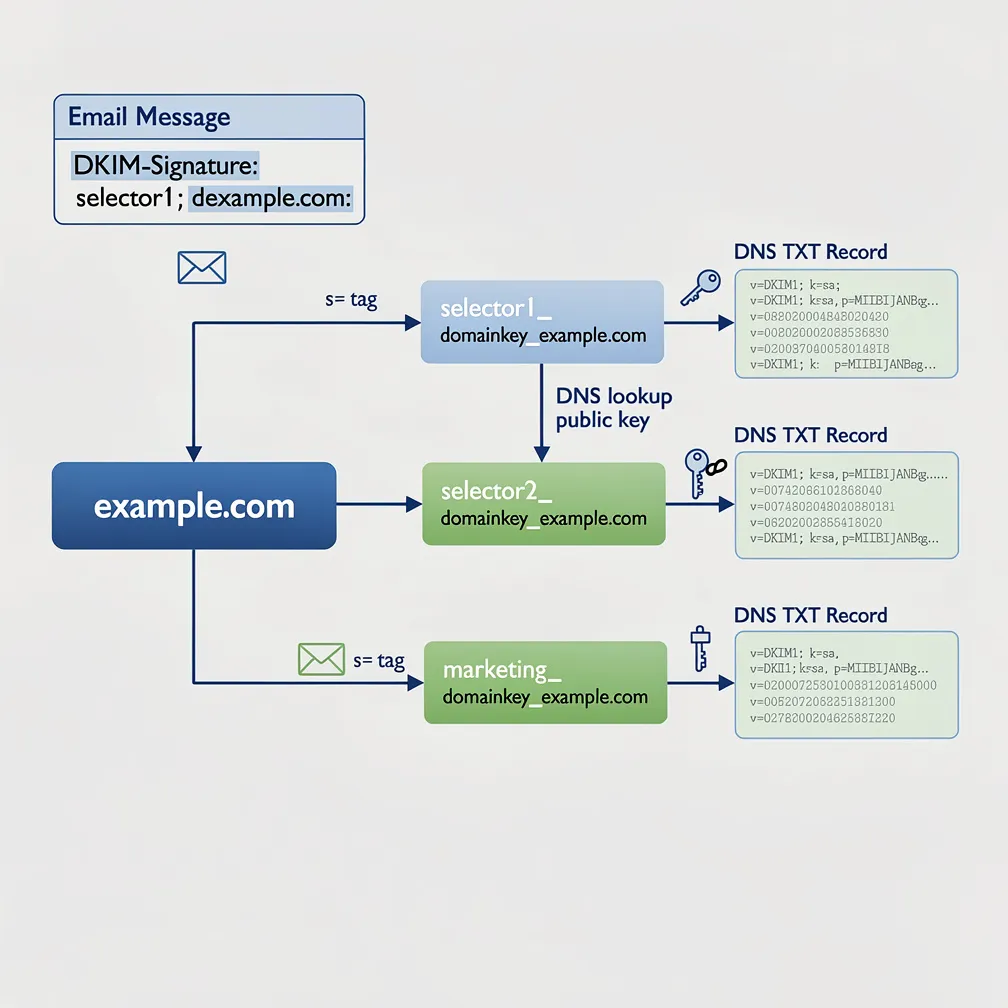
According to RFC 6376, a dkim selector serves as a mechanism for publishing multiple DKIM public keys under a single domain. The selector creates a namespace that allows organizations to segment authentication credentials across different mail streams, time periods, or infrastructure components.
The technical implementation follows a specific DNS structure: selector._domainkey.domain.com. When an email is signed with DKIM, the signature header includes an s= tag that specifies which selector to use. For example, a DKIM-Signature header might contain:
DKIM-Signature: v=1; a=rsa-sha256; d=example.com; s=marketing2024; ...
When a receiving mail server validates this signature, it extracts the selector value (marketing2024) and the domain (example.com), then queries DNS for the TXT record at marketing2024._domainkey.example.com. This record contains the public key used to verify the signature’s authenticity. This indirection mechanism is what makes selectors powerful—it allows multiple authentication keys to coexist under one domain without conflict.
Organizations face a fundamental choice when establishing dkim selector best practices: descriptive naming versus opaque naming. Each approach offers distinct advantages depending on your security posture and operational requirements.
Descriptive selectors provide immediate operational clarity. Examples include:
Descriptive naming simplifies troubleshooting and documentation. When investigating authentication failures, administrators immediately understand which mail stream or service is affected. However, this transparency comes with a tradeoff: it exposes infrastructure details that security-conscious organizations may prefer to keep private.
Opaque selectors use non-descriptive identifiers like k1, s20240115, or randomly generated strings. This approach provides security through obscurity, making it harder for attackers to map your email infrastructure. The disadvantage is increased operational complexity—administrators must maintain external documentation mapping selectors to their purposes.
Most organizations find a middle ground works best: using semi-descriptive selectors that provide enough context for operations without revealing sensitive architectural details.
Implementing multiple dkim selectors has become standard practice for organizations with diverse email requirements. Separate selectors enable isolation between distinct mail streams, each with independent authentication credentials.
Common use cases for multiple selectors include:
This segmentation provides significant benefits. If a marketing platform is compromised or begins sending problematic content, you can revoke only that selector without disrupting transactional emails or corporate communications. Each stream maintains independent reputation signals and allows granular forensic analysis when authentication issues arise.
Regular key rotation is essential for maintaining cryptographic hygiene, but poorly executed rotation causes authentication failures and delivery disruptions. A proper rotation workflow uses overlapping validity periods to ensure zero-downtime transitions.
The recommended rotation process follows these steps:
This overlapping approach ensures that emails signed with the old selector during the transition period can still be verified even after you’ve switched to the new selector for signing. DNS TTL values play a critical role—shorter TTLs enable faster rotation but increase DNS query load.
Effective selector management extends beyond simple naming schemes to encompass the entire key lifecycle. Key length considerations significantly impact both security and compatibility. While 1024-bit RSA keys remain widely supported, they’re increasingly considered insufficient for long-term security. Most organizations now deploy 2048-bit RSA keys as the standard, with some advanced implementations exploring Ed25519 for improved performance and security.
Private key storage security demands careful attention. Private keys should never be stored in plain text on web-accessible servers or in version control systems. Hardware security modules (HSMs) or encrypted key management services provide appropriate protection for sensitive environments.
Maintaining comprehensive documentation of selector-to-service mappings prevents operational confusion. A simple spreadsheet or configuration management database should track which selector corresponds to which mail stream, when keys were last rotated, and who has access to signing credentials.
For organizations managing dozens or hundreds of selectors, automation becomes essential. Infrastructure-as-code approaches using tools like Terraform for DNS management and automated key generation scripts reduce human error and ensure consistent rotation schedules.
Even well-designed selector architectures encounter problems. Understanding common failure modes accelerates resolution.
DNS lookup failures typically result from typos in selector names or missing DNS records. A selector configured as “marketing2024” but published in DNS as “marketing-2024” will fail validation every time.
Key mismatch errors occur during rotation when the private key used for signing doesn’t correspond to the public key published in DNS. This often happens when rotation steps are executed out of sequence.
Selector not found errors indicate the receiving server couldn’t locate the DNS record, either because it doesn’t exist or DNS propagation is incomplete.
TTL caching delays during rotation cause intermittent failures as different DNS resolvers cache records for varying durations.
The primary diagnostic tool is direct DNS verification using dig or nslookup:
dig TXT selector._domainkey.domain.com
This confirms whether the record exists, contains valid DKIM key data, and matches your signing configuration.
Optimal selector strategies vary based on organizational complexity. Small organizations with single mail servers typically need only one or two selectors—one for the primary mail server and optionally another for a marketing platform. Simplicity reduces management overhead while providing basic authentication.
Enterprises with multiple ESPs should implement dedicated selectors for each service provider and mail stream type. A typical enterprise might maintain 5-10 selectors covering corporate email, multiple marketing platforms, transactional services, and development/testing environments. This granularity enables precise control and troubleshooting.
Managed service providers (MSPs) managing client domains face unique challenges requiring per-client selectors. Using client-specific selectors (client1-2024, client2-2024) prevents cross-contamination if one client’s sending behavior damages reputation. Some MSPs implement hierarchical naming schemes that identify both the client and mail stream type.
For detailed comparisons of email authentication approaches and how selectors fit into broader deliverability strategies, visit our comprehensive comparison guide.
Strategic DKIM selector management transforms email authentication from a simple checkbox into a flexible, resilient architecture that supports complex organizational requirements. By implementing thoughtful naming conventions, maintaining multiple selectors for stream isolation, executing careful rotation procedures, and developing troubleshooting expertise, email administrators can ensure reliable authentication that scales with organizational growth. Whether managing a single domain or hundreds of client environments, these dkim selector best practices provide the foundation for maintaining deliverability and protecting domain reputation in an increasingly authentication-dependent email ecosystem.