Your organization can deploy the most sophisticated email security technologies available, yet a single employee clicking a malicious link can compromise your entire network. This reality underscores a fundamental truth in cybersecurity: technology alone cannot protect your organization. Building a robust human firewall through comprehensive email security training is no longer optional—it’s a critical business imperative that directly impacts your organization’s security posture, financial health, and regulatory compliance.
The human element consistently represents the weakest link in organizational security. Industry research indicates that human error factors into the vast majority of successful cyberattacks, with employees inadvertently opening the door to threat actors through compromised credentials, social engineering, and poor security hygiene.
When examining the financial implications, the cost-benefit analysis overwhelmingly favors investment in employee email security awareness programs. A single data breach can result in direct costs including incident response, forensic investigation, legal fees, regulatory fines, and notification expenses—not to mention indirect costs like reputational damage, customer attrition, and operational disruption. By contrast, comprehensive training programs require relatively modest investment while delivering measurable risk reduction.
Beyond risk mitigation, many organizations face regulatory mandates requiring documented security awareness training. Compliance frameworks across industries increasingly recognize that technical controls must be complemented by human-centered security practices, making employee training both a security necessity and a compliance requirement.
Effective email security training must address the full spectrum of security considerations employees encounter in their daily work:
The cornerstone of any phishing awareness training program is developing employees’ ability to recognize and respond appropriately to social engineering attempts. Employees must learn to identify common phishing indicators that signal potential threats:
Training should distinguish between bulk phishing campaigns that cast wide nets and targeted spear phishing attacks that leverage personal information to appear legitimate. Particular attention should be paid to business email compromise (BEC) schemes, where attackers impersonate executives or trusted partners to authorize fraudulent transactions.
Beyond email, employees should recognize vishing (voice phishing) and smishing (SMS phishing) attacks that increasingly complement email-based campaigns. Understanding pretexting techniques—where attackers create fabricated scenarios to manipulate victims—helps employees maintain healthy skepticism when unusual requests arrive through any communication channel.
Beyond threat recognition, employees need practical guidance on safe email handling:
Even the most vigilant employees will encounter sophisticated attacks that warrant professional assessment. Organizations must establish clear, accessible reporting channels that make it easy for employees to escalate suspicious emails to security teams.
Designating a specific incident response team contact—whether an email address, phone number, or integrated reporting button—removes ambiguity from the reporting process. Critically, organizations must cultivate a no-blame reporting culture that encourages employees to report potential threats without fear of reprimand, even if they’ve already interacted with a suspicious message.
Training should specify what information to capture when reporting suspicious emails, including full headers, sender information, and any actions already taken. Clear escalation timelines help employees understand when immediate reporting is necessary versus situations that can wait for normal business hours.
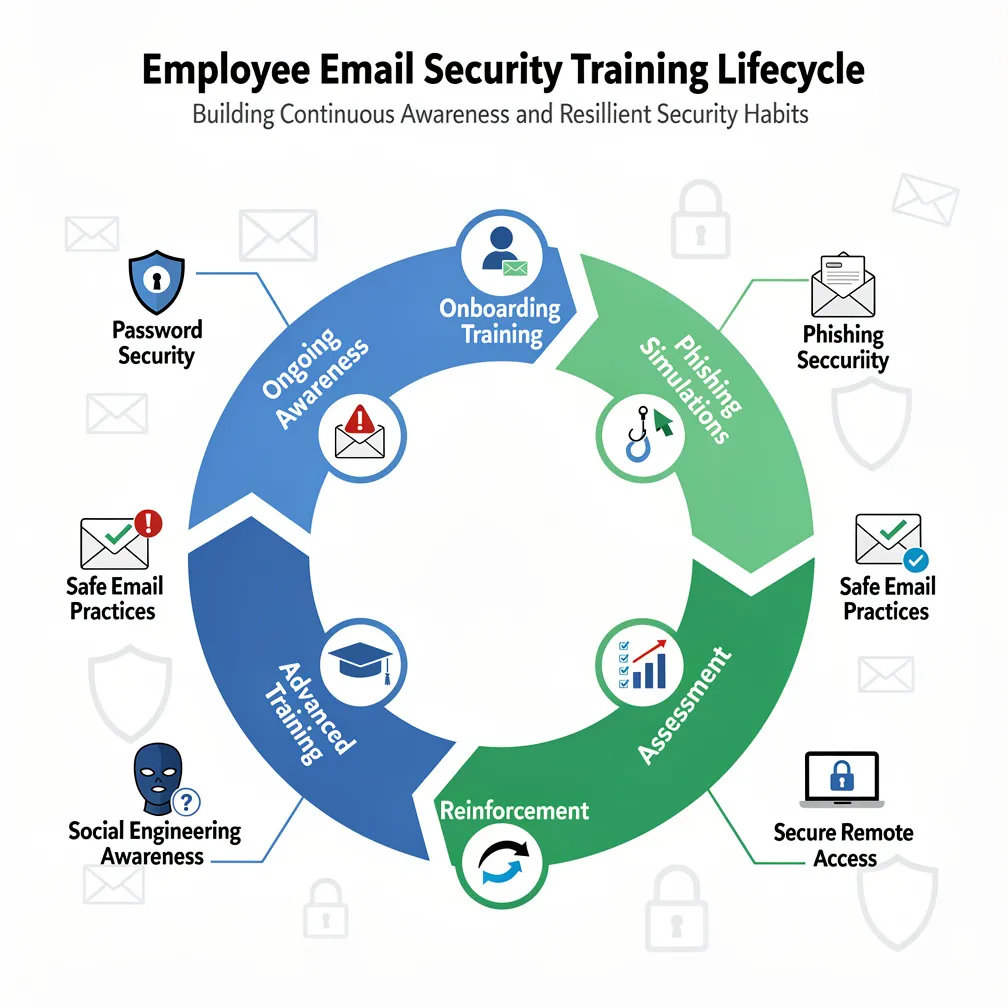
Program design significantly impacts training effectiveness. Security awareness training should occur at minimum quarterly, with more frequent touchpoints for organizations in high-risk industries. Initial onboarding training establishes foundational knowledge, while ongoing sessions reinforce concepts and address emerging threats.
Blended learning approaches combining videos, interactive simulations, and live workshops accommodate different learning styles and maintain engagement. Role-based training customization ensures content relevance—executives face different threat profiles than frontline employees and benefit from targeted training addressing their specific risks.
Executive buy-in and participation proves essential for program success. When leadership visibly prioritizes security awareness, the entire organization recognizes its importance. Simulated phishing campaigns serve dual purposes as both training tools and assessment mechanisms, providing real-world practice in controlled environments.
Organizations evaluating comprehensive email platforms should explore solutions offering integrated security features. Visit our comparison page to evaluate email delivery platforms with built-in security capabilities that complement your training initiatives.
Quantifiable metrics enable continuous program improvement and demonstrate return on investment. Key performance indicators include:
These metrics should inform program adjustments, identifying content areas requiring reinforcement and recognizing improvement trends that validate training investments.
Effective security awareness extends beyond formal training sessions into the daily fabric of organizational culture. Security champions programs designate enthusiastic employees as departmental resources who promote security awareness and serve as peer educators.
Monthly newsletters keep security top-of-mind by highlighting recent threat trends, sharing relevant tips, and recognizing employees who demonstrate exemplary security practices. Gamification and rewards programs create positive reinforcement, making security awareness engaging rather than burdensome.
Lunch-and-learn sessions provide informal learning opportunities that encourage questions and discussion. Integrating security awareness into onboarding ensures new employees develop good habits from day one. Perhaps most importantly, programs must stay current with emerging threats, regularly updating content to address evolving attack techniques and new vulnerability vectors.
Building a human firewall through comprehensive email security training represents one of the highest-return security investments organizations can make. By transforming employees from potential vulnerabilities into active defenders, organizations create layered security that complements technical controls with human intelligence and judgment.
The most effective programs combine thorough initial training with ongoing reinforcement, measurable assessment, and cultural integration. As threat actors continually refine their tactics, your training program must evolve accordingly, maintaining vigilance against both established and emerging threats. Investing in employee email security awareness today prevents the far greater costs of tomorrow’s preventable breaches.