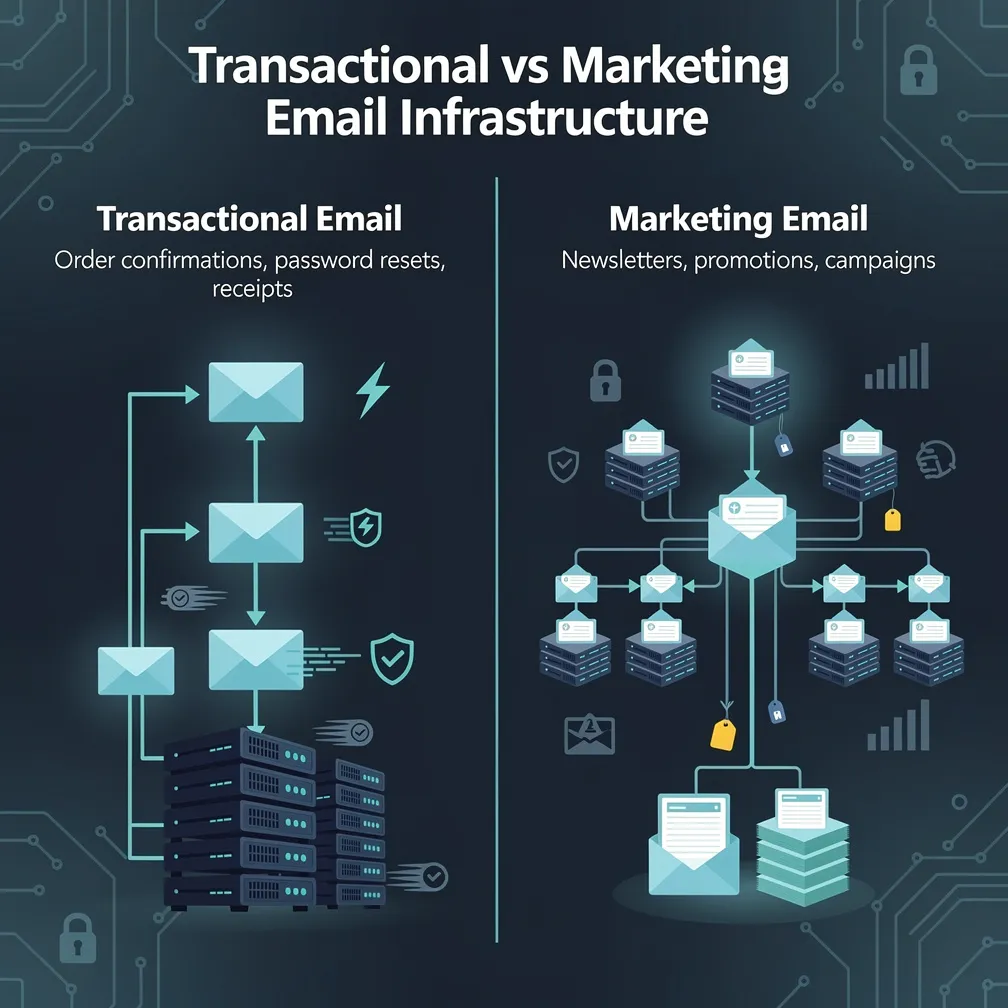
Your order confirmation and your weekly newsletter should never share the same sending infrastructure.
Here’s why — and what the separation actually looks like in practice.
Transactional email is triggered by user action: password resets, receipts, shipping notifications, two-factor codes. It’s expected immediately. A 30-second delay feels like a failure.
Marketing email is sender-initiated: newsletters, promotions, product announcements, drip sequences. Timing matters — but milliseconds don’t.
These aren’t just different content types. They require fundamentally different infrastructure decisions.
Sending Priority
IP & Domain Strategy
notify.yourdomain.commail.yourdomain.com, gradual warm-upAuthentication
Volume Patterns
Bounce & Complaint Handling
When you share infrastructure between transactional and marketing email, one bad marketing campaign can tank your transactional delivery. Suddenly password resets land in spam. Order confirmations disappear. Customer trust erodes.
The reverse happens too — high transactional volume on an IP that also sends marketing can make ISPs treat your promotional emails as suspicious when volume patterns shift.
Transactional and marketing email aren’t just different messages — they’re different systems with different reliability requirements, different reputation profiles, and different failure modes.
Treating them as one system is a risk most organizations don’t recognize until something breaks.
Separate your streams. Protect your transactional delivery. Your customers are counting on it.
—
How does your organization handle the split? Running on shared infrastructure, or fully separated?