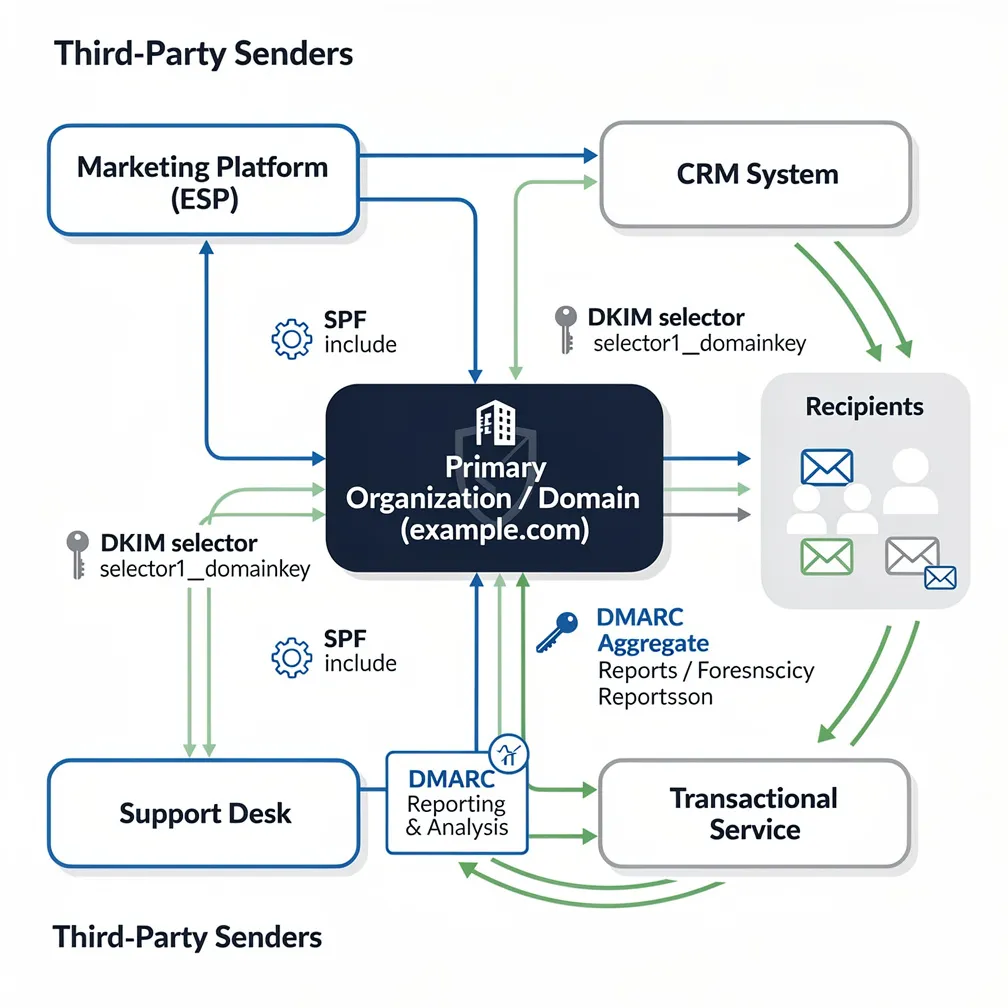
Modern organizations rely on dozens of third-party services to send email on their behalf—from marketing automation platforms and CRM systems to HR tools and customer support applications. While these services enable critical business functions, they also introduce significant security and deliverability risks when not properly managed. Without a structured approach to authorizing and monitoring third party email senders, organizations face authentication failures, reputation damage, and compliance violations that can cripple email communications.
This guide provides email administrators and IT managers with a practical framework for managing third-party email senders through proper authorization workflows, authentication configuration, and ongoing governance.
Organizations face multiple interconnected challenges when managing third-party email services:
Loss of visibility represents the most fundamental problem. When departments independently contract with email service providers, IT teams often remain unaware of these relationships until authentication failures occur or deliverability issues emerge. This blind spot creates security vulnerabilities and makes troubleshooting nearly impossible.
Shared reputation risk means that every third-party sender impacts your domain’s email reputation. A marketing vendor with poor list hygiene or a compromised SaaS platform can trigger spam complaints and blacklistings that affect all email sent from your domain, including critical transactional messages.
Authentication complexity escalates rapidly as organizations add more authorized senders. Each service requires specific SPF includes, DKIM selectors, and configuration that must be carefully coordinated to avoid conflicts and DNS lookup limits.
Compliance gaps emerge when third-party senders handle sensitive data without proper vetting. Organizations remain ultimately responsible for data protection and regulatory compliance, even when outsourcing email delivery to external platforms.
Shadow IT sending services proliferate as business units adopt new tools without IT involvement. These unauthorized senders often lack proper authentication, creating spoofing vulnerabilities and DMARC policy violations that undermine domain security.
Establishing control over third-party senders begins with comprehensive discovery and formal authorization workflows.
Sender discovery methods should employ multiple approaches to identify all active third-party senders:
Once discovered, each potential sender should follow a formal authorization workflow:
Managing SPF third party authorization requires careful planning to work within DNS protocol limitations while maintaining security.
The include mechanism strategy forms the foundation of third-party SPF authorization. Each vendor typically provides an SPF include statement that references their sending infrastructure. However, SPF’s 10 DNS lookup limit creates constraints as your sender list grows.
Flattening approaches can help manage the lookup limit by resolving third-party includes into direct IP addresses. However, this creates maintenance overhead since you must update your record whenever vendors change their infrastructure. Automated SPF flattening services can help, but introduce dependencies on external tools.
Subdomain delegation for high-volume senders provides an elegant solution for major sending sources. By delegating marketing.yourdomain.com or similar subdomains to specific vendors, you isolate their SPF configuration and preserve lookup budget on your primary domain.
Macro-based solutions using SPF’s macro syntax can reduce lookup counts in specific scenarios, though support varies across receiving mail servers.
Here’s an example SPF record incorporating multiple third-party senders:
v=spf1 include:_spf.google.com include:spf.protection.outlook.com include:servers.mcsv.net include:_spf.salesforce.com ip4:203.0.113.0/24 -all
This record authorizes Google Workspace, Microsoft 365, Mailchimp, and Salesforce while including a dedicated IP range and enforcing a hard fail policy.
DKIM delegation allows third-party senders to cryptographically sign email on your behalf while you retain control over DNS records.
Selector assignment strategy should use descriptive names that identify the vendor and purpose, such as mailchimp-marketing or salesforce-transactional. This naming convention simplifies troubleshooting and auditing.
Key management responsibilities must be clearly defined. The third-party vendor generates and stores the private key, while you publish the corresponding public key in your DNS. Never share your domain’s private keys with external parties.
Rotation coordination becomes critical for security. Establish procedures for regular key rotation and ensure vendors notify you before rotating keys so you can update DNS records without causing authentication failures.
CNAME vs direct TXT publishing approaches offer different trade-offs. CNAME records pointing to vendor-controlled zones simplify key rotation since vendors can update keys without requiring DNS changes from you. However, this delegates more control to the vendor. Direct TXT record publishing gives you complete control but requires coordination for every key rotation.
Continuous monitoring ensures third-party senders maintain proper authentication and don’t abuse your domain reputation.
DMARC aggregate reports provide visibility into all email sent from your domain, including third-party sources. Parse these reports to identify which vendors are sending, their authentication pass rates, and message volumes.
Volume anomaly detection helps identify compromised accounts or policy violations. Establish baseline sending volumes for each vendor and alert on significant deviations that might indicate abuse or misconfiguration.
Authentication pass rate tracking should maintain near 100% for authorized senders. Declining pass rates signal configuration drift or infrastructure changes that require investigation.
Bounce and complaint monitoring per sender reveals deliverability issues and list quality problems before they damage your domain reputation. Vendors with consistently high bounce or complaint rates require intervention or replacement.
Before authorizing third party senders, evaluate their security posture and operational practices using these criteria:
For organizations evaluating comprehensive email security solutions, our comparison page provides detailed analysis of leading platforms and their third-party sender management capabilities.
Sustainable third-party sender management requires formal governance processes that scale with your organization.
Sender registry documentation should maintain a centralized inventory of all authorized senders including business owner, purpose, authentication details, contract expiration, and security assessment date. This registry becomes the authoritative source for troubleshooting and auditing.
Annual review cadence ensures the sender list remains current. Annually review each authorized sender to confirm continued business need, verify authentication configuration, and reassess security posture.
Offboarding procedures for decommissioned vendors must include removing SPF includes, deleting DKIM selectors, revoking API access, and confirming data deletion. Incomplete offboarding leaves security vulnerabilities and authentication clutter.
Least-privilege authentication means authorizing only the specific sending capabilities each vendor requires. Avoid granting broad domain-wide sending permissions when more restrictive options exist.
Escalation procedures for authentication failures should define clear ownership and response timeframes when third-party senders experience DKIM or SPF failures that impact deliverability.
Managing third-party email senders requires balancing business enablement with security and deliverability protection. By implementing structured authorization workflows, properly configuring authentication protocols, maintaining continuous monitoring, and enforcing governance policies, organizations can safely leverage third-party email services while protecting their domain reputation.
At Email Delivery Pro, we help organizations implement comprehensive third-party sender management frameworks that scale with business needs while maintaining security and deliverability. Start by inventorying your current senders, establishing authentication baselines, and implementing the governance practices outlined in this guide to take control of your email ecosystem.