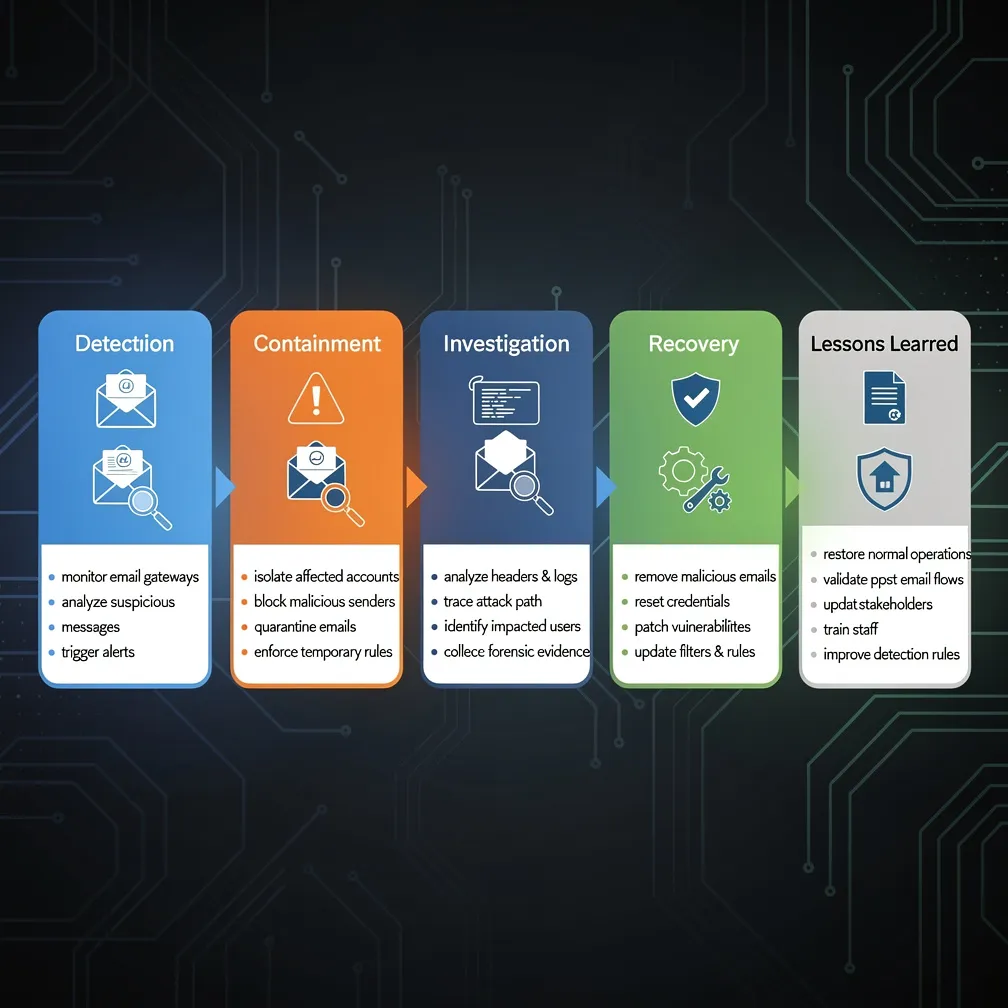
When an email security breach occurs, every second counts. The difference between a contained incident and a catastrophic data breach often comes down to how quickly and effectively your security team responds. Email remains the primary attack vector for cybercriminals, making robust email security incident response capabilities essential for any organization relying on digital communication.
This comprehensive guide provides security teams and incident responders with the frameworks, procedures, and strategies needed to effectively manage email security incidents from initial detection through complete recovery.
Understanding the various types of email security incidents is fundamental to developing an effective response strategy. Each incident type presents unique characteristics and requires tailored response approaches.
Business Email Compromise (BEC) involves attackers impersonating executives or trusted partners to manipulate employees into transferring funds or sensitive data. These sophisticated attacks exploit trust relationships and often bypass traditional security controls.
Account compromise occurs when attackers gain unauthorized access to legitimate email accounts through credential theft, brute force attacks, or session hijacking. Compromised email accounts provide attackers with trusted platforms for launching further attacks.
Phishing campaigns represent coordinated efforts to distribute fraudulent emails that deceive recipients into revealing credentials, downloading malware, or visiting malicious websites. These campaigns can target hundreds or thousands of users simultaneously.
Malware delivery incidents involve emails containing malicious attachments or links designed to infect recipient systems with ransomware, trojans, or spyware.
Data exfiltration via email includes both authorized users inappropriately sending sensitive information externally and attackers using compromised accounts to steal organizational data.
Insider threats encompass malicious or negligent actions by employees, contractors, or partners who abuse email access privileges to harm the organization.
Credential harvesting operations specifically target user authentication credentials through fake login pages and deceptive emails, building databases for future attacks.
Early detection dramatically improves email breach response outcomes. Security teams should implement multiple detection layers to identify incidents quickly.
The initial hour following detection determines the trajectory of your email security incident response. Swift, decisive action limits damage and preserves critical evidence.
Isolate affected accounts immediately by disabling access without deleting accounts or data. This prevents further unauthorized activity while preserving forensic evidence.
Preserve evidence by creating copies of relevant logs, email headers, message content, and system states before any remediation actions that might alter data.
Assess scope by identifying all potentially affected accounts, systems, and data. Determine whether the incident is isolated or part of a broader campaign.
Activate your incident response team using predefined communication channels. Ensure all key stakeholders understand their roles and responsibilities.
Document the timeline meticulously from the moment of detection. Accurate chronological records prove invaluable for investigation, regulatory compliance, and post-incident analysis.
Effective containment prevents incident escalation while maintaining business continuity where possible.
Credential resets should be implemented for all affected accounts and potentially related accounts, using secure out-of-band communication methods to verify user identity.
Session termination forces all active sessions to end, ensuring attackers lose access even if they possess valid credentials.
Mail flow rules can block exfiltration attempts by restricting outbound messages from compromised accounts or implementing approval workflows for sensitive data.
DNS record locks prevent attackers from modifying SPF, DKIM, or DMARC records to facilitate further attacks.
Transport rule quarantine automatically isolates suspicious messages matching specific criteria for security team review.
Network segmentation for mail servers limits lateral movement opportunities and contains damage to email infrastructure.
Thorough investigation reveals attack vectors, identifies all affected systems, and informs remediation strategies.
Mail log analysis examines authentication logs, message tracking logs, and audit logs to reconstruct attacker activities and identify entry points.
Header examination reveals message routing, authentication results, and potential spoofing indicators that illuminate attack methodologies.
Authentication record review analyzes SPF, DKIM, and DMARC validation results to understand how malicious messages bypassed security controls.
Compromised mailbox forensics includes examining inbox rules, forwarding configurations, sent items, deleted items, and folder permissions for signs of attacker activity.
Lateral movement assessment determines whether attackers used email access as a beachhead for broader network compromise.
Timeline reconstruction creates a comprehensive sequence of events from initial compromise through detection, enabling pattern identification and control gap analysis.
Successful email breach response requires addressing root causes, not just symptoms.
Root cause elimination addresses the specific vulnerabilities or control failures that enabled the incident, whether technical misconfigurations, policy gaps, or user behavior issues.
Security control hardening implements enhanced protections based on lessons learned, including multi-factor authentication enforcement, conditional access policies, and advanced threat protection features.
SPF/DKIM/DMARC reconfiguration ensures email authentication protocols are properly implemented with appropriate policies to prevent domain spoofing.
Monitoring enhancement addresses detection gaps revealed during the incident, improving visibility into future threats.
Phased service restoration returns email functionality incrementally while validating security controls at each stage.
Validation testing confirms that remediation actions effectively address vulnerabilities without introducing new issues.
Legal and regulatory obligations surrounding breach notification are complex and jurisdiction-dependent.
Regulatory obligations under frameworks like GDPR, HIPAA, and various state breach notification laws impose specific timelines and content requirements for breach notifications. GDPR typically requires notification within 72 hours of discovery, while other regulations vary.
Customer communication timing should balance legal requirements with the need for accurate information. Premature notification with incomplete information can cause unnecessary alarm, while delayed notification may violate regulations.
Law enforcement engagement criteria depend on incident severity, potential criminal activity, and jurisdictional requirements. Major incidents typically warrant law enforcement notification.
Insurance carrier notification should occur promptly as cyber insurance policies often contain specific notification timeframes and requirements.
Board and executive reporting ensures leadership understands incident impact, response actions, and business implications.
Preparation prevents poor performance during actual incidents. A comprehensive email security incident response plan provides the foundation for effective response.
Playbook development documents specific procedures for each incident type, including decision trees, command sequences, and tool configurations.
Role assignments clearly define responsibilities for incident commander, technical responders, communications lead, legal liaison, and executive sponsor positions.
Communication templates pre-written for various scenarios accelerate notification processes while ensuring consistent, appropriate messaging.
Escalation matrices specify when and how to elevate incidents based on severity indicators, ensuring appropriate resources engage at the right time.
Tabletop exercises test plans, identify gaps, and build team proficiency without the pressure of actual incidents.
Metrics and post-incident review processes capture lessons learned, measure response effectiveness, and drive continuous improvement.
Effective email security incident response requires preparation, practiced procedures, and the right tools. Security teams must develop comprehensive capabilities spanning detection, containment, investigation, remediation, and recovery to protect their organizations from email-borne threats.
At Email Delivery Pro, we understand that robust email security extends beyond prevention to include comprehensive incident response capabilities. Our platform provides the visibility, control, and forensic capabilities security teams need to respond effectively when incidents occur.
Ready to enhance your email security posture? Compare email security solutions to find the platform that best supports your incident response requirements. Don’t wait for a compromised email account to expose gaps in your response capabilities—build your email security incident response plan today.