The strength of your DKIM implementation hinges on a critical factor that many email administrators overlook: key length. As email security threats evolve and computing power increases, the cryptographic strength of your DKIM keys directly determines your vulnerability to factoring attacks. A weak DKIM key doesn’t just compromise authentication—it opens the door to domain spoofing, phishing attacks using your trusted domain, and complete DMARC policy bypass. Understanding dkim key length requirements isn’t optional anymore; it’s fundamental to maintaining email deliverability and protecting your domain reputation.
DKIM relies on RSA asymmetric cryptography, where key length directly correlates to security strength. The dkim key size landscape has evolved significantly over the past decade as older standards become obsolete.
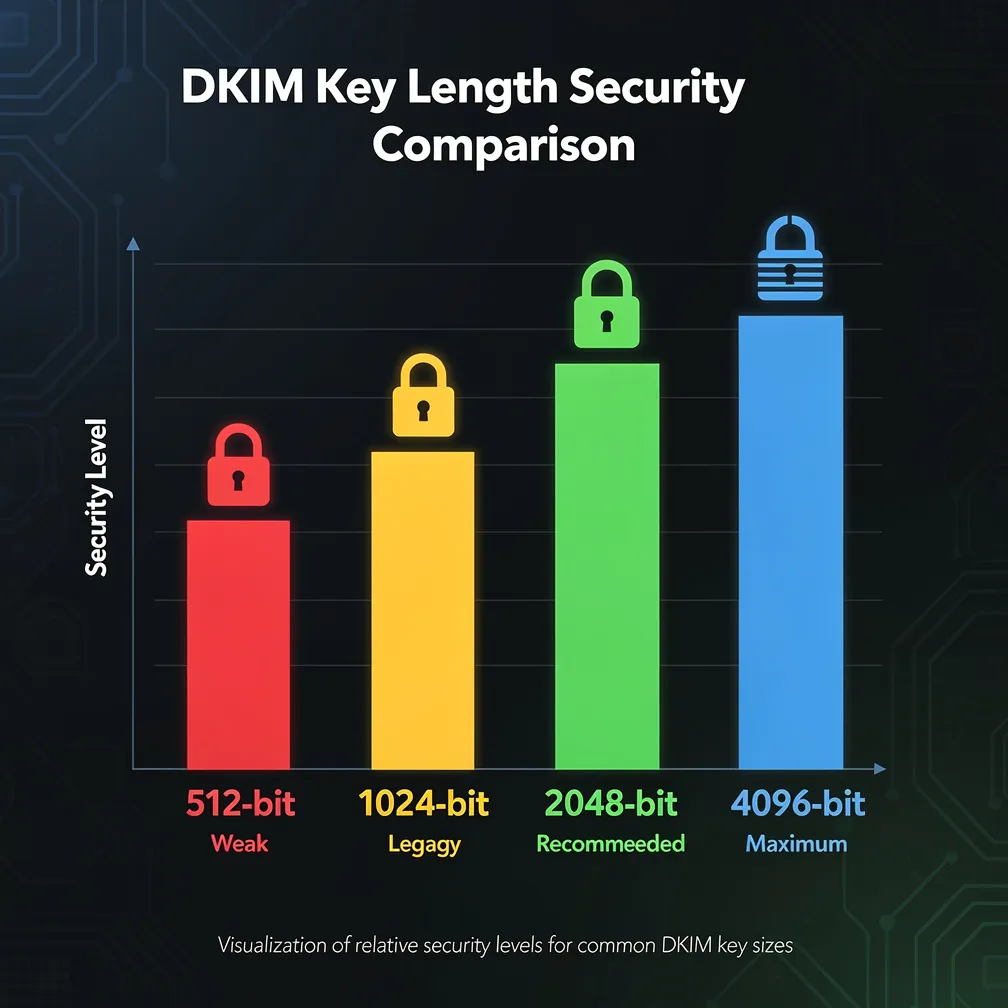
512-bit keys are completely deprecated and should never be used. These keys can be factored in hours or days with modern computing resources, making them cryptographically worthless for authentication purposes.
1024-bit keys represent the legacy standard that dominated DKIM implementations for years. While still functional, they’re increasingly viewed as insufficient for long-term security. These keys fit comfortably within DNS TXT record limits, requiring approximately 300-400 characters when base64-encoded.
2048-bit keys constitute the current industry standard and minimum recommended size for new deployments. When base64-encoded, these keys typically require 550-700 characters in DNS TXT records, occasionally necessitating split strings in DNS configurations to accommodate the larger payload.
4096-bit keys represent an emerging option for maximum security. However, they introduce significant DNS record size challenges, often requiring multiple TXT record strings, and may encounter compatibility issues with some older email systems and DNS resolvers that struggle with records exceeding 512 bytes per string.
The debate between dkim 1024 vs 2048 involves multiple technical considerations beyond simple security strength.
Cryptographic strength differs dramatically between these key sizes. A 1024-bit RSA key provides approximately 80 bits of security strength, while 2048-bit keys deliver roughly 112 bits. This seemingly modest difference translates to exponentially greater resistance to factoring attacks. Current estimates suggest that factoring a 1024-bit key could be accomplished by well-resourced adversaries within months to a few years using specialized hardware. In contrast, 2048-bit keys would require decades or centuries to crack with current technology.
Computational overhead represents a common concern when considering larger keys. In practice, the performance difference is negligible for modern email infrastructure. Signing operations with 2048-bit keys take microseconds longer than 1024-bit keys—a difference imperceptible in real-world email processing. Verification is even faster, with minimal impact on receiving servers.
DNS TXT record size presents the most practical implementation challenge. While 1024-bit keys comfortably fit in single-string TXT records, 2048-bit keys often require splitting across multiple strings within a single DNS record. Most modern DNS servers and email validators handle this transparently, but configuration requires attention to proper syntax.
Compatibility considerations have diminished significantly. Legacy concerns about older email systems rejecting 2048-bit keys have largely evaporated as infrastructure has modernized. The vast majority of receiving systems now handle 2048-bit keys without issue.
The consequences of inadequate dkim key length extend beyond theoretical vulnerabilities. Documented attacks on 512-bit RSA keys demonstrate that weak cryptography inevitably gets exploited. Security researchers have successfully factored 512-bit keys in academic settings, proving the concept isn’t theoretical.
For 1024-bit keys, the vulnerability timeline is increasingly compressed. While no widespread attacks have compromised 1024-bit DKIM keys in production environments yet, the cryptographic community consensus indicates these keys approach the end of their practical security lifespan. Nation-state actors and well-funded criminal organizations likely possess the resources to factor 1024-bit keys today.
Quantum computing introduces another dimension to key length considerations. When large-scale quantum computers become practical, they’ll render current RSA encryption vulnerable through Shor’s algorithm. While this remains years away, 2048-bit keys provide better resistance during the transition period to post-quantum cryptography.
The risk of key compromise enables attackers to forge DKIM signatures for your domain, completely bypassing email authentication. Combined with DMARC policy configurations that rely on DKIM alignment, a compromised key allows attackers to send authenticated phishing emails that appear to originate legitimately from your domain.
Industry standards have coalesced around 2048-bit minimum key lengths. RFC 6376, the DKIM specification, recommends against using keys smaller than 1024 bits and encourages 2048-bit keys for new deployments.
The Messaging, Malware and Mobile Anti-Abuse Working Group (M3AAWG) explicitly recommends 2048-bit keys as the minimum for production email systems. Their guidance emphasizes that 1024-bit keys should be considered transitional at best.
The 2024 sender requirements from major mailbox providers including Google and Yahoo mandate robust email authentication but don’t specify exact key lengths. However, their broader security expectations make 2048-bit keys the de facto standard for maintaining optimal deliverability.
NIST recommendations for RSA key lengths align with email industry guidance, specifying 2048-bit keys as the minimum for systems requiring security beyond 2030. Most major ESPs now deploy 2048-bit keys by default for customer accounts.
Even cryptographically strong keys require periodic rotation as a security best practice. Rotation limits the exposure window if a key is compromised and demonstrates security hygiene to receiving domains.
Recommended rotation frequency ranges from quarterly for high-security environments to annually for standard deployments. The specific interval depends on your threat model and compliance requirements.
Implementing zero-downtime rotation requires a selector rotation strategy. Publish your new DKIM key with a different selector while maintaining the old key. Monitor verification rates for emails signed with the new selector over several days. Once verification rates stabilize, update your signing infrastructure to use the new selector exclusively, then remove the old key after a grace period.
Monitoring verification rates during transitions is critical. Sudden drops in DKIM pass rates indicate configuration issues requiring immediate attention. Most email service providers offer analytics showing authentication success rates.
Automating rotation using scripts or ESP APIs eliminates manual errors and ensures consistent rotation schedules. Many modern email platforms provide API endpoints for key management operations.
Effective DKIM key management requires systematic processes beyond initial deployment. Email Delivery Pro recommends these essential practices:
DKIM key length directly impacts your email authentication security posture. The industry has clearly moved to 2048-bit keys as the minimum acceptable standard, with 1024-bit keys representing a security liability rather than a viable option. If your infrastructure still relies on 1024-bit keys, prioritize migration to 2048-bit immediately. For new deployments, there’s no justification for anything less than 2048-bit keys. Combined with proper key rotation practices and comprehensive management processes, strong DKIM keys form the foundation of trustworthy email delivery. Explore our email authentication comparison tools to evaluate your current configuration and identify improvement opportunities.