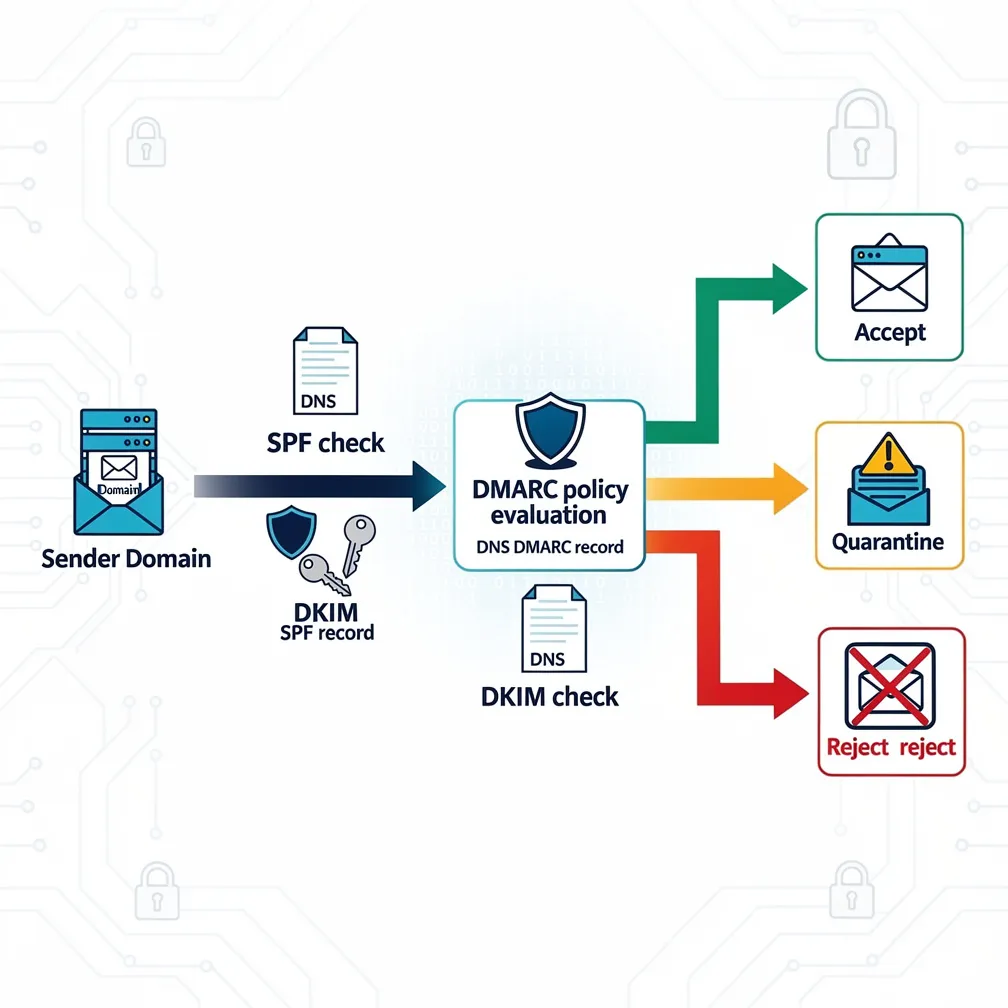
DMARC (Domain-based Message Authentication, Reporting and Conformance) is an email authentication protocol that protects organizations from email spoofing, phishing attacks, and business email compromise. By building on existing authentication methods like SPF and DKIM, DMARC provides domain owners with powerful tools to prevent unauthorized use of their email domains and gain visibility into email authentication failures.
At its core, DMARC email authentication allows domain owners to publish policies in DNS that tell receiving mail servers how to handle messages that fail authentication checks. This critical security layer has become essential for organizations protecting their brand reputation and securing email communications in an environment where email-based threats continue to evolve.
Email spoofing remains one of the most effective attack vectors for cybercriminals. Without DMARC, attackers can easily forge your domain in the “From” header of emails, making phishing messages appear legitimate to recipients. These spoofed emails can bypass basic security controls and reach employee or customer inboxes, potentially leading to credential theft, malware infections, or financial fraud.
DMARC addresses this fundamental vulnerability by creating an authentication framework that:
For security professionals and IT managers, DMARC implementation is increasingly required for compliance with security frameworks, industry standards, and customer security requirements. Major email providers including Gmail, Yahoo, and Microsoft actively use DMARC policies in their filtering decisions, making proper configuration essential for reliable email delivery.
DMARC doesn’t function in isolation – it relies on two foundational email authentication technologies: SPF (Sender Policy Framework) and DKIM (DomainKeys Identified Mail). Understanding how these three protocols work together is essential for effective implementation.
SPF allows domain owners to specify which IP addresses and mail servers are authorized to send email for their domain. When a receiving server gets an email, it checks the SPF record in DNS to verify that the sending IP address is authorized. SPF validates the envelope sender (the “MAIL FROM” address used in SMTP transactions).
DKIM adds a cryptographic signature to email headers, allowing receiving servers to verify that the message content hasn’t been tampered with and that it was authorized by the domain owner. DKIM validates the “d=” domain in the signature, which is typically the same as the “From” domain but doesn’t have to be.
The critical innovation DMARC introduces is the concept of identifier alignment. For a message to pass DMARC authentication, it must:
This alignment requirement prevents attackers from using legitimate mail servers with valid SPF/DKIM records while spoofing your domain in the “From” header – the address recipients actually see. DMARC supports two alignment modes:
DMARC policies define what action receiving mail servers should take when a message fails DMARC authentication. The policy is published in a DNS TXT record for your domain and applies to all email claiming to be from that domain.
The “none” policy instructs receiving servers to take no action on authentication failures but to send DMARC reports to the domain owner. This monitoring mode is the recommended starting point for DMARC implementation, allowing you to:
Organizations typically remain in monitor mode for 2-4 weeks while analyzing reports and fixing authentication issues with legitimate email sources.
The “quarantine” policy instructs receiving servers to treat authentication failures as suspicious, typically delivering them to spam or junk folders rather than the inbox. Quarantine mode provides meaningful protection while allowing recipients to check quarantined folders for legitimate messages that might have authentication issues.
This intermediate enforcement level is valuable for organizations that want protection but need flexibility during the transition period or have complex email environments with multiple vendors and services.
The “reject” policy instructs receiving servers to refuse delivery entirely for messages that fail DMARC authentication. This is the strongest protection level and the ultimate goal for most DMARC implementations. Messages that fail authentication are blocked before reaching any folder, providing maximum protection against spoofing and phishing.
Moving to reject mode requires confidence that all legitimate email sources are properly authenticated and aligned. Organizations should achieve consistent 100% DMARC pass rates in quarantine mode before progressing to reject.
DMARC supports gradual policy rollout through the “pct=” tag, which specifies what percentage of failing messages should have the policy applied. For example, “pct=25” applies the policy to 25% of failures, allowing cautious progression from quarantine to reject mode.
One of DMARC’s most powerful features is the reporting mechanism that provides unprecedented visibility into email authentication and delivery. DMARC supports two report types:
Aggregate reports are XML-formatted summaries sent daily by receiving mail servers, containing:
These reports allow security teams to identify all email sources, detect spoofing attempts, and monitor authentication health over time. Aggregate reports are specified in the DMARC record using the “rua=” tag with an email address or URI.
Forensic reports (also called failure reports) provide real-time samples of individual messages that failed DMARC authentication. These reports contain message headers and sometimes full message content, enabling detailed investigation of authentication failures.
Forensic reports are specified using the “ruf=” tag but are sent less frequently by receiving servers due to privacy concerns. Many large email providers have discontinued forensic report generation.
Raw DMARC reports are technical and voluminous – major domains receive millions of report records daily. Most organizations use DMARC analysis platforms that parse XML reports, aggregate data across sources, and provide dashboards showing:
Organizations that implement DMARC with enforcement policies realize multiple security and operational benefits:
For security professionals and IT managers ready to implement DMARC, the recommended approach follows these phases:
DMARC implementation is a journey rather than a one-time project. Organizations with complex email environments may spend several months in monitoring and remediation phases before achieving enforcement. However, the security and deliverability benefits make this investment essential for any organization serious about email security and brand protection in 2026 and beyond.