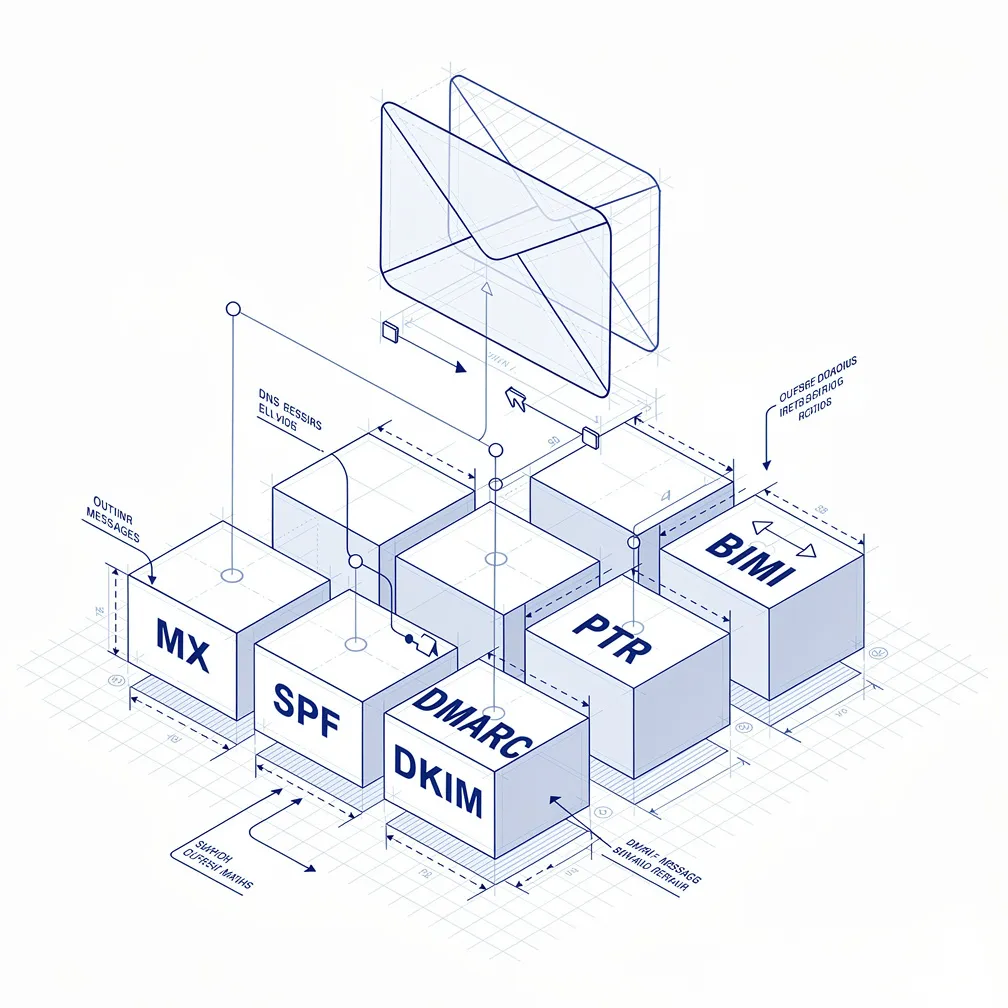
Your email doesn’t just “send.” Behind every delivered message is a foundation of DNS records working together. Miss one, and your deliverability crumbles.
Here’s the complete stack every sender needs to understand:
MX (Mail Exchange)
Tells the world which servers accept email for your domain. Without it, nobody can reply to you — and you can’t receive the DMARC reports that keep your authentication healthy.
SPF (TXT Record)
Declares which IP addresses are authorized to send on your behalf. Your first line of defense against spoofing. Every legitimate sending source — your ESP, transactional service, CRM — must be included.
DKIM (TXT Record)
Publishes your public key so receivers can verify your messages haven’t been tampered with in transit. This cryptographic signature travels with every email you send.
DMARC (TXT Record)
Sets the policy for what happens when SPF or DKIM fails. Report, quarantine, or reject — you decide. At enforcement (p=reject), you’re telling the world that unauthorized messages using your domain should be blocked.
PTR (Reverse DNS)
Maps your sending IP back to your domain. Mailbox providers check this to confirm you are who you claim to be. A missing or mismatched PTR record is one of the fastest ways to get flagged.
BIMI (TXT Record)
Displays your verified brand logo in the inbox. The visual trust layer that rewards a complete authentication setup. Requires DMARC at enforcement to activate — it’s the capstone of the entire stack.
Why Complete DNS Setup Is Non-Negotiable
Each record builds on the others. SPF and DKIM feed into DMARC. DMARC at enforcement unlocks BIMI. PTR validates what SPF declares. MX ensures you can receive the reports DMARC generates.
This isn’t optional configuration — it’s infrastructure. Organizations that treat their DNS as the foundation of email deliverability see fewer authentication failures, higher inbox placement rates, and stronger sender reputation across every mailbox provider.
Treat your DNS like the foundation it is. Every record matters. Every gap is a vulnerability.