Email forwarding is a common practice in modern organizations, yet it remains one of the most persistent challenges for email authentication. Despite implementing proper SPF records, email administrators frequently encounter delivery failures when messages pass through forwarding services. Understanding why email forwarding SPF validation breaks and how to address these issues is critical for maintaining reliable email delivery in today’s authentication-focused landscape.
At Email Delivery Pro, we’ve seen countless organizations struggle with forwarded messages that fail authentication checks, leading to rejected emails and frustrated users. This comprehensive guide explains the technical reasons behind the SPF forwarding problem and provides actionable solutions to ensure your forwarded emails reach their intended destinations.
The fundamental issue with SPF and email forwarding stems from a mismatch between SPF’s design and the nature of forwarding itself. SPF (Sender Policy Framework), as defined in RFC 7208, validates email based on the IP address of the sending mail server against the authorized IPs published in the sender domain’s DNS records.
When an email is forwarded, the message passes through an intermediary server that wasn’t part of the original sender’s infrastructure. This intermediary server—whether it’s a university mail system, corporate forwarding service, or personal forwarding rule—becomes the new sending IP address. However, this forwarder’s IP address is not listed in the original sender’s SPF record, creating an authentication mismatch.
SPF was designed to prevent email spoofing by validating that the server sending email for a specific domain is authorized to do so. While this works perfectly for direct email delivery, forwarding introduces a third party that legitimately sends the message on behalf of the original sender without being explicitly authorized in the SPF record. This architectural limitation is inherent to SPF’s IP-based validation model.
To understand why SPF fail forwarded email scenarios occur, we need to examine the SMTP envelope flow during forwarding. When an email is sent, the SMTP transaction includes an envelope sender specified in the MAIL FROM command, which is separate from the header From address visible to recipients.
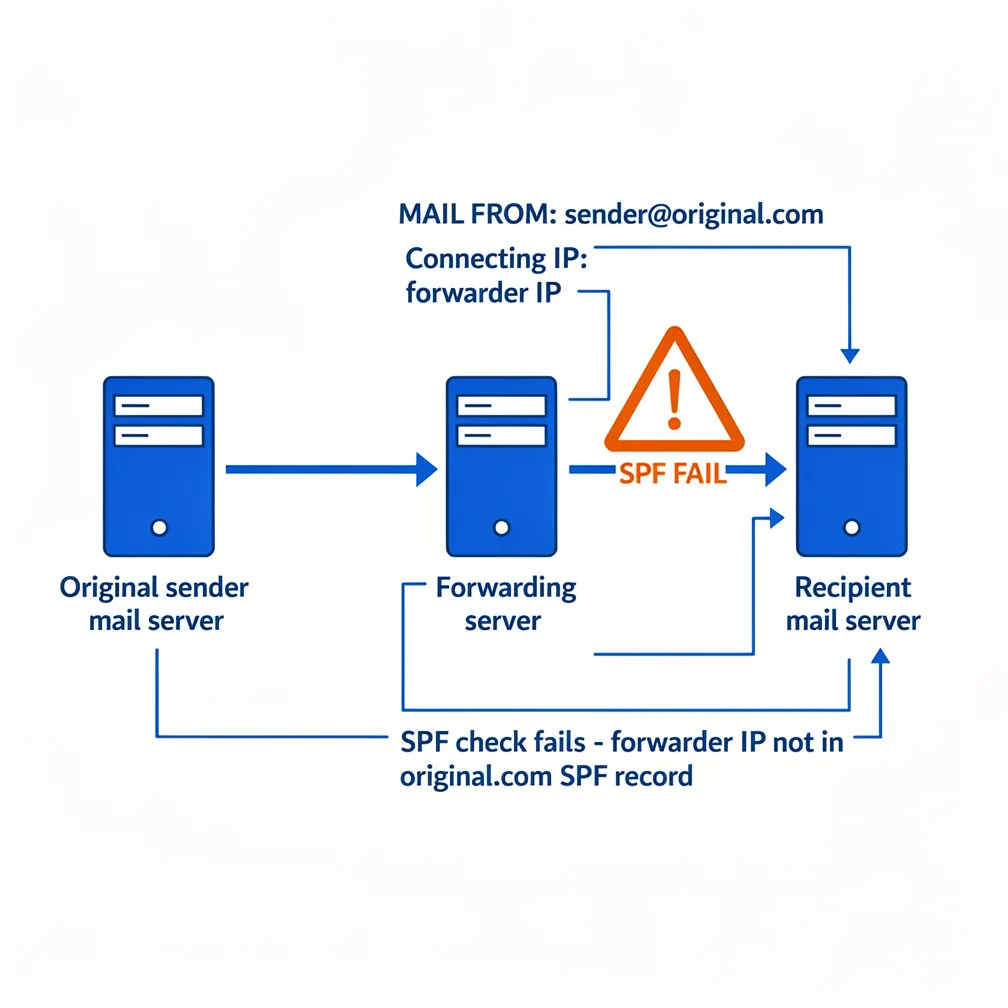
In a typical forwarding scenario, the process unfolds as follows: The original sender transmits a message with their domain in the MAIL FROM envelope address. When the message reaches the forwarding server, that server accepts the message and then initiates a new SMTP connection to the final destination. Critically, the MAIL FROM envelope address typically remains unchanged—it still contains the original sender’s domain.
However, the connecting IP address has now changed to the forwarder’s IP address. When the final destination server performs SPF validation, it queries the SPF record for the domain in the MAIL FROM address (the original sender’s domain) and checks whether the connecting IP (the forwarder’s IP) is authorized. Since the forwarder’s IP is not listed in the original sender’s SPF record, the SPF check fails with a result of “fail” or “softfail.”
This failure occurs regardless of whether the original message passed SPF validation at the forwarding server. Each hop in the email path performs independent SPF validation, and forwarding breaks the chain of trust that SPF relies upon.
The email forwarding SPF problem affects numerous common email scenarios that organizations rely on daily. University alumni forwarding services, where graduates maintain @university.edu addresses that forward to personal accounts, frequently trigger SPF failures. Corporate forwarding rules that redirect messages from one domain to another encounter identical issues.
Traditional Unix-style .forward files, which have been used for decades to redirect email, now cause authentication problems in the modern email landscape. Mailing list software like Mailman and services like Google Groups that redistribute messages to subscribers also trigger SPF failures because the list server forwards messages while preserving the original sender’s address.
These SPF failures have cascading effects on DMARC (Domain-based Message Authentication, Reporting, and Conformance) alignment. DMARC requires either SPF or DKIM to pass and align with the header From domain. When forwarding breaks SPF alignment, the message must rely solely on DKIM to pass DMARC. If DKIM also fails—perhaps because the forwarder modified the message content—the entire DMARC check fails, potentially resulting in message rejection.
Sender Rewriting Scheme (SRS) provides a technical solution to the SPF forwarding problem by rewriting the envelope sender address during forwarding. Instead of preserving the original MAIL FROM address, SRS rewrites it to use the forwarder’s domain, allowing SPF validation to succeed against the forwarder’s SPF record.
When a forwarding server implements SRS, it transforms the original envelope sender into a specially formatted address that encodes the original sender information. SRS addresses use prefixes like SRS0 and SRS1 to indicate the rewriting level. An SRS0 address is created on the first rewrite and includes a timestamp, hash for validation, the original domain, and the original local part. If the message is forwarded again, an SRS1 address is created to prevent the address from growing indefinitely.
For example, an original address like [email protected] might be rewritten to [email protected]. The receiving server now validates SPF against forwarder.com’s SPF record, which includes the forwarder’s IP address, allowing the check to pass.
SRS also handles bounce messages through reverse path processing. When a bounced message returns to the SRS address, the forwarding server decodes the SRS address, validates the hash to prevent abuse, and forwards the bounce to the original sender. This maintains proper bounce handling while solving SPF validation issues.
Beyond SRS, several alternative approaches address forwarding authentication challenges. Authenticated Received Chain (ARC), defined in RFC 8617, preserves authentication results as messages pass through intermediaries. Each forwarding server adds ARC headers that cryptographically seal the authentication results from the previous hop, allowing the final destination to see that the message originally passed authentication even if the current SPF check fails.
DKIM (DomainKeys Identified Mail) proves more resilient to forwarding than SPF because DKIM signatures survive forwarding as long as the signed portions of the message remain unmodified. The signature validates based on cryptographic verification rather than IP address, making it forwarding-resistant. Organizations should always implement DKIM as a backup authentication method when SPF fails due to forwarding.
Some organizations maintain trusted forwarder lists, configuring their mail servers to accept SPF failures from known legitimate forwarding services. While this approach works for predictable forwarding sources, it doesn’t scale well and requires ongoing maintenance.
Proper DMARC policy configuration provides another layer of protection. By setting DMARC to rely on either SPF or DKIM passing (rather than requiring both), organizations ensure that messages forwarded with intact DKIM signatures still pass DMARC even when SPF fails. Starting with a DMARC policy of “p=none” during monitoring phases allows organizations to identify forwarding patterns before enforcing stricter policies.
Email administrators should implement several best practices to minimize authentication failures in forwarding scenarios:
The SPF forwarding problem represents a fundamental tension between email authentication and legitimate email forwarding practices. While SPF’s IP-based validation model provides strong protection against spoofing in direct delivery scenarios, it inherently conflicts with forwarding’s architecture. Understanding why SPF fail forwarded email situations occur empowers email administrators to implement appropriate solutions.
By combining DKIM for forwarding-resistant authentication, SRS for envelope rewriting, ARC for authentication chain preservation, and thoughtful DMARC policies, organizations can maintain strong authentication while accommodating legitimate forwarding use cases. At Email Delivery Pro, we help organizations navigate these complex authentication challenges to ensure reliable email delivery across all scenarios.