Email remains the primary attack vector for cybercriminals, with threats ranging from phishing and malware to business email compromise and data exfiltration. As the first line of defense in your email infrastructure, properly configured email gateway security determines whether sophisticated threats reach your users or get blocked at the perimeter. This comprehensive guide walks IT security teams through the critical components of secure email gateway deployment and management.
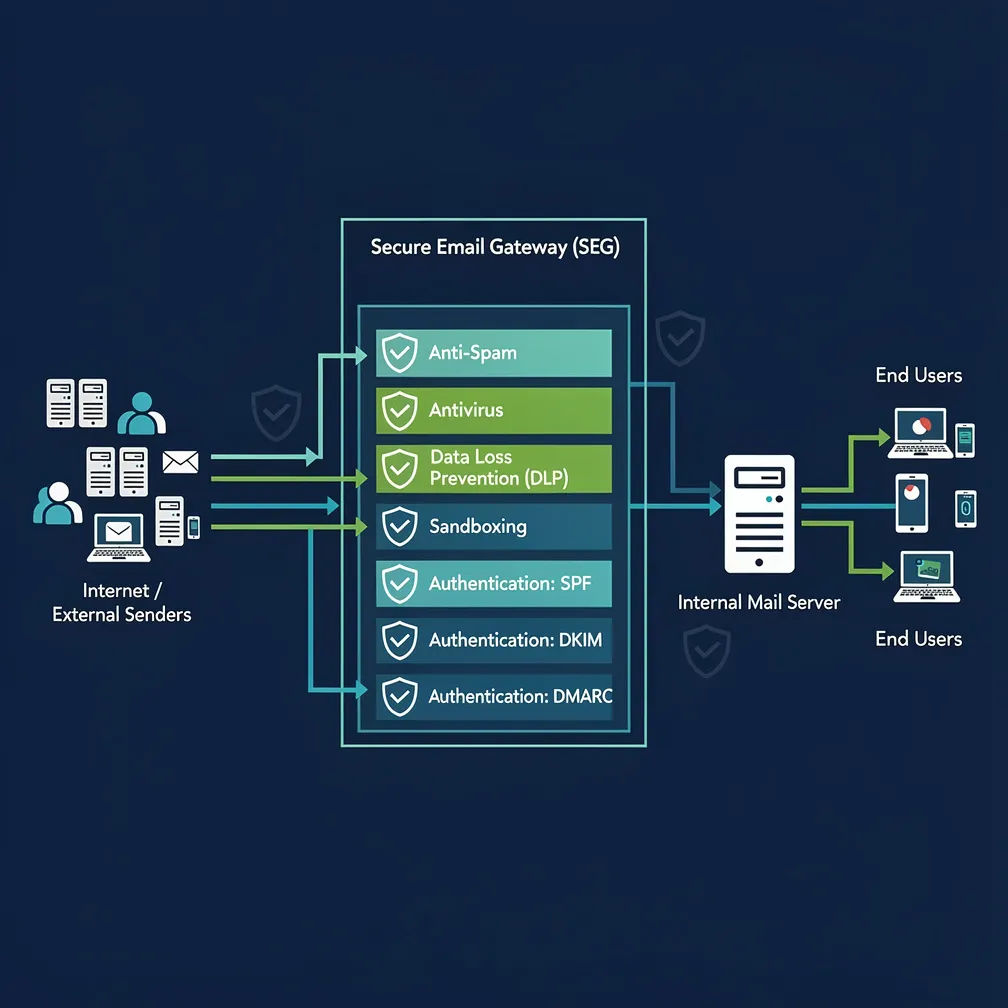
An email gateway functions as a specialized mail transfer agent (MTA) positioned between the internet and your internal mail servers. It operates as an inspection layer that processes all inbound and outbound email traffic before messages reach their final destination. When external mail servers query your domain’s MX records, they’re directed to your email gateway rather than directly to your Exchange, Office 365, or other mail servers.
The gateway acts as an SMTP relay, accepting connections from external sources, performing comprehensive security checks, and then forwarding legitimate messages to your internal mail infrastructure. This architectural positioning enables centralized policy enforcement and threat inspection without requiring modifications to your existing mail server configuration. By serving as a dedicated relay point, the gateway shields your mail servers from direct internet exposure while providing a consolidated point for security policy application.
Modern secure email gateway solutions provide multiple layers of protection that work in concert to identify and neutralize threats:
Email security gateway best practices require robust authentication mechanisms to verify both message sources and destinations. TLS enforcement ensures encrypted transport, with STARTTLS negotiation automatically upgrading plaintext SMTP connections to encrypted sessions. Certificate validation confirms the identity of connecting mail servers, preventing man-in-the-middle attacks.
For business partner communications requiring guaranteed encryption, mutual TLS (mTLS) establishes bidirectional certificate authentication where both parties verify each other’s identity. SMTP AUTH requirements ensure that users sending outbound mail through the gateway authenticate with valid credentials before message acceptance.
IP-based access controls restrict which networks can relay mail through your gateway, preventing unauthorized use as an open relay. Sender verification mechanisms, including reverse DNS lookups and HELO/EHLO validation, confirm that connecting servers match their claimed identities.
Email gateway security relies heavily on authentication standards to validate message legitimacy. For inbound mail, gateways perform SPF checks by querying the sender’s DNS records to verify that the connecting IP address is authorized to send mail for the claimed domain. This prevents basic domain spoofing attempts.
Outbound messages get signed with DKIM cryptographic signatures, allowing recipient servers to verify that messages weren’t altered in transit and originated from your infrastructure. The gateway must properly sign messages while preserving existing signatures when forwarding.
DMARC policy enforcement represents the most critical authentication layer. Gateways check whether messages pass SPF or DKIM authentication and whether the authenticated domain aligns with the From header. When alignment fails, the gateway applies the domain owner’s published DMARC policy—either monitoring, quarantining, or rejecting the message. Properly configured gateways generate aggregate reports detailing authentication results and send them to domain owners, providing visibility into authentication failures and potential spoofing attempts.
Maintaining authentication through relay chains presents technical challenges. Gateways must preserve SPF and DKIM results when forwarding messages internally, typically through Authentication-Results headers, ensuring that downstream security layers can make informed decisions based on perimeter authentication checks.
Effective policy configuration requires separating inbound and outbound policies, as they serve fundamentally different security objectives. Inbound policies focus on threat prevention, while outbound policies emphasize DLP and reputation protection.
Critical policy decisions include whether to quarantine suspicious messages for administrator review or reject them outright. Quarantine allows recovery of false positives but requires administrative overhead. Content filtering rules examine message components against regular expressions and keyword lists, identifying sensitive data or policy violations.
Header manipulation capabilities enable adding authentication results, classification tags, or routing directives to messages as they pass through the gateway. Routing rules direct messages to specific mail servers based on recipient domain, message characteristics, or policy requirements.
Exception handling provides mechanisms to bypass normal policy for trusted partners or specific scenarios. Policy inheritance and override hierarchies determine precedence when multiple rules match a single message, typically flowing from global defaults to domain-specific policies to individual user exceptions.
Modern secure email gateway solutions employ sophisticated detection mechanisms beyond traditional signature-based approaches. Machine learning classifiers analyze message characteristics, sender behavior, and content patterns to identify previously unknown threats. These models continuously adapt to emerging attack techniques.
Reputation databases aggregate threat intelligence from global sources, providing real-time verdicts on sender IPs, domains, and URLs. Heuristic analysis examines message structure and content for suspicious patterns indicative of phishing or social engineering attempts.
Behavioral sandboxing executes attachments in isolated virtual environments, observing their actions to detect malicious behavior that static analysis might miss. This provides protection against zero-day exploits and polymorphic malware.
Impersonation detection identifies attempts to mimic executive email addresses or trusted partners through display name spoofing, homoglyph substitution (using visually similar characters from different alphabets), or cousin domains. These techniques target the human element that traditional authentication mechanisms cannot fully protect against.
Organizations face critical architectural decisions when implementing email gateway security. On-premise secure email gateways provide maximum control and data sovereignty, with all inspection occurring within your infrastructure. This model suits organizations with compliance requirements prohibiting external data processing but requires hardware investment and ongoing maintenance.
Cloud SEG solutions position the inspection layer in the vendor’s infrastructure, with MX records pointing to cloud-hosted gateways that forward clean mail to your mail servers. This approach offers rapid deployment, automatic scaling, and reduced infrastructure burden. Latency considerations become important, as messages traverse additional network hops.
API-based security represents an emerging model, particularly for Microsoft 365 and Google Workspace deployments. These solutions integrate directly with cloud email platforms through APIs rather than acting as SMTP relays, enabling inline inspection without routing changes. This architecture minimizes latency while providing comprehensive protection.
Hybrid architectures combine multiple approaches, using on-premise gateways for internal mail flow while leveraging cloud services for external threat intelligence and sandboxing. Integration patterns for Microsoft 365 and Google Workspace vary, with some organizations using native platform security supplemented by third-party gateways, while others replace platform security entirely with specialized solutions.
Implementing defense-in-depth layering ensures that no single point of failure compromises your email security posture. Deploy multiple detection mechanisms and validation layers, recognizing that determined attackers may bypass individual controls.
Regular policy audits identify outdated rules, overly permissive exceptions, and gaps in coverage. As business requirements and threat landscapes evolve, policies must adapt accordingly. Log retention and SIEM integration provide visibility into security events and enable forensic investigation of incidents.
Failover and redundancy configurations ensure email continuity during gateway failures. Deploy multiple gateway instances with load balancing and automatic failover mechanisms. Firmware updates and security patches must be applied promptly to address vulnerabilities, following a testing protocol that validates functionality before production deployment.
Configuration backup procedures enable rapid recovery from misconfigurations or system failures. Implement change management processes requiring documentation, approval, and testing before policy modifications reach production. Establish monitoring and alerting thresholds that notify administrators of anomalous traffic patterns, policy violations, or system performance degradation.
Email gateway security forms the foundation of organizational email protection, but configuration complexity means many deployments fail to leverage available capabilities fully. By implementing comprehensive authentication protocols, integrating with modern standards like DMARC, deploying advanced threat detection, and following operational best practices, organizations can significantly reduce email-borne risk. For expert guidance on evaluating and comparing email security solutions, explore our detailed platform comparisons to find the right fit for your security requirements.