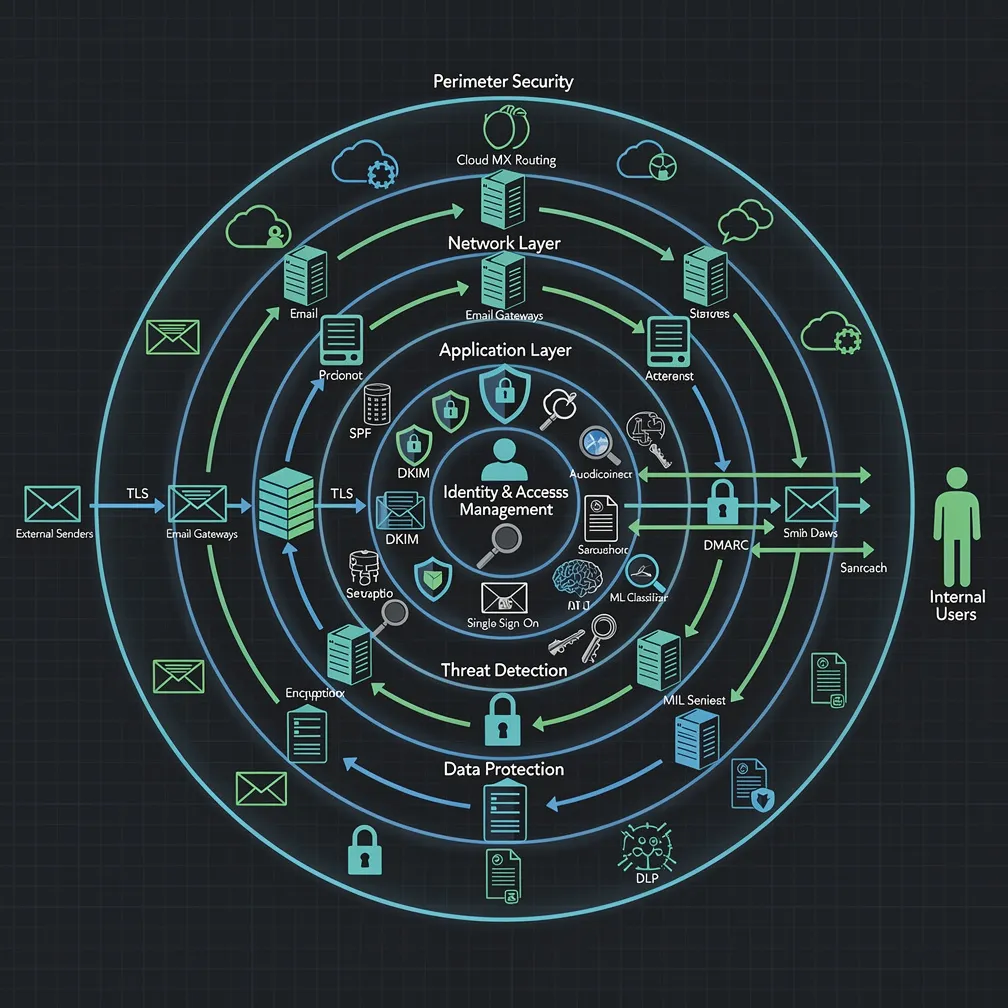
Email remains the primary attack vector for enterprise breaches, making robust email security architecture not just a technical requirement but a business imperative. Security architects face the challenge of designing systems that protect against evolving threats while maintaining operational efficiency and user experience. Building enterprise-grade email security architecture requires a systematic approach that balances multiple security principles, integrates diverse technologies, and adapts to hybrid cloud environments.
Effective email security architecture begins with foundational principles that guide every design decision. Defense-in-depth ensures no single control failure compromises the entire system, while zero trust mandates verification at every stage regardless of network position. The principle of least privilege restricts access rights to the minimum necessary for each function, complemented by separation of duties that prevents any individual from controlling critical security functions end-to-end.
Modern secure email architecture must incorporate fail-secure defaults that maintain security posture even during component failures. Security by design embeds protection mechanisms from the initial architecture phase rather than retrofitting them later. Comprehensive threat modeling identifies potential attack vectors specific to your email infrastructure, enabling risk-based layering that allocates resources proportionally to actual threats. Maintaining architectural decision records for email systems creates an audit trail explaining why specific security controls were implemented, facilitating future reviews and compliance documentation.
Enterprise email security design demands multiple defensive layers working in concert. The perimeter layer filters traffic at network boundaries, blocking malicious connections before they reach mail servers. The network layer implements segmentation and traffic inspection, isolating email infrastructure from other systems. The application layer enforces protocol-level security, validating SMTP transactions and message structures.
The data layer protects message content through encryption and classification, while the user layer addresses human factors through authentication and awareness. The monitoring layer provides visibility across all other layers, detecting anomalies and coordinating responses. Understanding how layers interact prevents gaps where threats slip between controls. Building redundancy between layers ensures that if one control fails, others compensate. Designing for graceful degradation maintains core security functions even when advanced features fail. Creating layer-specific controls mapping documents which threats each layer addresses, identifying coverage gaps and redundancies.
Authentication forms the cornerstone of email security architecture. SPF, DKIM, and DMARC provide foundational sender authentication, verifying message origins and preventing domain spoofing. Authenticated Received Chain (ARC) preserves authentication results through forwarding chains, solving the legitimate forwarding problem that breaks SPF alignment.
Brand Indicators for Message Identification (BIMI) extends authentication with visual brand verification, increasing user confidence in legitimate messages. MTA-STS enforces transport security policies, preventing downgrade attacks during message transmission. DANE/TLSA provides certificate pinning through DNSSEC, adding cryptographic assurance to server identity.
Certificate-based sender identity offers stronger authentication for high-value communications. Multi-factor authentication for mail access protects user accounts from credential compromise. OAuth 2.0 for application access eliminates password sharing for third-party integrations. Conditional access policies adapt authentication requirements based on risk factors like location, device posture, and user behavior.
Modern threats demand sophisticated detection capabilities. Anti-spam engines filter bulk unwanted messages using reputation systems and content analysis. Antivirus scanning detects known malware signatures in attachments and embedded content. Sandboxing for attachment detonation executes suspicious files in isolated environments, identifying zero-day threats through behavioral analysis.
URL rewriting and time-of-click analysis protect against links that become malicious after initial delivery. Impersonation detection identifies display name spoofing and lookalike domains targeting executives. Business email compromise detection analyzes communication patterns to flag unusual requests, particularly financial transactions. Machine learning classifiers adapt to emerging threats faster than signature-based approaches. Threat intelligence feeds provide real-time information about active campaigns and indicators of compromise. Content disarm and reconstruction removes potentially malicious elements while preserving document functionality. Post-delivery remediation automatically removes messages discovered as threats after reaching mailboxes.
Protecting message confidentiality requires comprehensive encryption strategies. TLS 1.3 enforcement ensures transport security using modern cryptographic protocols. Organizations must choose between opportunistic encryption, which uses TLS when available, and mandatory encryption, which rejects unencrypted connections.
S/MIME for end-to-end encryption protects message content from sender to recipient, independent of transport security. PGP/GPG alternatives offer open-standard encryption options, though with greater complexity. Information rights management extends protection beyond delivery, controlling how recipients use messages. Data loss prevention integration prevents sensitive information from leaving the organization through email. Classification-based encryption policies automatically apply appropriate protection based on content sensitivity. Robust key management architecture secures cryptographic materials throughout their lifecycle. Certificate lifecycle automation prevents expiration-related outages and security gaps.
Controlling who accesses email systems and data requires sophisticated identity management. Role-based access control grants permissions based on job functions rather than individual assignments. Privileged access management for mail admins protects highly sensitive administrative functions through additional controls and monitoring.
Service account governance manages non-human identities used by applications and automation. API access controls secure programmatic access to email data and functions. Mailbox delegation policies govern when users can access others’ mailboxes, balancing operational needs with privacy. Shared mailbox security addresses risks from accounts accessed by multiple users. Guest and external access policies control collaboration with partners while protecting internal resources. Just-in-time access provisioning grants temporary elevated permissions only when needed. Identity federation for hybrid environments provides seamless authentication across on-premise and cloud systems.
Platform choice fundamentally shapes email security architecture. Microsoft 365 security architecture provides integrated protection through Exchange Online Protection, Defender for Office 365, and Azure Active Directory. Google Workspace security model offers similar integrated capabilities with different implementation approaches.
Hybrid deployment patterns combine cloud and on-premise systems, requiring careful security integration. API-based security vs gateway-based approaches represent fundamentally different architectural models—APIs provide deeper integration while gateways offer platform independence. CASB integration extends security policies across multiple cloud services. Organizations must decide between cloud-native security features and bolt-on third-party solutions, each offering distinct advantages.
Understanding the shared responsibility model clarifies which security aspects the provider manages versus customer obligations. Data residency and sovereignty requirements may mandate specific deployment architectures. Multi-cloud email considerations address organizations using multiple platforms simultaneously.
Security architecture must maintain protection even during failures and attacks. High availability patterns eliminate single points of failure through redundancy and load distribution. Failover and disaster recovery plans ensure security functions continue during outages. Geographic redundancy protects against regional failures and enables global performance.
Circuit breaker patterns for security services prevent cascading failures when security components become unavailable. Graceful degradation maintains core protections when advanced features fail. Capacity planning for security processing ensures systems handle peak loads and attack traffic without performance degradation.
Change management for security policies prevents misconfigurations that create vulnerabilities or outages. Continuous validation and testing verifies that security controls function as designed. Establishing an architecture review cadence ensures designs evolve with changing threats and business requirements.
Building enterprise-grade email security architecture requires balancing technical sophistication with operational reality. Security architects must integrate diverse technologies into cohesive systems that protect against current threats while adapting to future challenges. By applying sound architectural principles, implementing defense-in-depth, and designing for resilience, organizations create email security architectures that protect their most critical communication channel while enabling business productivity.