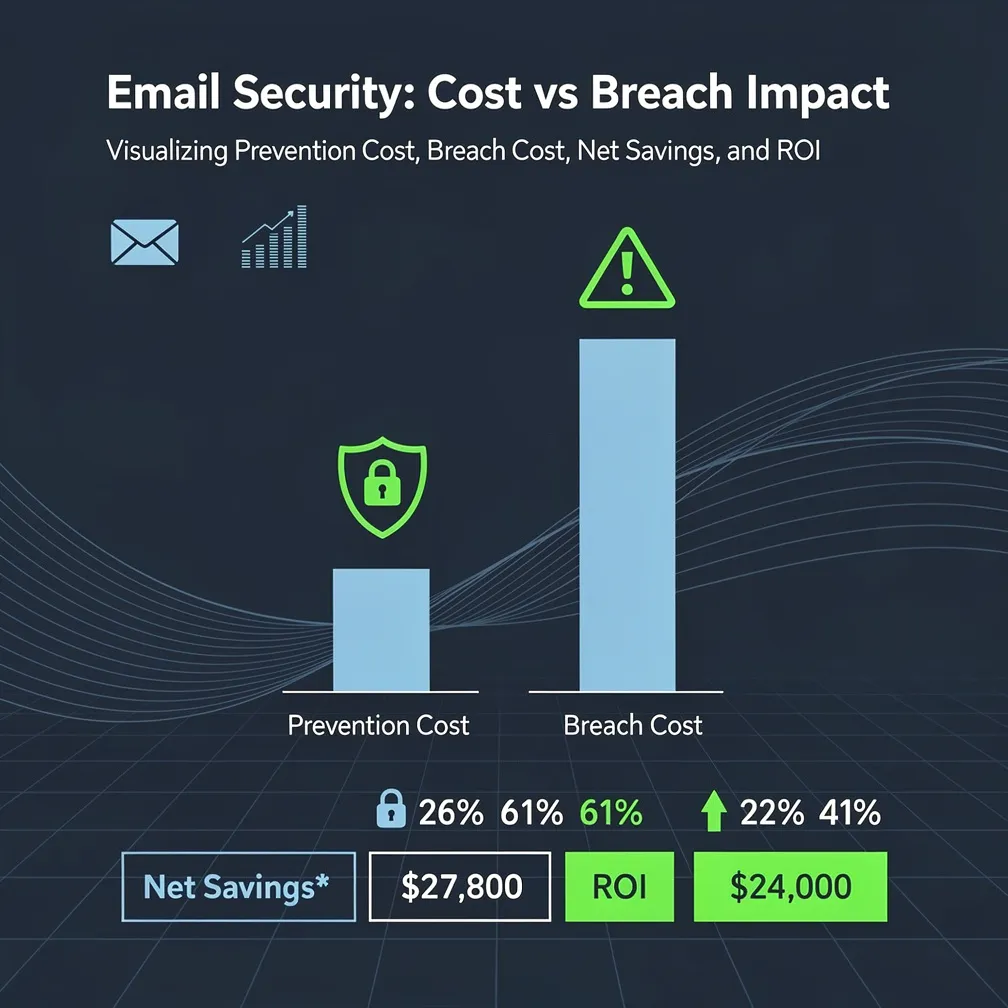
When executives evaluate cybersecurity investments, email security often competes with numerous other priorities for limited budget dollars. Yet email remains the primary attack vector for the majority of successful breaches. The challenge isn’t whether to invest in email protection—it’s demonstrating the email security ROI in financial terms that resonate with decision-makers. This analysis provides CFOs, CISOs, and executives with a framework for quantifying the email security cost benefit and building a compelling business case for protection investments.
Understanding breach costs requires examining both direct and indirect financial impacts. Direct costs include immediate, quantifiable expenses that appear on balance sheets, while indirect costs represent longer-term value erosion that can exceed direct losses by substantial margins.
Direct breach costs typically encompass:
Indirect costs often prove more substantial:
Industry benchmarks show breach costs vary significantly by organization size, industry sector, and breach severity, with per-record costs ranging from nominal amounts for low-sensitivity data to substantial sums for regulated information. Organizations in healthcare, financial services, and professional services typically experience costs at the higher end of these ranges.
Effective email security investment decisions require quantifying organizational risk exposure. This process involves several analytical components that transform abstract threats into concrete financial projections.
Threat frequency assessment examines historical attack patterns against your organization and industry peers. Document phishing attempts, business email compromise incidents, malware delivery attempts, and account takeover events to establish baseline threat levels.
Exposure calculation multiplies threat frequency by organizational vulnerability factors including user count, email volume, data sensitivity, brand visibility, and existing security control effectiveness. Organizations with larger attack surfaces and higher-value targets face proportionally greater exposure.
Probability modeling applies statistical methods to estimate breach likelihood across different timeframes. Rather than predicting specific incidents, probability models provide ranges of expected outcomes that support risk-adjusted decision-making.
Asset valuation methodology identifies and quantifies the value of assets email security protects: intellectual property, customer data, financial information, operational systems, and brand reputation. This valuation establishes the potential loss magnitude for risk calculations.
Risk scoring frameworks combine probability and impact assessments into standardized metrics that enable comparison across different risk categories and support portfolio-level security investment optimization.
Comprehensive cost analysis examines all investment components, not merely licensing fees. Understanding total cost of ownership enables accurate ROI calculation and prevents budget surprises.
Licensing models vary by vendor and typically price per user, per mailbox, or by email volume. Enterprise agreements may offer volume discounts, while cloud-based solutions often employ subscription pricing with annual or multi-year commitments.
Implementation costs include professional services for deployment, configuration, policy development, and integration with existing infrastructure. Organizations should budget for both vendor services and internal resource allocation during implementation phases.
Ongoing management requires dedicated security staff time for policy administration, alert investigation, threat hunting, and system optimization. Factor both direct labor costs and opportunity costs of staff allocation.
Training expenses encompass both technical training for security teams and security awareness programs for end users. Effective email security requires human and technical controls working in concert.
Integration expenses account for connecting email security platforms with SIEM systems, threat intelligence feeds, identity management, and incident response workflows. Deep integration maximizes security value but requires upfront investment.
Total cost of ownership calculations aggregate all expense categories across a multi-year timeframe, typically three to five years, providing realistic investment figures for ROI analysis.
The fundamental email security ROI formula calculates return as: (Avoided Losses – Total Investment) / Total Investment × 100. This percentage represents the return generated per dollar invested in email protection.
Avoided losses equal the expected annual loss from email-based threats without additional security controls, calculated by multiplying breach probability by average breach cost, then multiplying by the reduction percentage the security solution provides.
Payback period indicates how quickly the investment recovers its cost through avoided losses and efficiency gains. Shorter payback periods strengthen business cases, particularly in organizations with conservative capital allocation approaches.
Net present value approach discounts future benefits to current value, accounting for the time value of money. NPV analysis proves particularly valuable for multi-year investments where benefits accumulate over extended periods.
Sensitivity analysis tests ROI calculations across different assumption scenarios, identifying which variables most significantly impact returns. This analysis demonstrates ROI resilience and highlights assumptions requiring greatest confidence.
Scenario modeling develops multiple cases—conservative, expected, and optimistic—showing ROI ranges rather than single-point estimates. This approach acknowledges inherent uncertainty while providing decision-makers with bounded expectations.
The primary value driver for email security investments is preventing incidents that would otherwise occur. Quantifying this prevention value requires estimating both incident frequency and per-incident costs.
Incidents prevented per year estimates derive from threat intelligence showing attack frequency combined with security control effectiveness ratings. Organizations typically prevent numerous low-severity incidents and occasional high-severity breaches.
Average incident cost avoidance weights different incident types by their respective costs and prevention probabilities. Business email compromise, ransomware, and data exfiltration incidents each carry distinct cost profiles.
Cascade effect prevention accounts for incidents that, once successful, enable subsequent attacks. Preventing initial compromise eliminates entire attack chains, multiplying prevention value.
Insurance premium reduction often follows demonstrable security improvements. Insurers increasingly require specific email security controls and reward comprehensive protection with lower premiums.
Regulatory penalty avoidance proves particularly valuable in highly regulated industries where data protection failures trigger substantial fines and enforcement actions.
Beyond breach prevention, email security delivers measurable productivity improvements that contribute to overall email security cost benefit calculations.
Reduced spam handling time eliminates minutes daily per employee spent identifying and deleting unwanted messages. Aggregated across the organization, these minutes represent substantial labor cost savings.
Fewer account lockouts result from preventing credential phishing, reducing password reset requests and associated helpdesk burden while eliminating employee downtime.
Less IT helpdesk burden follows from automated threat remediation and reduced user-reported security concerns, freeing technical staff for strategic initiatives rather than reactive incident handling.
Faster email processing occurs when employees trust their inbox security, eliminating excessive caution and verification steps that slow communication.
Reduced false positive management from advanced security solutions with high accuracy decreases time spent investigating and releasing legitimate messages incorrectly quarantined.
Employee confidence improvement enables more effective email use for business purposes when users trust security controls protect them from threats.
Regulatory compliance represents a significant cost center that email security directly impacts through multiple mechanisms.
Regulatory fine prevention addresses requirements across frameworks including GDPR, HIPAA, PCI DSS, and industry-specific regulations mandating email protection controls. Non-compliance penalties often exceed security investment costs by orders of magnitude.
Audit preparation efficiency improves when comprehensive email security provides automated documentation of controls, policies, and incident response capabilities that auditors require.
Documentation automation within security platforms generates compliance reports, policy enforcement logs, and security metrics that manual processes would require substantial labor to produce.
Cross-framework compliance leverage occurs when email security controls satisfy requirements across multiple regulatory frameworks simultaneously, reducing redundant compliance investments.
Legal defense cost reduction follows from demonstrable due diligence in implementing reasonable security measures, potentially limiting liability in breach-related litigation.
Translating analysis into executive action requires structured communication that addresses stakeholder priorities and decision-making processes.
Executive summary structure should lead with financial metrics—ROI percentage, payback period, and net benefit—followed by risk reduction quantification and strategic alignment with organizational objectives. Limit executive summaries to one page with supporting detail in appendices.
Risk-adjusted metrics present multiple scenarios showing ROI ranges rather than single-point estimates, acknowledging uncertainty while demonstrating positive returns across realistic assumption sets.
Comparison frameworks benchmark proposed investments against industry peers, alternative security investments, and the cost of inadequate protection. Our comparison resources help organizations evaluate different email security approaches and vendors.
Implementation roadmap outlines deployment phases, resource requirements, and milestone timelines, demonstrating that the organization can execute the investment effectively.
Stakeholder communication strategy tailors messaging for different audiences: financial metrics for CFOs, risk reduction for CISOs, operational continuity for COOs, and strategic advantage for CEOs.
Ongoing measurement plan establishes metrics for tracking actual ROI against projections, enabling continuous optimization and supporting future security investment requests with demonstrated returns.
Email security investment decisions ultimately balance quantifiable financial returns against less tangible but equally important factors including risk tolerance, regulatory obligations, and competitive positioning. By systematically quantifying costs, benefits, and risks, organizations transform email security from a discretionary expense into a strategic investment with measurable returns. The business case for email protection becomes compelling when executives see clear financial justification supported by rigorous analysis and realistic projections.