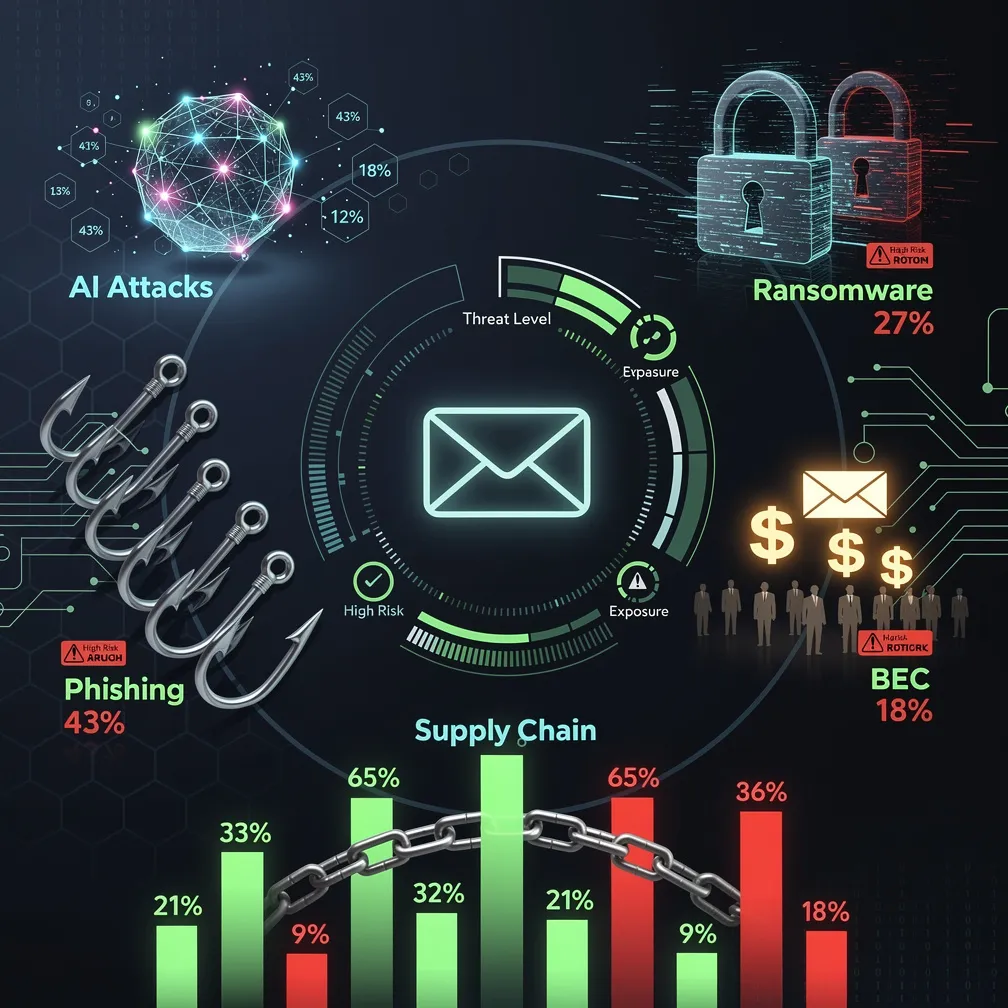
Email remains the primary attack vector for cybercriminals, and as we move through 2026, the sophistication and variety of email security threats continue to outpace traditional defensive measures. For CISOs and security professionals, understanding this evolving landscape isn’t optional—it’s critical to organizational survival. The convergence of artificial intelligence, social engineering refinement, and supply chain complexity has created a threat environment that demands constant vigilance and adaptive defense strategies.
Email security threats have evolved from simple spam campaigns to sophisticated, multi-vector attacks that exploit human psychology, technical vulnerabilities, and organizational trust relationships simultaneously. Organizations face thousands of malicious emails daily, with security teams struggling to distinguish legitimate communications from carefully crafted threats. The attack surface has expanded exponentially as remote work, cloud adoption, and digital transformation initiatives have increased email dependency across enterprises.
The fundamental challenge facing security teams is that email remains both essential for business operations and inherently vulnerable to exploitation. Attackers leverage this dependency, knowing that blocking all suspicious emails creates operational friction, while allowing too much through invites compromise. This tension defines the modern email security paradigm, where cyber threats email pose existential risks to organizations of all sizes.
Phishing has transcended its origins as easily identifiable scam emails. Today’s threat actors employ polymorphic phishing techniques that dynamically alter email content, sender information, and embedded links to evade signature-based detection systems. Each recipient receives a subtly different version of the attack, making traditional pattern recognition ineffective.
QR code phishing—or “quishing”—has emerged as a particularly insidious technique. By embedding malicious URLs within QR codes, attackers bypass text-based URL scanners and exploit the trust users place in these now-ubiquitous codes. Security tools struggle to analyze image-based threats at scale, creating a detection gap that sophisticated actors readily exploit.
Multi-stage attacks have become standard practice among advanced threat actors. Initial emails contain no malicious payload, instead establishing trust or delivering benign content that passes security filters. Subsequent communications then exploit this established trust to deliver credential harvesting pages or malware. This patience-driven approach defeats point-in-time security analysis, requiring behavioral analytics and extended monitoring to detect.
Credential harvesting has evolved beyond simple fake login pages. Modern campaigns employ real-time phishing proxies that sit between victims and legitimate services, capturing credentials and session tokens while providing authentic user experiences. These man-in-the-middle techniques bypass multi-factor authentication by capturing and replaying authentication tokens in real-time.
Business Email Compromise (BEC) attacks have reached unprecedented levels of sophistication. Attackers invest weeks or months researching organizational structures, communication patterns, and business processes before launching targeted campaigns. This reconnaissance enables them to craft emails that perfectly mimic executive communication styles and arrive at moments when urgency overrides caution.
Deepfake technology has introduced a new dimension to BEC threats. Voice synthesis and video manipulation tools enable attackers to impersonate executives with alarming accuracy. Security teams must now consider that voice calls and video conferences—traditionally used to verify suspicious email requests—can themselves be weaponized. The psychological impact of hearing a CEO’s voice or seeing their face requesting urgent wire transfers creates powerful social engineering leverage.
Vendor impersonation schemes exploit the complex web of third-party relationships that characterize modern business operations. Attackers compromise or spoof vendor accounts, then send invoice modifications or payment redirect requests that appear entirely legitimate within established business contexts. The distributed nature of vendor management across organizations creates visibility gaps that BEC actors expertly navigate.
While ransomware has existed for years, email delivery mechanisms continue evolving to defeat defensive measures. Malicious attachments now employ sophisticated evasion techniques, including password-protected archives that security tools cannot inspect without user interaction. Attackers include the password in the email body, training users to bypass security controls themselves.
HTML smuggling represents a particularly challenging threat vector. Malicious code embedded within HTML emails assembles malware components client-side, after passing through email security gateways. This technique exploits the fundamental trust placed in HTML rendering engines and the difficulty of analyzing dynamic code execution at email gateway level.
Initial access brokers have industrialized email-based compromise, selling access to compromised networks as a commodity. These specialized threat actors focus exclusively on gaining initial foothold through email threats 2026, then auction access to ransomware operators and other cybercriminals. This specialization has increased both the volume and sophistication of email-based intrusion attempts.
Generative AI has fundamentally altered the email threat landscape. Large language models enable attackers to create grammatically perfect, contextually appropriate phishing emails at scale, eliminating the linguistic indicators that previously helped identify threats. These AI-generated messages adapt tone, vocabulary, and content to specific industries, roles, and even individual communication styles scraped from public sources.
Automated spear-phishing has reached industrial scale. AI systems analyze social media profiles, corporate websites, and leaked databases to craft personalized attacks for thousands of targets simultaneously. What once required human intelligence and time-intensive research now occurs automatically, democratizing sophisticated attack capabilities.
Adversarial AI techniques specifically target machine learning-based security systems. Attackers use AI to test email variations against detection models, iteratively refining attacks until they evade automated defenses. This creates an arms race where both attackers and defenders employ increasingly sophisticated AI systems, with attackers holding the advantage of initiative.
Supply chain compromise through email represents one of the most challenging threat categories for CISOs. When legitimate vendor accounts are compromised, attackers inherit established trust relationships and whitelisted sender status. Security systems designed to facilitate business communication become attack enablers, as emails from compromised trusted senders bypass scrutiny applied to external communications.
Software update notification spoofing exploits the regular cadence of legitimate update communications. Attackers monitor software vendors’ update schedules and send malicious update notifications timed to coincide with expected legitimate communications. Users conditioned to apply updates promptly become vectors for malware installation.
Partner ecosystem risks multiply as organizations expand their digital integration with suppliers, customers, and service providers. Each connection represents a potential attack path, and email serves as the universal communication medium across these relationships. The distributed nature of ecosystem security creates inconsistent protection levels that sophisticated attackers systematically identify and exploit.
Defending against modern email security threats requires layered, adaptive strategies that combine technology, process, and human elements. Zero trust email architecture forms the foundation, treating every email as potentially malicious regardless of apparent sender or content. This approach eliminates implicit trust and requires continuous verification throughout the email lifecycle.
AI-powered detection systems have become essential for identifying sophisticated threats that evade signature-based tools. Machine learning models analyze behavioral patterns, linguistic anomalies, and contextual inconsistencies that human analysts and traditional tools miss. However, these systems require continuous training and validation to maintain effectiveness against evolving adversarial techniques.
Email authentication protocols—DMARC, SPF, and DKIM—provide critical protection against domain spoofing and impersonation attacks. Proper implementation requires technical precision and ongoing management. Organizations should consult resources like our DMARC policy configuration technical guide to ensure robust authentication deployment that prevents unauthorized use of organizational domains.
Security awareness training must evolve beyond annual compliance exercises to continuous, scenario-based education that reflects current threat techniques. Simulated phishing campaigns should incorporate the sophisticated tactics actually employed by threat actors, including multi-stage attacks, quishing, and AI-generated content. Training effectiveness metrics should focus on behavioral change rather than completion rates.
Incident response capabilities specifically designed for email threats enable rapid containment and remediation. Automated playbooks should address credential compromise, BEC attempts, and ransomware delivery, with clear escalation paths and communication protocols. Regular tabletop exercises testing email-specific scenarios ensure response readiness when actual incidents occur.
The email threat landscape of 2026 presents unprecedented challenges for CISOs and security professionals. The convergence of AI-powered attacks, supply chain complexity, and increasingly sophisticated social engineering demands comprehensive, adaptive defense strategies. Organizations that treat email security as a static problem solved by single-point solutions will find themselves compromised. Success requires continuous evolution of technical controls, process improvements, and human awareness programs that match the pace of attacker innovation. Email Delivery Pro remains committed to helping organizations navigate this complex landscape with solutions that address both current and emerging email security threats.