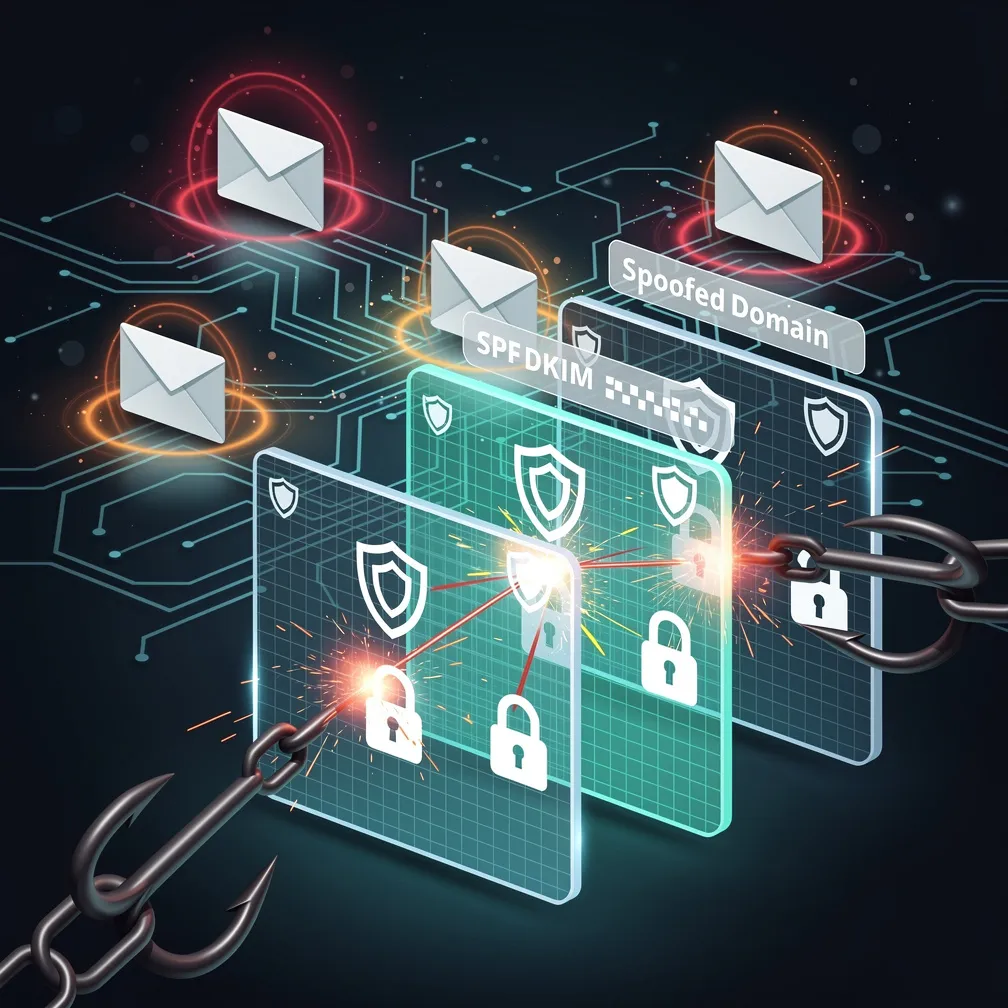
Email remains the primary attack vector for organizations of every size. In 2026, the threat landscape has shifted dramatically — adversaries are leveraging generative AI, automated reconnaissance, and increasingly sophisticated social engineering to bypass traditional email security controls. For CISOs, IT directors, and security teams, understanding these evolving email security threats in 2026 is no longer optional. It is a core operational imperative.
The attacks we face today bear little resemblance to the spray-and-pray campaigns of a decade ago. Threat actors are patient, well-funded, and technically proficient. They study organizational hierarchies, mimic communication patterns, and exploit trust relationships between vendors, partners, and internal teams.
This guide examines the five most critical email security threats confronting organizations in 2026, and details how authentication protocols — SPF, DKIM, and DMARC — serve as the foundational first line of defense against each one.
Business email compromise continues to dominate as the highest-impact email attack category. BEC attacks do not rely on malware payloads or malicious links — they exploit human trust and organizational processes. An attacker impersonates a CEO requesting an urgent wire transfer, a vendor submitting updated payment details, or an HR director requesting employee tax documents.
What makes BEC particularly dangerous in 2026 is the convergence of compromised mailboxes and AI-enhanced social engineering. Attackers gain access to legitimate email accounts through credential stuffing or token theft, study communication patterns for weeks, then insert themselves into active conversation threads at precisely the right moment.
SPF (Sender Policy Framework) restricts which IP addresses can send email on behalf of your domain. When an attacker attempts to spoof your CEO’s email address from an unauthorized server, SPF validation fails at the receiving mail server.
DKIM (DomainKeys Identified Mail) cryptographically signs every outbound message. If an attacker modifies the message body or headers in transit — common in BEC reply-chain attacks — the DKIM signature invalidates, alerting the recipient’s mail server to tampering.
DMARC (Domain-based Message Authentication, Reporting and Conformance) ties SPF and DKIM together with alignment checks and enforcement policies. With a DMARC policy set to p=reject, spoofed messages that fail both SPF and DKIM alignment are blocked before reaching the inbox.
The democratization of large language models has eliminated the traditional tells of phishing emails. Gone are the grammatical errors, awkward phrasing, and generic greetings that trained employees to spot fraudulent messages. AI-generated phishing emails in 2026 are contextually relevant, linguistically flawless, and personalized at scale.
Attackers feed public data — LinkedIn profiles, press releases, regulatory filings, social media activity — into AI models that generate highly targeted phishing campaigns. A single threat actor can now produce thousands of unique, personalized phishing emails that reference real projects, colleagues, and company events.
These campaigns often combine credential harvesting pages with legitimate-looking OAuth consent screens, making even security-aware employees vulnerable when under time pressure.
While SPF, DKIM, and DMARC cannot analyze message content for deceptive intent, they eliminate the most dangerous delivery mechanism: domain impersonation. An AI-generated phishing email is exponentially more effective when it arrives from what appears to be a legitimate internal domain.
DMARC enforcement ensures that phishing emails cannot be sent from your exact domain (yourcompany.com) to your employees or partners. Combined with BIMI (Brand Indicators for Message Identification), authenticated messages display your verified brand logo in supporting mail clients — giving recipients a visual trust indicator that unauthenticated phishing emails cannot replicate.
For email phishing protection at scale, organizations must deploy DMARC at enforcement level across all domains and subdomains — including parked domains that attackers frequently exploit.
Domain spoofing remains one of the most effective attack techniques because it exploits a fundamental limitation of email: the protocol itself does not verify sender identity. Without authentication, any mail server can claim to send email from any domain.
In 2026, attackers have expanded beyond exact-domain spoofing to lookalike domains (homoglyph attacks), subdomain spoofing, and cousin domains. An email from [email protected] or [email protected] can easily deceive recipients scanning their inbox quickly. Combined with valid SSL certificates — now trivially obtained — these lookalike domains host convincing login pages for credential harvesting.
For email spoofing prevention, DMARC is the definitive solution for exact-domain spoofing. When published with p=reject, DMARC instructs receiving mail servers to discard any message that fails authentication checks for your domain. This completely eliminates exact-domain spoofing.
To combat lookalike and cousin domain attacks:
Credential harvesting serves as the precursor to nearly every other attack on this list. Attackers send emails directing recipients to convincing login pages that capture usernames and passwords. In 2026, these campaigns have become remarkably sophisticated — they use adversary-in-the-middle (AiTM) proxies that capture both credentials and session tokens, bypassing multi-factor authentication in real time.
The harvested credentials provide initial access for BEC campaigns, data exfiltration, lateral movement, and ransomware deployment. A single compromised email account can serve as the launchpad for a months-long intrusion.
Authentication protocols reduce credential harvesting exposure in two critical ways:
Outbound protection: DMARC prevents attackers from sending credential harvesting emails that appear to come from your domain — targeting your employees, customers, or partners. When your domain has DMARC at p=reject, fraudulent login page notifications “from” your IT department cannot reach inboxes.
Inbound signal: DMARC forensic reports (ruf) alert your security team when someone attempts to spoof your domain. This provides early warning of credential harvesting campaigns targeting your organization — often before employees report suspicious emails.
Combine authentication protocols with:
Supply chain email attacks represent the most difficult threat to detect because they originate from legitimate, compromised accounts belonging to trusted vendors and partners. An attacker compromises a supplier’s email account, monitors communication patterns, then sends fraudulent invoices or malicious documents from the real, authenticated email address.
Because the sending infrastructure is legitimate — the email passes SPF, DKIM, and DMARC validation — traditional authentication alone cannot block these attacks. This is where layered defense becomes essential.
While authentication protocols cannot prevent abuse of a legitimately compromised account, they provide critical supporting capabilities:
Additional defenses for supply chain email attacks:
Authentication protocols are necessary but not sufficient. They form the foundation layer upon which all other email security controls depend. Without SPF, DKIM, and DMARC at enforcement level, every subsequent security investment — from secure email gateways to AI-powered threat detection — operates with a compromised foundation.
A mature email security posture in 2026 combines authentication with:
Organizations that fail to implement email authentication and layered email security face escalating risk exposure. BEC losses continue to dwarf ransomware payouts. A single successful credential harvesting campaign can lead to data breaches with regulatory, legal, and reputational consequences that extend for years.
The security teams that treat email authentication as a compliance checkbox rather than a security control are the ones that end up in incident response engagements. SPF, DKIM, and DMARC are not aspirational — they are table stakes for any organization that takes its security posture seriously.
Email security threats in 2026 demand proactive, layered defenses built on a foundation of properly configured authentication protocols. The threats will continue to evolve. Your defenses must evolve faster.