Every day, security teams face a persistent threat that exploits one of email’s fundamental vulnerabilities: the ability to forge sender addresses. Email spoofing remains one of the most effective attack vectors in cybercriminals’ arsenals, enabling fraud schemes that cost organizations millions annually. For IT managers and security professionals, understanding how to detect and prevent email spoofing isn’t optional—it’s essential infrastructure protection that safeguards both your organization and the customers who trust your brand.
Email spoofing is the creation of email messages with a forged sender address, making the message appear to originate from someone or somewhere other than the actual source. Attackers manipulate email headers to impersonate trusted entities—executives, business partners, well-known brands, or even internal departments—to deceive recipients into taking harmful actions.
The core concept behind email spoofing exploits a fundamental characteristic of email protocols: the sender address is not inherently verified. Just as someone could write a fake return address on a physical envelope, attackers can specify any “From” address they choose when sending email. This forgery creates a false sense of legitimacy that bypasses recipients’ natural skepticism, making spoofed emails remarkably effective for social engineering attacks.
Understanding what email spoofing is requires recognizing that it’s not hacking in the traditional sense—attackers don’t need to compromise legitimate email accounts. Instead, they leverage protocol weaknesses to create convincing impersonations from their own infrastructure.
The technical mechanics of email spoofing exploit inherent weaknesses in the Simple Mail Transfer Protocol (SMTP), the foundational protocol for email transmission developed in the 1980s before security became a primary concern. SMTP was designed for convenience and interoperability, not authentication, creating vulnerabilities that persist today.
Email messages contain two critical “From” addresses that security teams must understand:
Attackers exploit this distinction by setting a legitimate envelope address (often a disposable domain they control) while forging the header From address to impersonate a trusted entity. Without proper authentication mechanisms, receiving mail servers have no reliable way to verify whether the header From address is legitimate.
The SMTP protocol allows any mail server to connect and claim to send on behalf of any domain. Attackers simply configure their mail servers or use readily available tools to specify arbitrary sender addresses. The lack of built-in authentication means that, by default, there’s no mechanism to validate that the sending server is actually authorized to send email for the claimed domain.
Email spoofing serves as the foundation for some of the most damaging cyberattacks targeting organizations today. The dangers extend far beyond simple nuisance, creating substantial financial, operational, and reputational risks.
Business Email Compromise (BEC) represents one of the most financially devastating spoofing-based attacks. Attackers impersonate executives or financial officers, sending urgent payment requests to accounting departments. These carefully crafted messages exploit organizational hierarchies and create pressure for immediate action, resulting in wire transfers to attacker-controlled accounts.
Credential phishing campaigns use spoofed emails impersonating IT departments, cloud service providers, or business applications to trick users into surrendering login credentials. These attacks often lead to account takeovers that enable broader network compromise.
Malware delivery becomes more effective when messages appear to come from trusted sources. Spoofed emails from colleagues, vendors, or service providers significantly increase the likelihood that recipients will open malicious attachments or click dangerous links.
Brand damage occurs when attackers spoof your organization’s domain to target your customers or partners. These attacks erode trust in your brand, damage business relationships, and can result in customer attrition.
Financial losses accumulate through direct fraud, incident response costs, regulatory penalties, legal liabilities, and the operational disruption that follows successful attacks.
Understanding common attack patterns helps security teams recognize and defend against email spoofing threats:
CEO Fraud: Attackers research organizational structures through LinkedIn and corporate websites, then send spoofed emails from the CEO or CFO to finance personnel requesting urgent wire transfers for confidential acquisitions or time-sensitive payments. The authority of the apparent sender and urgency of the request override normal verification procedures.
Vendor Impersonation: Attackers monitor business relationships and spoof emails from regular vendors requesting updated payment information or sending fraudulent invoices. The familiarity of the sender and routine nature of the request make these attacks particularly effective.
IT Department Spoofing: Messages appearing to come from internal IT support request password resets, credential verification, or software installations. Employees conditioned to comply with IT requests often follow instructions without verification, especially when messages reference legitimate systems or create urgency around security or compliance issues.
Supply Chain Attacks: Attackers spoof trusted partners or service providers to distribute malware or gain access to systems, exploiting the trust inherent in established business relationships.
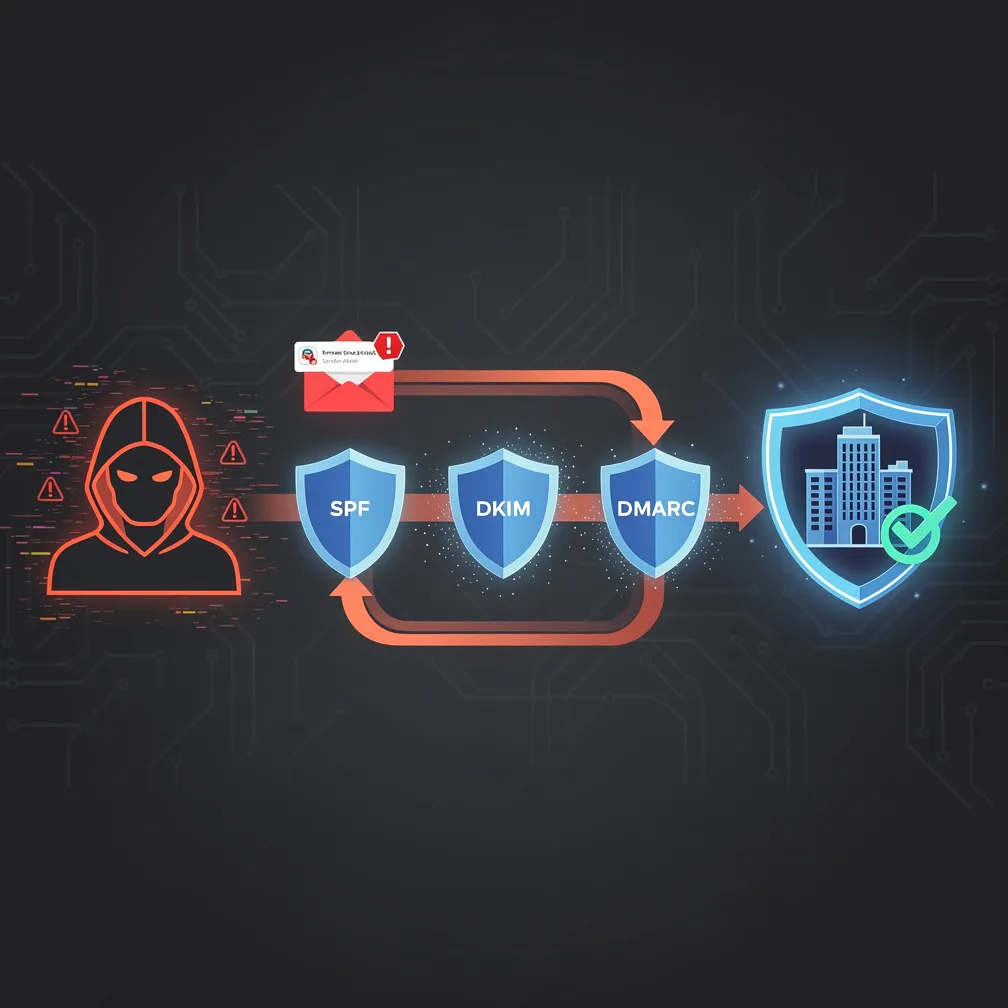
Preventing email spoofing requires implementing three complementary authentication protocols that work together as a comprehensive defense. These technical controls form the foundation of modern email security:
Sender Policy Framework (SPF) allows domain owners to publish DNS records specifying which mail servers are authorized to send email for their domain. Receiving servers check SPF records to verify that incoming messages originate from approved sources. SPF validates the envelope From address, preventing unauthorized servers from sending on behalf of your domain.
DomainKeys Identified Mail (DKIM) adds cryptographic signatures to email messages. The sending server signs outgoing messages with a private key, and receiving servers verify the signature using a public key published in DNS. DKIM proves message integrity and authenticity, confirming that messages haven’t been altered in transit and originated from authorized infrastructure.
Domain-based Message Authentication, Reporting, and Conformance (DMARC) builds upon SPF and DKIM, providing policy enforcement and visibility. DMARC allows domain owners to specify how receiving servers should handle messages that fail authentication checks—monitor, quarantine, or reject. Critically, DMARC requires alignment between the domain in the header From address and the domains authenticated by SPF or DKIM, directly preventing the header forgery that enables spoofing.
Together, these three protocols create a verification framework that prevents email spoofing by ensuring only authorized senders can successfully deliver messages claiming to originate from your domain.
Beyond foundational authentication protocols, security teams should implement additional technologies that enhance spoofing detection and prevention:
Secure Email Gateways (SEGs) provide advanced filtering that examines messages for spoofing indicators beyond standard authentication. These solutions analyze header anomalies, sender reputation, and content characteristics to identify sophisticated attacks.
AI-Based Detection Systems leverage machine learning to identify anomalous sender behavior, unusual communication patterns, and subtle indicators of impersonation attacks. These tools excel at detecting spoofing attempts that pass authentication checks, such as look-alike domains or compromised accounts.
Brand Indicators for Message Identification (BIMI) allows organizations with strong DMARC policies to display verified logos in email clients, providing visual confirmation of message authenticity. This helps recipients quickly identify legitimate messages and recognize potential spoofing attempts.
MTA Strict Transport Security (MTA-STS) enforces encrypted connections between mail servers, preventing downgrade attacks that could facilitate message interception or manipulation.
DMARC Reporting and Analytics Tools process authentication reports to provide visibility into email traffic, identify legitimate senders requiring authorization, and detect spoofing attempts targeting your domain.
Implementing comprehensive email spoofing protection requires a systematic approach combining technical controls with organizational practices:
Email spoofing remains a critical threat that demands comprehensive, layered defenses. While implementing SPF, DKIM, and DMARC provides essential technical protection, preventing email spoofing requires ongoing vigilance, continuous monitoring, and organizational awareness. Security teams must combine authentication protocols, advanced detection technologies, and human-centered controls to create resilient defenses against this persistent threat. At Email Delivery Pro, we understand that protecting your organization from spoofed emails isn’t a one-time project—it’s an ongoing commitment to email security that safeguards your operations, reputation, and stakeholder trust.