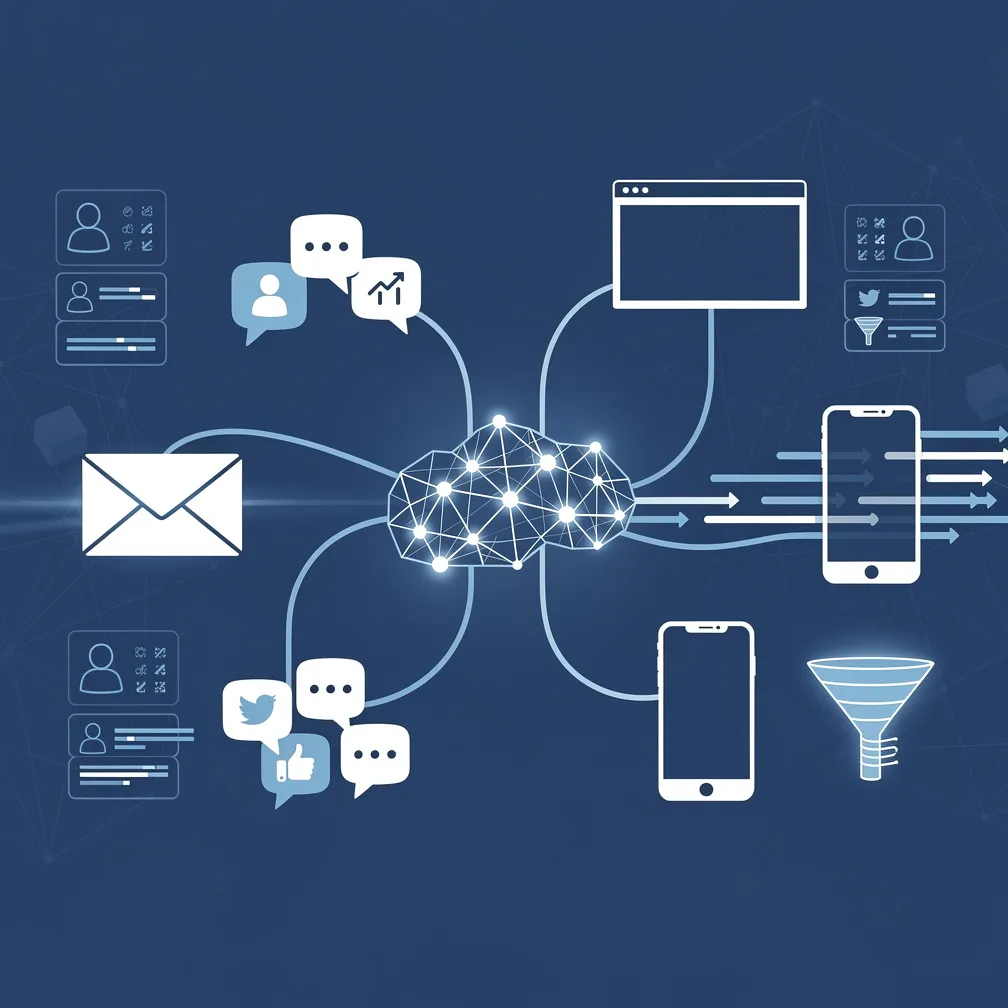
The enterprise marketing landscape of 2026 has fundamentally transformed. CMOs now navigate an environment where artificial intelligence drives personalization at unprecedented scale, privacy regulations reshape data strategies, and the traditional boundaries between brand and performance marketing have dissolved. For enterprise marketing leaders, success hinges not on adopting isolated tactics, but on building integrated systems where reliable infrastructure—particularly email delivery platforms—serves as the connective tissue between strategy and execution. The enterprises thriving in 2026 share a common thread: they’ve moved beyond experimentation to operationalize sophisticated enterprise digital marketing strategies 2026 demands, supported by infrastructure capable of executing at massive scale while maintaining precision and compliance.
Enterprise marketers in 2026 leverage artificial intelligence to deliver personalized experiences across millions of customer touchpoints simultaneously. This isn’t the rudimentary segmentation of previous years—modern AI systems analyze behavioral patterns, purchase history, engagement signals, and contextual data in real-time to generate truly individualized content for each recipient.
The challenge for enterprises isn’t creating personalized content; it’s delivering it reliably at volume. When your marketing automation platform generates dynamic content for seven million email recipients based on 150 different variables, your email delivery infrastructure becomes mission-critical. Email Delivery Pro’s architecture supports this complexity by maintaining deliverability rates even when each message contains unique subject lines, personalized product recommendations, and dynamically generated imagery based on recipient behavior.
Forward-thinking CMOs recognize that AI personalization strategies fail without the infrastructure to execute them. Enterprise marketing trends increasingly prioritize the integration between AI decisioning engines and delivery systems capable of handling the computational and logistical demands of true one-to-one marketing at enterprise scale.
The deprecation of third-party cookies has accelerated enterprise adoption of zero-party data strategies—information customers intentionally and proactively share with brands. Unlike inferred or purchased data, zero-party data provides explicit insights into customer preferences, intentions, and interests.
Email channels have emerged as the primary zero-party data collection mechanism for enterprises. Through sophisticated preference centers, interactive surveys, and progressive profiling techniques embedded within email experiences, marketing leaders build comprehensive customer profiles based on volunteered information. This approach delivers dual benefits: richer data quality and enhanced customer trust.
Implementing effective zero-party data strategies requires email delivery systems that support:
Email Delivery Pro enables enterprises to transform email from a broadcast channel into an interactive data collection platform while maintaining the deliverability standards that ensure these valuable touchpoints reach intended recipients.
Account-based marketing has matured significantly, with 2026 marking the era of intent-driven ABM orchestration. Enterprise B2B marketers now integrate multiple intent signal sources—website behavior, content consumption, search patterns, and third-party research activity—to trigger precisely timed, highly relevant outreach to target accounts.
The sophistication of B2B digital marketing strategies in 2026 lies in orchestration: coordinating multi-channel touchpoints that respond dynamically to account-level intent signals. Email serves as the primary execution channel for these orchestrated sequences, delivering personalized content to multiple stakeholders within target accounts based on their individual roles and demonstrated interests.
At enterprise scale, ABM programs might simultaneously run hundreds of account-specific sequences, each containing dozens of conditional branches based on engagement patterns. This complexity demands email delivery infrastructure capable of managing intricate logic trees, maintaining sender reputation across high volumes, and ensuring messages reach executive inboxes despite increasingly sophisticated spam filters.
Email Delivery Pro’s enterprise ABM capabilities include dedicated IP pools for high-value accounts, advanced deliverability monitoring by account segment, and integration APIs that connect intent platforms directly with email orchestration engines.
Privacy regulations have proliferated beyond GDPR to encompass state-level laws across North America and expanding global frameworks. Enterprise CMOs in 2026 treat privacy compliance not as a legal obligation but as a competitive differentiator and trust-building mechanism.
Authenticated email channels represent the gold standard for privacy-compliant direct communication. Unlike advertising platforms dependent on tracking technologies of questionable compliance, email marketing to opted-in subscribers provides explicit, documented consent for communication. This makes email infrastructure increasingly valuable as enterprises seek marketing channels that deliver results without regulatory risk.
Privacy-first strategies require delivery platforms that support granular consent management, automated compliance with regional unsubscribe requirements, and comprehensive audit trails documenting permission status. These capabilities transform email from a potential compliance liability into a defensible, privacy-respecting communication channel.
The historical division between brand-building and performance marketing has collapsed in 2026. Enterprise CMOs now demand channels that simultaneously strengthen brand perception and drive measurable conversion outcomes. Email delivery occupies a unique position in this convergence—it functions as both a brand touchpoint that reinforces identity and positioning, and a performance channel delivering quantifiable ROI through direct response mechanisms.
Sophisticated enterprises leverage email’s dual nature by designing programs that integrate brand storytelling with conversion pathways, measuring both engagement metrics and revenue attribution. This requires delivery infrastructure that maintains consistent brand presentation across millions of sends while supporting the tracking and attribution capabilities performance marketing demands.
The enterprise digital marketing strategies 2026 requires aren’t theoretical—they’re operational realities for leading organizations. CMOs implementing these five pillars share a common recognition: strategy without infrastructure is aspiration without execution. As marketing technology stacks grow more sophisticated, the reliability, scalability, and capability of email delivery infrastructure increasingly determines which enterprises successfully operationalize advanced strategies versus those whose ambitious plans founder on technical limitations. The competitive advantage in 2026 belongs to marketing leaders who invest in both strategic vision and the foundational systems that transform strategy into measurable business outcomes.