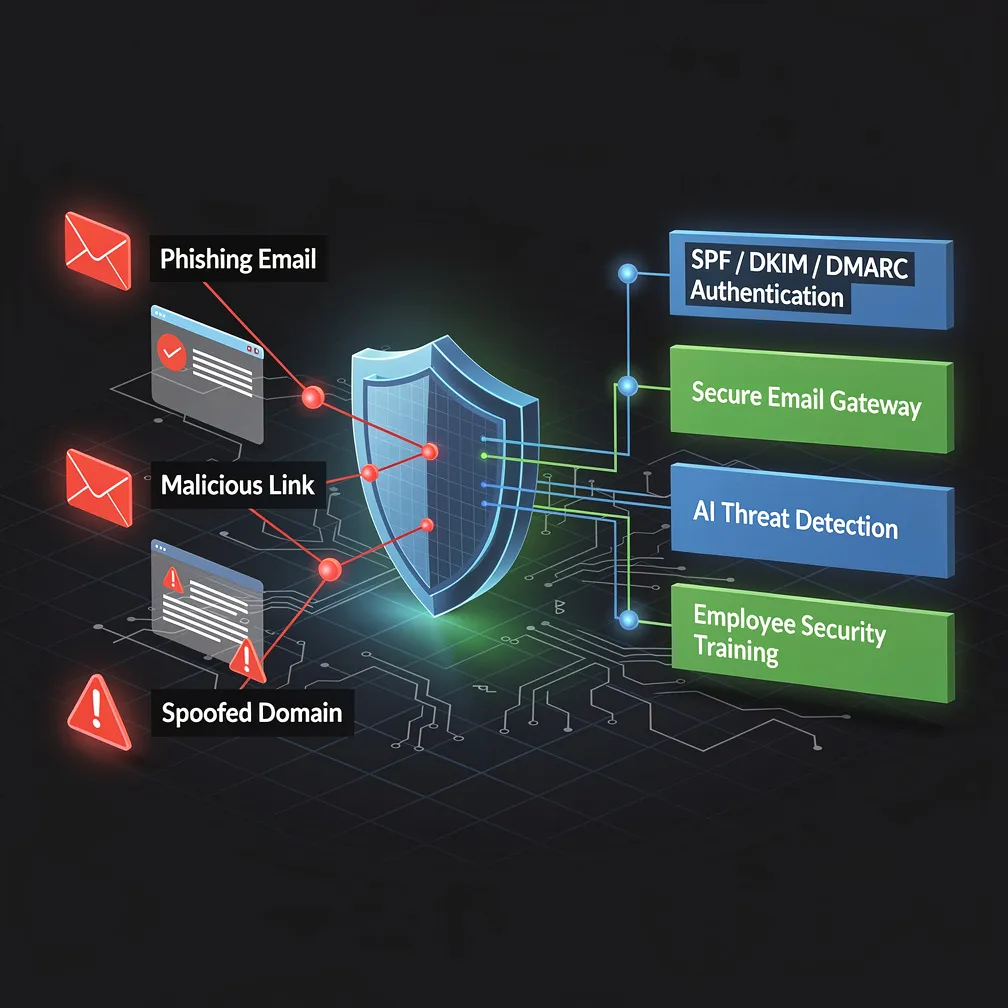
Despite decades of cybersecurity advancements, phishing remains the primary entry point for most successful cyberattacks. For CISOs and security professionals, implementing robust phishing protection isn’t optional—it’s foundational to organizational resilience. This comprehensive guide examines the current threat landscape and provides actionable strategies for building defense-in-depth against increasingly sophisticated phishing campaigns.
Phishing is a form of social engineering where threat actors impersonate trusted entities to manipulate victims into divulging sensitive information, transferring funds, or executing malicious code. Unlike technical exploits that target software vulnerabilities, phishing exploits human psychology—leveraging urgency, authority, fear, and trust to bypass technical controls.
The fundamental reason phishing remains the number one attack vector is simple: humans are often the path of least resistance. While organizations invest millions in perimeter security, endpoint protection, and network segmentation, a single convincing email can circumvent these controls entirely. Attackers understand that exploiting human decision-making under pressure is more efficient than discovering zero-day vulnerabilities.
Key characteristics that make phishing effective:
The phishing threat landscape has evolved dramatically, with adversaries leveraging emerging technologies to enhance attack sophistication. Modern phishing campaigns bear little resemblance to the grammatically incorrect, obviously fraudulent emails of the past.
Artificial intelligence and large language models have fundamentally transformed phishing capabilities. Threat actors now generate contextually appropriate, linguistically flawless messages at scale, eliminating traditional red flags that security awareness training emphasizes. AI enables hyper-personalization, allowing attackers to craft messages that reference specific projects, relationships, and organizational context gleaned from public sources and previous breaches.
Business Email Compromise (BEC) represents the most financially damaging phishing evolution. These attacks involve compromising or spoofing executive email accounts to authorize fraudulent wire transfers or data exfiltration. BEC attacks bypass traditional email security filters by containing no malicious links or attachments—only carefully crafted social engineering.
The scale of the phishing problem continues to expand across all sectors. Organizations face thousands of phishing attempts monthly, with attack volume increasing during geopolitical events, natural disasters, and other crisis situations when users are more susceptible to emotional manipulation.
Effective anti phishing solutions must address multiple attack vectors:
Spear Phishing: Targeted attacks directed at specific individuals or organizations, incorporating personalized information to increase credibility. These campaigns often precede advanced persistent threat (APT) operations.
Whaling: Spear phishing targeting C-level executives and high-value individuals with access to sensitive data or financial authorization. These attacks leverage extensive reconnaissance and sophisticated social engineering.
Vishing (Voice Phishing): Telephone-based attacks where adversaries impersonate IT support, executives, or trusted vendors to extract credentials or sensitive information. Often combined with email phishing in multi-channel campaigns.
Smishing (SMS Phishing): Text message-based phishing exploiting the higher open rates and trust associated with SMS communications. Particularly effective for credential harvesting through mobile devices.
Clone Phishing: Attacks that replicate legitimate previously-sent emails, replacing genuine links or attachments with malicious versions. These leverage existing communication threads to establish authenticity.
Implementing robust email phishing protection begins with email authentication protocols that prevent domain spoofing—a fundamental technique in most phishing campaigns.
Sender Policy Framework (SPF) allows domain owners to specify which mail servers are authorized to send email on their behalf. By publishing SPF records in DNS, organizations enable receiving servers to verify sender legitimacy and reject unauthorized sources.
DomainKeys Identified Mail (DKIM) adds cryptographic signatures to email headers, allowing recipients to verify message integrity and confirm the sending domain authorized the message. DKIM prevents message tampering during transit and validates sender authenticity.
Domain-based Message Authentication, Reporting, and Conformance (DMARC) builds upon SPF and DKIM, providing policy enforcement and reporting mechanisms. DMARC allows domain owners to specify how receiving servers should handle authentication failures—from monitoring to quarantine to rejection.
Implementation recommendations:
While email authentication provides foundational protection, comprehensive defense requires multiple technological layers:
Email Security Gateways (SEGs) inspect inbound and outbound email traffic, applying reputation analysis, content filtering, and behavioral detection to identify phishing attempts before reaching user inboxes.
URL Sandboxing and Rewriting technologies detonate suspicious links in isolated environments to identify malicious behavior, while URL rewriting routes clicks through security inspection proxies that evaluate destinations in real-time.
Attachment Scanning and Detonation examines email attachments using signature-based detection, heuristic analysis, and dynamic sandbox execution to identify malware before user interaction.
AI-Powered Threat Detection leverages machine learning models trained on organizational communication patterns to identify anomalies indicating phishing attempts—unusual sender behavior, atypical requests, or communication pattern deviations.
Browser Isolation executes web content in remote containers, preventing malicious code from reaching endpoints even when users click phishing links. This approach assumes compromise and contains potential damage.
Technology alone cannot solve the phishing problem. Organizations must develop employees as an active defense layer—the human firewall concept.
Security Awareness Programs should move beyond annual compliance training to continuous, engaging education that addresses evolving threat tactics. Microlearning approaches deliver focused, regular content that reinforces recognition skills without overwhelming users.
Phishing Simulations provide practical experience identifying attacks in a consequence-free environment. Effective simulation programs vary difficulty levels, provide immediate educational feedback, and avoid punitive approaches that discourage reporting.
Reporting Culture Development transforms employees from potential victims into detection sensors. Organizations must establish simple reporting mechanisms, provide feedback on reported messages, and celebrate reporting behavior to encourage continued vigilance.
Training recommendations:
Effective phishing protection requires integrating technology, people, and processes within a defense-in-depth framework aligned with zero trust principles.
The zero trust approach assumes breach and verifies every access request regardless of source. Applied to phishing defense, this means implementing multi-factor authentication (MFA) to mitigate credential compromise, applying least privilege access to limit lateral movement following successful phishing, and continuously validating user and device posture.
Combining technology, people, and process creates resilient defense:
Incident Response Planning specific to phishing incidents should define clear procedures for containment, eradication, and recovery. This includes credential reset protocols, lateral movement investigation, and communication templates for notifying affected parties.
Continuous Improvement requires treating phishing defense as an iterative program. Regular assessment of control effectiveness, threat intelligence integration, and adaptation to emerging attack techniques ensure defenses remain relevant.
Phishing will continue threatening organizations as long as email remains a primary business communication channel. CISOs must implement layered defenses combining email authentication, advanced detection technologies, and robust security awareness programs.
At Email Delivery Pro, we understand that effective email phishing protection requires both technical expertise and strategic implementation. By establishing email authentication protocols, deploying advanced anti phishing solutions, and fostering security-conscious organizational culture, you transform phishing from an existential threat into a manageable risk.
The question isn’t whether your organization will face phishing attacks—it’s whether your defenses will withstand them. Begin by assessing your current email authentication posture, evaluating detection capabilities, and measuring security awareness effectiveness. Phishing protection is not a project with an end date—it’s an ongoing commitment to organizational resilience.