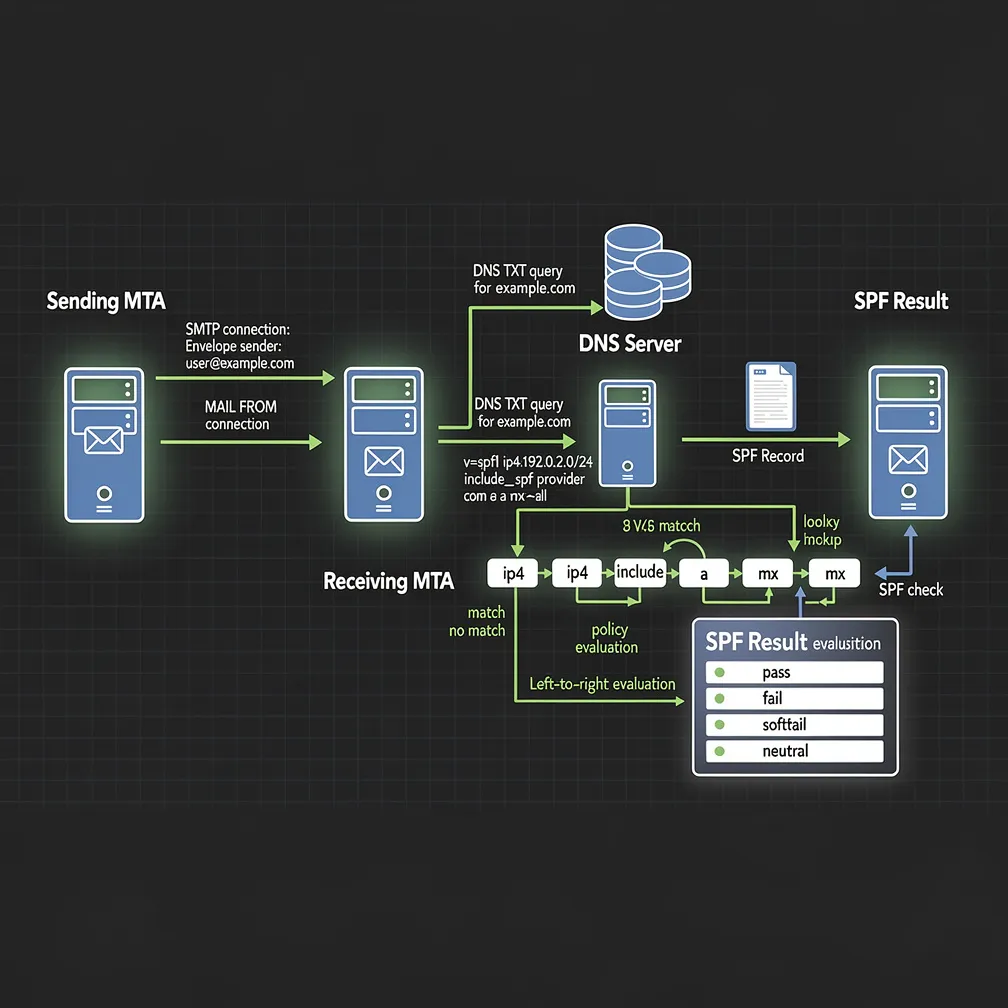
As email authentication becomes increasingly critical in the fight against phishing and domain spoofing, understanding the technical intricacies of the sender policy framework is essential for security architects and advanced email administrators. While many practitioners have a surface-level understanding of SPF, mastering its protocol-level specifications, limitations, and advanced configurations is what separates competent administrators from true email security architects. This deep dive explores the technical foundations and implementation challenges that define modern SPF deployment at scale.
The spf protocol is formally defined in RFC 7208, which specifies the exact structure and behavior of SPF records published as DNS TXT records. Every valid SPF record must begin with the version tag v=spf1, followed by a space-separated list of mechanisms and optional modifiers. This version tag is mandatory and must appear at the start of the record to distinguish SPF records from other TXT record content.
SPF mechanisms define which IP addresses are authorized to send email for a domain. Each mechanism can be prefixed with one of four qualifiers:
Common mechanisms include ip4, ip6, a, mx, include, exists, and the terminal all mechanism. The record must be terminated with an all mechanism (typically -all or ~all) that defines the policy for IPs not matching previous mechanisms. Two modifiers exist: redirect for delegating SPF policy to another domain, and exp for specifying custom failure explanation messages.
Critical DNS considerations include the 255-character limit for single TXT record strings and the 512-byte UDP response size limit for DNS queries. While multiple strings can be concatenated, the entire SPF record should remain under practical size limits to ensure reliable DNS propagation and query responses.
Understanding spf email authentication requires examining the SMTP transaction flow. SPF validation occurs after the SMTP MAIL FROM command, which specifies the envelope sender address (RFC5321.MailFrom). This envelope sender is distinct from the header From address visible to recipients and represents the return path for bounce messages.
The validation sequence follows these steps:
This left-to-right evaluation order is critical for performance optimization, as more specific or frequently-matched mechanisms should appear earlier in the record. The distinction between envelope sender (MAIL FROM) and header From is fundamental—SPF only validates the envelope sender, which is why additional protocols like DMARC are necessary for complete domain authentication.
SPF validation produces seven possible result codes, each carrying specific implications for message handling:
Results are recorded in the Authentication-Results header, which provides a standardized format for communicating validation outcomes. Each receiving organization maps these results to local policy decisions—some reject on fail, others only use SPF as one input among multiple signals. The Authentication-Results header includes the checked identity (typically smtp.mailfrom) and the result, enabling downstream systems to make informed filtering decisions.
Traditional email forwarding represents the most significant operational challenge for the sender policy framework. When a message is forwarded, the envelope sender typically remains unchanged while the message is transmitted from a new IP address—one not authorized in the original sender’s SPF record. This causes SPF validation to fail at the final destination, even for legitimate messages.
Several mitigation strategies exist:
Sender Rewriting Scheme (SRS) addresses this by rewriting the envelope sender to use the forwarding domain, making the forwarder responsible for SPF validation. The original sender information is encoded in the local part of the new envelope sender, allowing bounce messages to be decoded and returned to the original sender.
Authenticated Received Chain (ARC) preserves authentication results across forwarding hops, allowing the final destination to see that SPF passed at an intermediate trusted hop. ARC creates a chain of cryptographically signed headers that document authentication results and message modifications.
Mailing lists present similar challenges, as they often preserve the original sender while transmitting from list server IPs. List software may implement SRS, rewrite the From header, or rely on subscribers whitelisting list servers. Traditional .forward files on Unix systems typically forward without SRS, breaking SPF for forwarded messages.
The spf protocol includes several inherent limitations that architects must understand. The most significant is the 10 DNS lookup limit, which prevents abuse and excessive DNS load. This count includes mechanisms that require DNS queries (a, mx, include, exists, redirect) but excludes ip4 and ip6 mechanisms. Exceeding this limit results in a permerror.
RFC 7208 Section 4.6.4 specifies a void lookup limit of 2, where void lookups are DNS queries returning no data (NXDOMAIN or empty response). This prevents attackers from creating SPF records that generate excessive DNS traffic.
SPF provides no protection against header From spoofing when used alone. Since SPF validates only the envelope sender, attackers can use an authorized envelope sender while spoofing the header From that users see. This is why DMARC identifier alignment is essential—DMARC requires that the envelope sender domain align with the header From domain.
SPF offers no message body integrity checking, making it vulnerable to message modification after validation. Time-of-check versus time-of-use issues can occur when DNS records change between validation and delivery, though this is rare in practice.
SPF macro syntax enables sophisticated authorization logic. Macros are expanded during validation and include:
Per-user SPF policies can be implemented using macros with the exists mechanism. For example, exists:%{l}._spf.%{d} checks for a DNS record specific to the local part, enabling user-level authorization without enumerating all users in the main SPF record.
CIDR notation should be used judiciously with ip4 and ip6 mechanisms. Overly broad ranges increase attack surface, while overly specific ranges create management overhead. The exists mechanism enables complex authorization logic by checking for the existence of A records, which can be dynamically generated based on authorization databases.
The exp modifier specifies a domain where an explanatory TXT record can be retrieved on failure, providing custom rejection messages. This record can also use macros to provide context-specific failure information.
Modern organizations often operate multi-cloud environments with multiple email service providers (ESPs), creating significant challenges for spf email authentication. Each ESP requires authorization in the SPF record, and include mechanisms quickly approach the 10-lookup limit when multiple providers are used.
Subdomain delegation strategies help manage complexity by assigning different subdomains to different ESPs, each with its own SPF record. For example, marketing.example.com might use one ESP while transactional.example.com uses another. This approach requires careful DNS management and sender address standardization.
Shared hosting environments present challenges when multiple customers share IP addresses. Hosting providers must either maintain comprehensive SPF records that customers include, or provide dedicated IP addresses for customers requiring strict SPF policies.
CDN and reverse proxy architectures can complicate SPF when web applications send email, as the sending IP may be a CDN node rather than the origin server. Hybrid on-premises/cloud architectures require coordinating SPF records across multiple infrastructure teams.
At scale, SPF record management demands automation. Infrastructure-as-code approaches using DNS management APIs enable version control, testing, and automated deployment of SPF changes. Monitoring systems should track DNS lookup counts and validate SPF records before publication to prevent permerror conditions.
Mastering the sender policy framework requires understanding not just the basic concepts, but the protocol-level details, limitations, and architectural considerations that impact enterprise deployments. Email security architects must balance the technical constraints of SPF—particularly the DNS lookup limit—against the operational reality of complex, multi-provider email infrastructures. By combining deep SPF knowledge with complementary protocols like DMARC and ARC, architects can build robust email authentication systems that protect against domain spoofing while maintaining operational flexibility. At Email Delivery Pro, we recognize that effective email security requires this level of technical depth, and we encourage administrators to move beyond checkbox compliance toward true architectural mastery of email authentication protocols.