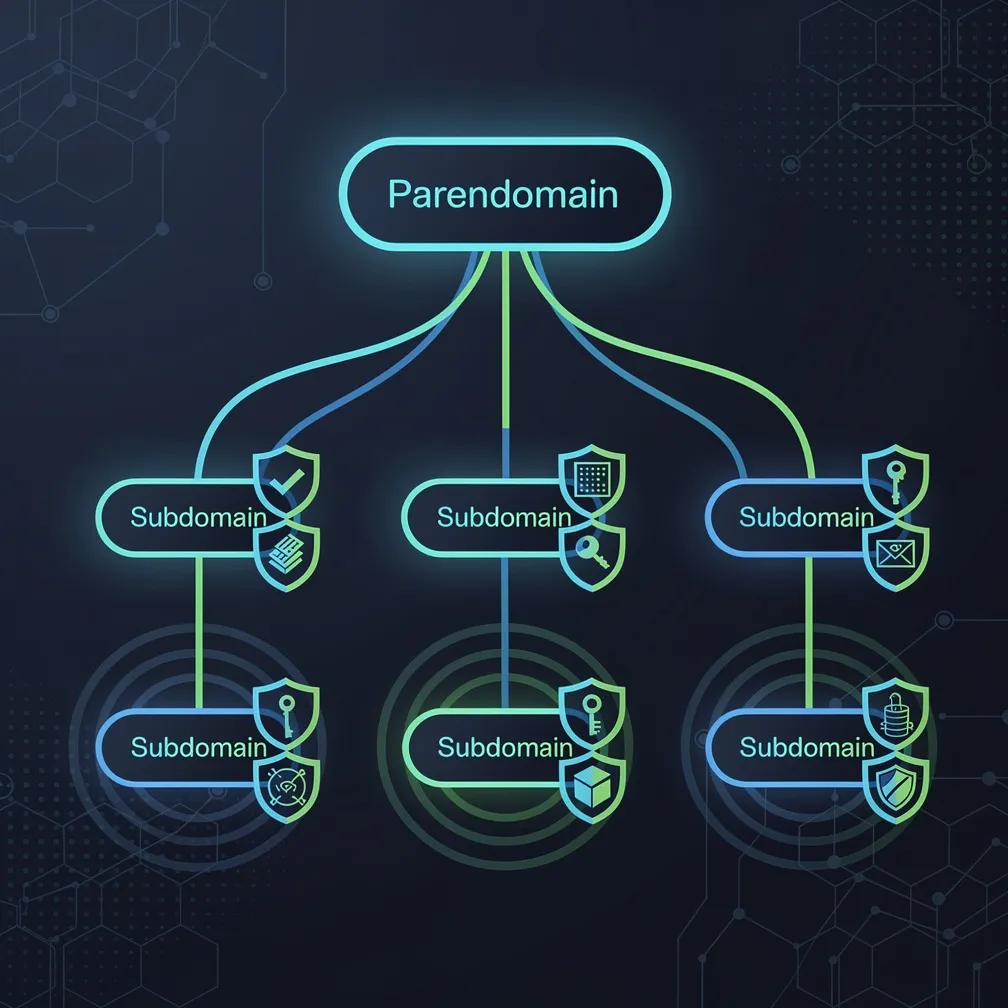
While most email administrators focus security efforts on their primary domain, subdomains often represent the weakest link in organizational email infrastructure. Attackers increasingly exploit this oversight, leveraging forgotten or misconfigured subdomains to bypass authentication mechanisms and launch sophisticated phishing campaigns. Understanding subdomain email security isn’t just about protecting secondary domains—it’s about defending your entire domain hierarchy from exploitation.
Subdomains present unique security challenges that differ fundamentally from primary domain protection. Attackers view subdomains as attractive targets for several reasons:
The fundamental misconception is that securing the parent domain provides protection for all subdomains. Email authentication protocols treat each subdomain as a distinct entity, requiring explicit configuration for comprehensive security.
Subdomain takeover represents one of the most serious email security threats. This attack occurs when DNS records point to services or resources that no longer exist, allowing attackers to claim those resources and receive email intended for your organization.
Common takeover scenarios include:
Real-world attack patterns typically follow this sequence: reconnaissance to identify dangling DNS records, claiming the abandoned service, configuring email reception, and launching targeted phishing campaigns that appear to originate from legitimate organizational subdomains. The emails pass basic DNS validation because the attacker legitimately controls the infrastructure referenced by your DNS records.
A critical misunderstanding among email administrators concerns SPF inheritance. According to RFC 7208, SPF records do NOT inherit from parent domains to subdomains. Each subdomain requires its own explicit SPF record for proper authentication.
When an email arrives from [email protected], receiving servers query the SPF record at subdomain.example.com—not example.com. If no SPF record exists at the subdomain level, the SPF check returns a “none” result, allowing spoofed emails to pass this authentication layer.
For subdomains that should never send email, implement an explicit deny policy:
v=spf1 -all
This spf subdomain record instructs receiving servers to reject all email claiming to originate from that subdomain. The hardFail (-all) is preferable to softFail (~all) for unused subdomains, as it provides unambiguous rejection instructions.
For subdomains that do send email, configure a complete SPF record specifying authorized sending sources, independent of the parent domain’s SPF configuration.
DMARC provides more flexible subdomain handling than SPF, but still requires careful configuration. The dmarc subdomain policy mechanism uses the sp= tag in the parent domain’s DMARC record to specify default handling for all subdomains.
Understanding the distinction between p= and sp= is essential:
Example parent domain DMARC record with subdomain protection:
v=DMARC1; p=reject; sp=reject; rua=mailto:[email protected]
This configuration applies a reject policy to both the parent domain and all subdomains. However, individual subdomains can publish their own _dmarc records that override the parent’s sp= tag, providing granular control when specific subdomains require different policies.
The pct= tag applies to subdomain policies as well, allowing gradual enforcement rollout across your domain hierarchy. For comprehensive protection, set sp=reject once you’ve verified legitimate subdomain email flows.
DKIM implementation for subdomains requires attention to signature domain alignment. The d= tag in DKIM signatures must match or align with the subdomain sending the email for DMARC authentication to pass.
When implementing DKIM for subdomain.example.com, the DKIM selector record is published under the subdomain’s namespace:
selector._domainkey.subdomain.example.com
This creates key management complexity in organizations with numerous subdomains. Each subdomain potentially requires distinct DKIM keys, particularly when different teams or systems manage subdomain email infrastructure. Centralized key management systems become essential for maintaining security without administrative burden.
For DMARC alignment, the d= tag in the DKIM signature can specify either the exact subdomain (strict alignment) or the organizational domain (relaxed alignment), depending on your DMARC alignment mode configuration.
Protecting subdomains that should never send email requires explicit defensive configuration. Implement these three protections for every non-sending subdomain:
The null MX record is particularly valuable as it provides an explicit signal that the subdomain should never receive email, preventing backscatter and misdirected messages.
Automated subdomain discovery tools can identify unprotected subdomains by querying certificate transparency logs, DNS enumeration, and organizational asset inventories. Regular scans help maintain comprehensive protection across your domain hierarchy.
Wildcard DNS records create significant email security challenges. A wildcard MX or A record (*.example.com) matches all subdomain queries that don’t have explicit records, effectively creating infinite subdomains that can receive or appear to send email.
The interaction between wildcards and email authentication is problematic:
Wildcard records are acceptable for web services where email isn’t involved, but wildcard MX records should be avoided except in specific circumstances where all possible subdomains require identical mail handling and have proper authentication records configured.
Implementing comprehensive subdomain email security requires systematic processes and ongoing vigilance:
For organizations evaluating email security solutions, our comparison page provides detailed analysis of platforms offering subdomain protection features.
Subdomain email security demands the same rigor as primary domain protection. The independent nature of email authentication across domain hierarchies means that securing your apex domain provides no protection for subdomains. By implementing explicit SPF records, appropriate DMARC subdomain policies, proper DKIM configuration, and defensive records for unused subdomains, email administrators can close security gaps that attackers increasingly exploit. Regular audits, comprehensive inventories, and systematic decommission procedures transform subdomain security from a vulnerability into a strength, protecting your organization’s entire domain hierarchy from email-based attacks.