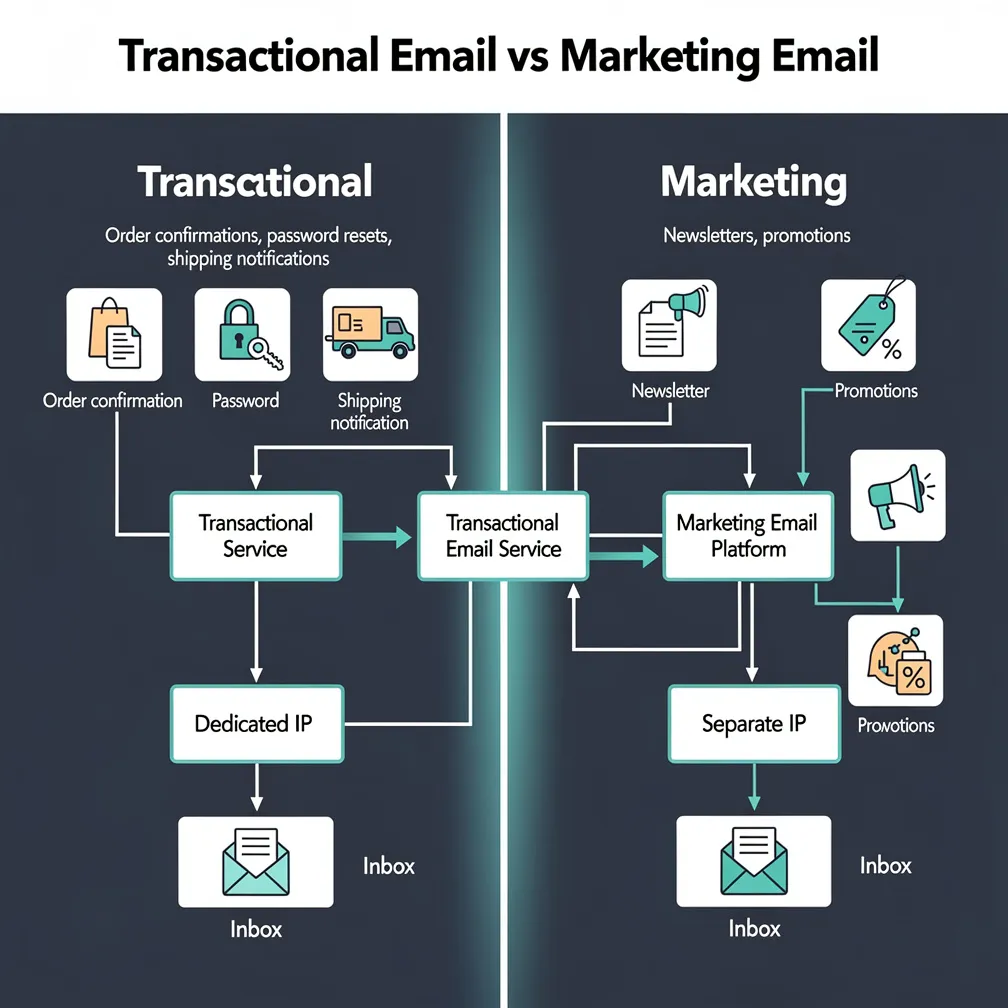
Every email your organization sends falls into one of two categories: transactional or marketing. While this distinction may seem straightforward, the infrastructure, compliance, and deliverability implications of how you handle each type are significant. Organizations that treat all outbound email as a single stream frequently discover that their password reset emails land in spam folders — not because of authentication failures, but because their marketing campaigns damaged the shared sending reputation.
This guide breaks down the critical differences between transactional email and marketing email, explains why email stream separation matters, and provides actionable transactional email best practices alongside marketing email guidelines for protecting deliverability across both channels.
Transactional emails are messages triggered by a specific user action or system event. The recipient expects them — often immediately — because they initiated the interaction. Examples include:
The defining characteristic: the recipient expects this message right now as a direct result of something they did. Delivery speed and reliability are paramount.
Marketing emails are messages sent to promote products, services, content, or engagement. They are sent at the sender’s initiative, not triggered by immediate user action. Examples include:
The defining characteristic: the sender initiates the timing and content. The recipient opted in at some prior point but did not specifically request this particular message at this moment.
The CAN-SPAM Act treats transactional and marketing email differently:
The critical caveat: if a transactional email contains marketing content that a reasonable recipient would consider the primary purpose of the message, it loses its transactional classification and all CAN-SPAM requirements apply.
Under GDPR, the distinction operates differently:
However, if you embed marketing content within a transactional email (product recommendations in a shipping notification, for example), that marketing content still requires proper consent under GDPR.
This distinction has practical implications:
The single most impactful architectural decision for email deliverability is separating transactional and marketing email onto different infrastructure. Here is why:
Mailbox providers (Gmail, Microsoft, Yahoo) assign sender reputation at the IP address and domain level. When both email types share infrastructure, a reputation problem in one stream contaminates the other. A marketing campaign that generates spam complaints drags down the IP reputation — and suddenly your transactional password reset emails arrive in spam folders or face delivery delays.
Transactional email has a steady, organic sending pattern — messages go out continuously as users interact with your platform. Marketing email is bursty — you send thousands or millions of messages in a short window during campaigns. These dramatically different volume patterns look suspicious to mailbox providers when combined on a single IP. The sudden spikes from marketing sends can trigger throttling that delays time-sensitive transactional messages.
Transactional emails typically see high open rates and low complaint rates because recipients expect them. Marketing emails have lower engagement and higher complaint rates by nature. Mixing these streams on shared infrastructure means your transactional email’s positive engagement signals get diluted by marketing email’s lower engagement — degrading overall reputation.
Proper email stream separation requires deliberate infrastructure decisions across multiple layers:
Each email stream should send from its own dedicated IP address (or IP pool). This ensures reputation isolation at the most fundamental level. If your marketing IP gets blocklisted, your transactional IP remains unaffected.
Use different sending domains or subdomains for each stream:
mail.yourdomain.com — transactional emailnews.yourdomain.com — marketing emailThis provides domain-level reputation isolation. Each subdomain builds its own reputation with mailbox providers independently. If your marketing subdomain’s reputation suffers, your transactional subdomain remains protected.
Each sending domain/subdomain needs its own:
Many organizations use one service for transactional email (optimized for speed and reliability — services like Amazon SES, Postmark, or a dedicated SMTP relay) and a different platform for marketing email (optimized for campaign management, segmentation, and scheduling). This separation provides:
Organizations that ignore email stream separation encounter predictable problems:
A single marketing campaign that generates elevated spam complaints (even temporarily) can degrade the IP reputation used by both streams. The result: transactional emails — the ones your users need immediately — start arriving in spam or experiencing delays.
Mailbox providers throttle senders whose reputation dips. When your marketing campaign triggers throttling on a shared IP, your password reset emails sit in the sending queue behind thousands of marketing messages. A user waiting for a two-factor authentication code experiences a 30-minute delay because Gmail throttled your shared IP after a promotional blast.
Once a shared IP or domain develops a “marketing sender” reputation (lower engagement, higher complaints), mailbox providers may route even transactional messages through promotional or spam filtering. Your shipping notifications end up in the Promotions tab. Your security alerts go to spam.
If a shared IP lands on a blocklist due to marketing practices (purchased lists, stale addresses, high complaint rates), every email from that IP is affected — including the transactional messages that had nothing to do with the blocklisting event.
Protect the deliverability and reliability of your transactional email stream with these practices:
Protect your marketing email reputation and deliverability with these practices:
If you are currently sending transactional and marketing email from shared infrastructure, use this checklist to plan your separation:
notify.domain.com for transactional, mail.domain.com for marketing).The difference between transactional email and marketing email extends far beyond content — it encompasses legal classification, infrastructure architecture, reputation management, and deliverability strategy. Organizations that invest in proper email stream separation protect their most critical communications (password resets, security alerts, order confirmations) from the inherent reputation volatility of marketing campaigns.
Email stream separation is not an optimization — it is a foundational architectural decision. The cost of maintaining separate infrastructure is trivial compared to the cost of transactional emails landing in spam when your users need them most.