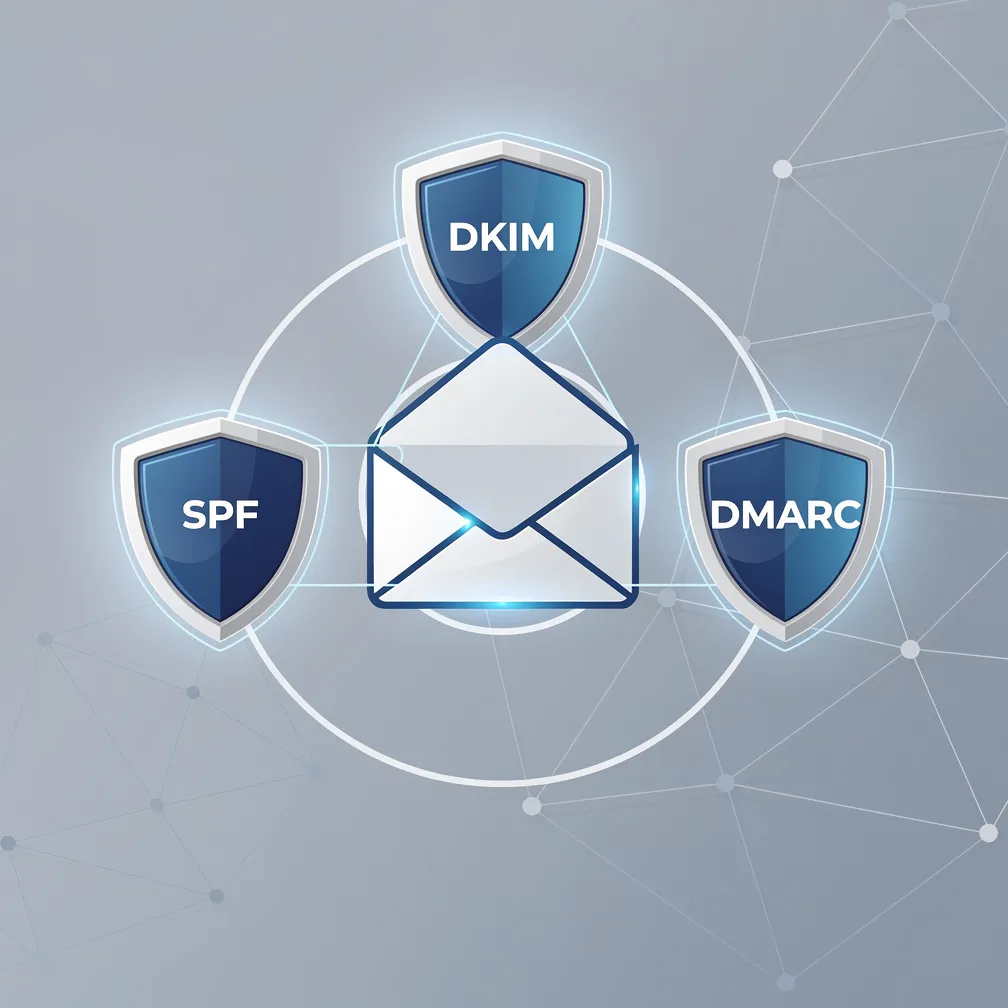
Email remains the primary attack vector for cybercriminals, with phishing attacks and email spoofing costing organizations billions annually. For IT security teams and CISOs, implementing robust email authentication protocols isn’t optional—it’s a critical defense layer.
Three core protocols form the foundation of modern email security: SPF, DKIM, and DMARC. Understanding how these work together is essential for protecting your organization’s email infrastructure and maintaining sender reputation.
SPF (Sender Policy Framework) validates that incoming mail from a domain comes from authorized IP addresses. When you publish an SPF record in your DNS, you’re creating a whitelist of mail servers permitted to send email on your domain’s behalf.
Implementation is straightforward: add a TXT record to your DNS specifying authorized sending IPs. However, SPF has limitations—it doesn’t authenticate the “From” address users see, only the envelope sender. This is where DKIM adds another security layer.
DKIM uses cryptographic signatures to verify email hasn’t been tampered with in transit. Your mail server attaches a digital signature to outgoing messages using a private key. Receiving servers validate this signature against a public key published in your DNS.
DKIM provides message integrity—if even one character is modified during transmission, the signature validation fails. This protects against man-in-the-middle attacks and ensures message authenticity. For security-conscious organizations, DKIM is non-negotiable.
While SPF and DKIM provide authentication mechanisms, DMARC (Domain-based Message Authentication, Reporting, and Conformance) tells receiving servers what to do when authentication fails. It’s the policy enforcement protocol that ties everything together.
DMARC policies have three levels:
Critically, DMARC provides visibility through aggregate and forensic reports. These reports show you exactly who’s sending email using your domain—both legitimate senders and potential attackers attempting spoofing.
Deploy these protocols incrementally. Start with SPF, add DKIM for message signing, then implement DMARC in monitor mode. Analyze reports for 30-60 days before moving to quarantine or reject policies.
Common mistakes to avoid: incomplete SPF records that break legitimate forwarding, failing to include all authorized sending services (marketing platforms, CRMs), and moving too quickly to DMARC reject without proper monitoring.
Email authentication isn’t just about security—it’s increasingly a compliance requirement. Industries handling sensitive data (healthcare, finance, government contractors) face regulatory pressure to implement DMARC. Major email providers like Gmail and Yahoo now require DMARC for bulk senders.
Beyond compliance, proper implementation improves deliverability rates. Authenticated emails reach inboxes more reliably, protecting your organization’s communication effectiveness and brand reputation.
For IT teams evaluating email security solutions, ensure your provider supports all three protocols with robust monitoring and reporting capabilities. Your email authentication posture directly impacts your overall security architecture.